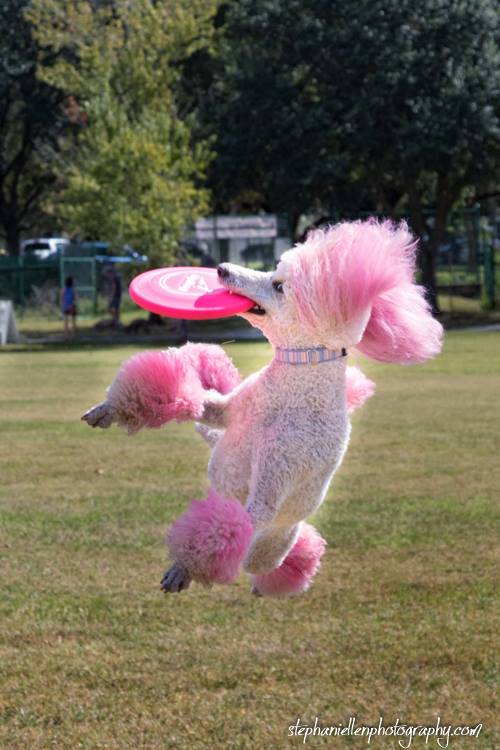
We first met Jolene, a beautiful white Standard Poodle, in Tampa at Woofstock, hosted by TampaPets.org. Her fur had been accented in pink to show her support for Breast Cancer Awareness. The following is an original feature from the winter 2015/16 (current) issue of The New Barker dog magazine, written by Anna Cooke.
At fifty years old, Barbara Mahoney decided to end her abusive marriage and sell her business. She knew the change would be good for her, but realized she was still not in a good place, emotionally. She recalled how happy she felt around her mother’s dogs while growing up, especially the Poodles. Now, she wanted a constant companion, someone who would give her unconditional love. A dog who would go swimming with her. Heck, maybe she’d even get into agility, she thought. Jolene came into Barbara’s life in 2011, and she decided to let the dog show her just what she wanted to do in the way of “work.”
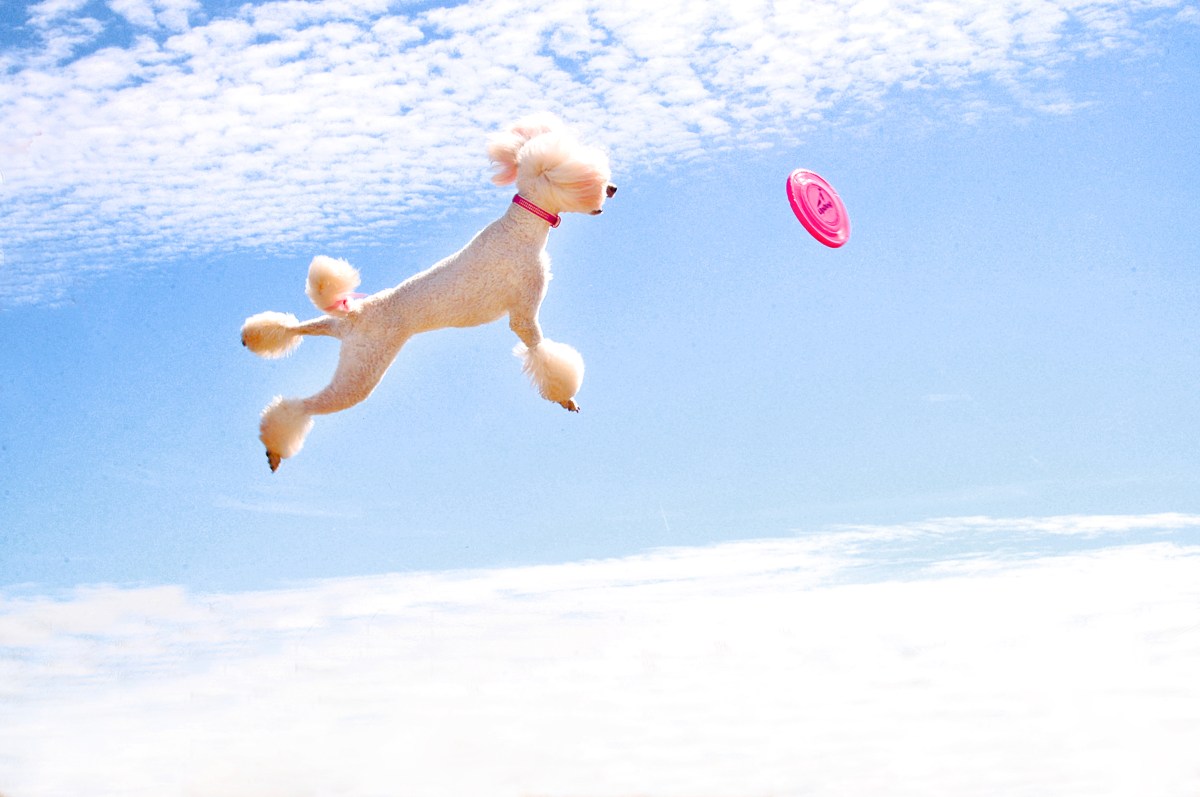
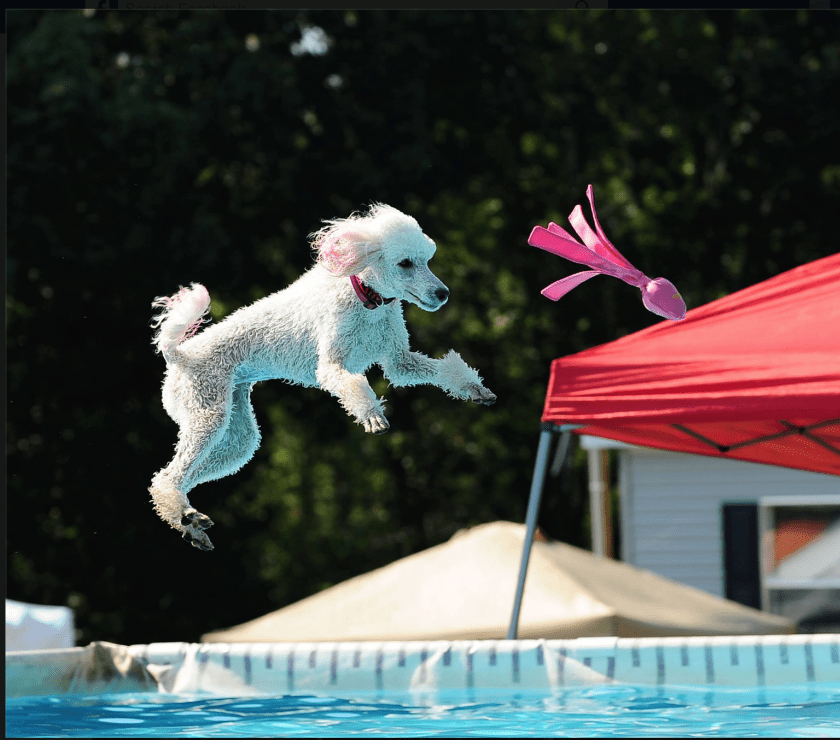
When she was just a year old, Jolene began her athletic career in dock diving. She received her canine therapy certification in water rehabilitation. She took the Southeastern Regional Division championship in her class, and all was good. Then, someone threw a Frisbee. Jolene ran after it, and caught it. She and Barbara were hooked. Barbara sought out competitions and talked to other people about Jolene’s talent. “I even found people to throw Jolene the disc when I broke my clavicle,” she said. “I didn’t want her to stop having fun while I was laid up.” The duo’s devotion to the sport and hard work quickly paid off. Jolene became the only World Qualifying Standard Poodle in the sport.
“Working with dogs in activities like disc and agility enriches and completes our relationship with them,” Barbara told us. “Jolene is an exceptional Poodle, but she is also an incredible disc dog.”
Barbara and five other people formed Up Dog Challenge, an organization they hope will inform dog lovers how “awesome this sport is,” she told us. The group’s goal is to provide a non-intimidating forum where people will feel comfortable asking questions about the sport. Go to an Up Dog Challenge event and everyone involved is approachable and enthusiastic about the sport. “We want more people to know how fun this is,” added Barbara. “All ages and skill levels are welcome. All breed types, size, and shape. We’ll even teach you how to throw a disc so that your dog will catch it. We have trainers that are very good with newcomers to the sport. They explain how your dog thinks and will train you to throw the disc in a way that maximizes your dog’s success. We want to optimize that play for you both.”
Dogs are happiest when they have something to do, when people play with them. “Happy dogs equal happy people,” said Barbara. “Look what Jolene did for me. She changed my life.”
MORE: 2016 marks the 42nd consecutive year of competitive canine disc sports. The first annual UpDog International Finals will be held March 18 – 20 in Brooksville, Florida at Florida Classic Park (5360 Lockhart Road). Qualified teams must pre-register by Sunday, January 31. For more information, visit UpDogChallenge.com
This story originally appeared in the current issue of The New Barker dog magazine.
Yes, it’s true. Even the greatest gift giver in the world does the research to make a list. For dogs and dog lovers on his list, he’s been known to refer to The New Barker dog magazine for ideas. So take heart, gentle human gift giver – for the dog and dog lover on your list, who seem to have everything they need (each other), here are some unique ideas from The New Barker, of course.
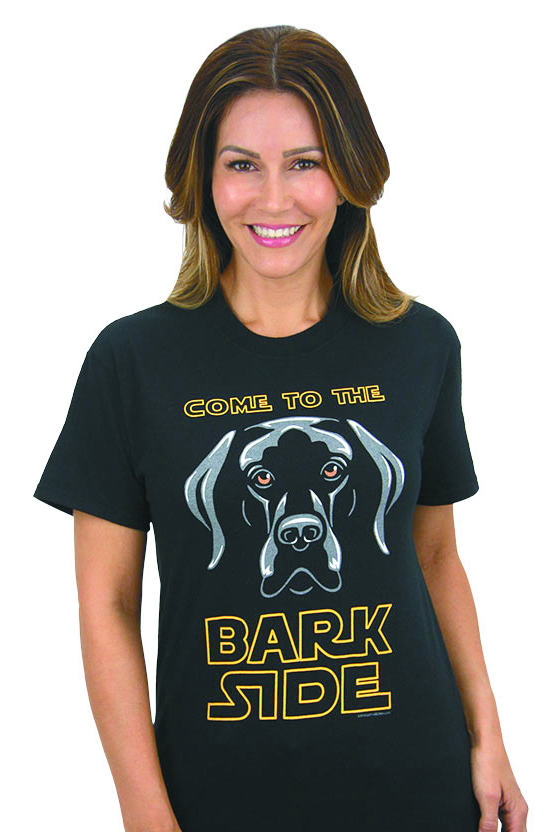
Dog lovers with a sense of humor. Clothing, like this t-shirt that plays into the Star Wars craze right now, with just the right touch of dog. Available at The Doggie Door in Winter Park (407.644.2969). Or maybe the dog lover on your list is into craft beer. How about this hoodie, available at Pet Food Warehouse in St. Pete (727.521.6191) and Earth Pets Organic in Gainesville (352.377.1100).
Dog lovers with a sense of style. Nothing says ‘put together’ like the accessory of a scarf. The fashionista on your list will appreciate this cosmo-PAW-litan scarf with dog silhouettes. Available in assorted color combos of grey/blue, grey/peach or grey/light green. One Lucky Dog in St. Pete (727.527.5825).
Dog lovers who are tea connoisseurs. Add a little whimsy to their tea and crumpets ritual with these whimsical hand-painted ceramics. Cats In Bloom Tea For One tea pot and mug designed by artist Sharon Bloom. Catzilla Covered Butter Dish designed by artist Candace Reiter. Both are available at Pawsitively Posh Pooch in St. Pete (727.892.9303).
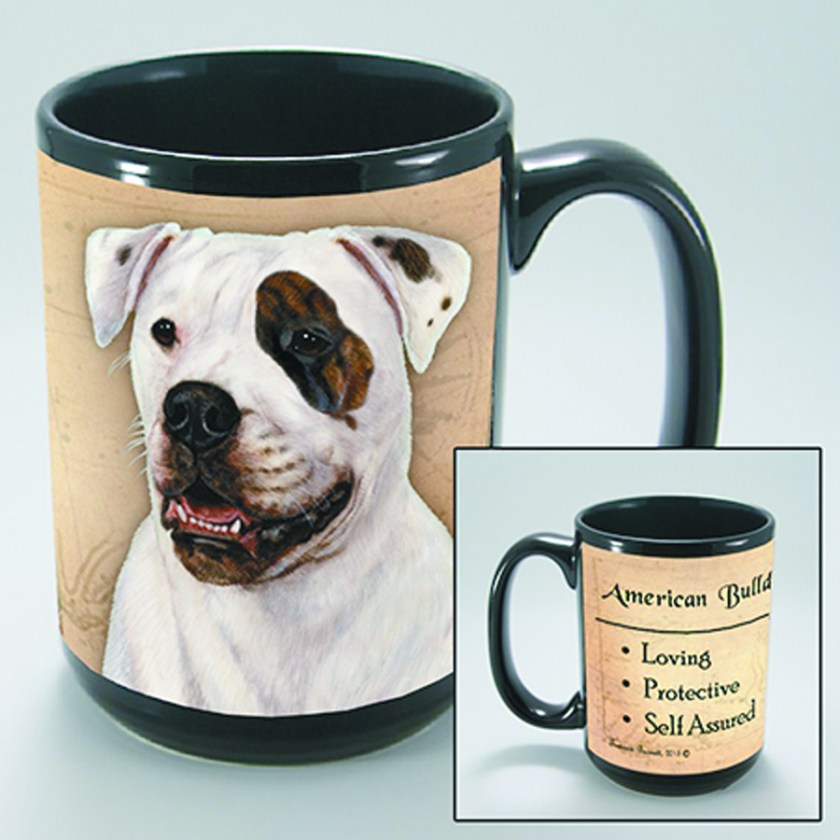
Dog lovers who insist on at least one cup of java before heading out for their power dog walk. How about a breed-specific coffee mug? Beautifully hand-painted, the details bring out each breed’s characteristic. Available at Fluffy Puppies, Clearwater (727.446.7999).
For the homebody dog lover. How about dog art, underfoot with a machine washable accent rug? They’re so reasonably priced, you’ll want to buy one (or two) for yourself. Each rug is artist-inspired. The bright colors won’t fade through many washes and will stand up to heat, cold and sunlight. Available at Pet Food Warehouse, St. Pete (727.521.6191).
Dog lovers who sleep with dogs. Nothing shows off someone’s sense of humor, style and love of home than a well-made bed, accessorized with dog-themed pillowcases. 300 thread count for extra softness. Made in the USA. Available at One Lucky Dog, St. Petersburg (727.527.5825) and Sweet Sage Cafe & Boutique, North Redington Beach (727.391.0453).
Dog lovers who love to dress their dogs (big and small). EZ Reflective Royal Elegance Harness Vest. No choke design – pulls on chest, not the neck. Designed for easy on/easy off (not over the head). High quality quick release buckle with reinforced D-ring and reflective safety striping. Available at Fluffy Puppies, Clearwater (727.446.7999). For big dogs, visit Dade City’s Dog Mania & Cats to see their line of unique, hand-crafted clothing and accessories. Dressing up is not just for the little ones, anymore. Dog Mania & Cats (352.467.9622). Visit their beautiful new store on Meridian Avenue.
For the dog lover who is also a romantic. You must see and touch this beautiful collection of vintage hinged trinket boxes to appreciate them. Made of sculpted resin, decorated with enamel and 24 karat accents; bejeweled with Swarovski crystal. Each one is worthy of holding precious keepsakes. Available at Pawsitively Posh Pooch, St. Petersburg (727.892.9303).
For the practical dog lover. There’s no shame in being practical, and practical doesn’t have to be boring, right? Anyone who has ever owned a Dog Gone Smart Dirty Dog Rug has gone back to purchase more. We love using them just outside the shower area for a spa-like feel underfoot. Millions of microfiber strands create an extra large super-sponge for use just about anywhere in your home. Place them in crates; under food and water bowls to keep water and kibble in place. Plush, velvety soft and easy to wash. Non-slid backing helps it stay in place. Available at all the shops listed above as well as: Animal House, St. Pete (727.328.0503), Fuzzy & Furries, St. Pete (727.954.3952), Pet Supplies Plus, Pinellas Park (727.415.8016) & Clearwater (727.453.9131).
Go forth and shop, fellow dog lovers. You have now been properly advised, and Santa can’t hold a cookie to your super shopping powers.
Kamerion Wimbley Tackles Life Head-On…On His Own Terms.
Kamerion and Yogi take a break after a light workout in Tampa, recently, to sit down and talk with Anna Cooke, editor of The New Barker dog magazine.
The average starting pay for a professional football player in the NFL is $1.9 million per year. 70% of NFL players are between the ages of 22 and 27. Players in that age bracket earn less than the NFL average overall. Most NFL players don’t make it to the age range when they can start making serious money. According to Business Insider, that age bracket, 28 to 35, earns an average of $4 million a year and up.
After nine years with the NFL, 31-year-old Kamerion Wimbley was ready to walk away from it all to spend more quality time with his family. He’d had a successful college career at Florida State University as one of the nation’s top defensive ends. He was drafted 13th overall in the 2006 NFL Draft by the Cleveland Browns and led the team in sacks during his outstanding 2006-2007 rookie debut. In 2010, Kamerion was traded to the Oakland Raiders where he proceeded to take the Bay Area by storm, both on the field and off with his community involvement.
When he made the decision to retire earlier this year, he was an outside linebacker for the Tennessee Titans, where he’d played since 2012. He posted on Twitter, “Although my wife and two young daughters have always been incredibly supportive of my career, I am looking forward to spending more meaningful time with them and never missing another big moment in their lives.”
In a team-issued statement, Titans General Manager Ruston Webster said, “We want to congratulate Kamerion on his NFL career. He is a true pro and a fantastic person. Not everyone gets to walk away from the game on their own terms, but he is doing that today, and with my utmost respect. I know he has a number of business ventures already and we wish him and his family the best in what lies ahead.”
Wimbley left a two-year contract worth more than $4 million in salary on the table. It turns out that Kamerion Wimbley’s business acumen off the field is just as precise and hard-hitting as his athleticism was on the field. Of the 10 successful business ventures he owns and/or is involved with, his favorite is Gold Label Kennels in Crawfordville, Florida. There, The American Bully breed he has always loved, is safely and responsibly bred. Gold Label Kennels also focuses on training, showing, rescuing and adopting The American Bully.
Wimbley’s love for The American Bully began as a youngster during years of watching the #WestminsterKennelClubDogShow on television. He was attracted to the look of the breed, no doubt: majestic, muscular and tough. “Love at first sight,” he recalls; then adds, “But, the real charm of the breed is their inner beauty. That’s what really made me fall in love with them. They may look tough on the outside, but inside, they are sweet and gentle dogs.”
He was already educating friends, family, colleagues and whoever would listen on the importance of responsible dog ownership when the news of Michael Vick and his Bad Newz Kennels dog fighting ring hit the media in 2007. Wimbley’s Cleveland Browns teammates, many of whom already had preconceived notions about the Bully breed even prior to the Vick incident, looked to him for answers. He took the opportunity to step up his efforts to inform the public and help dispel the stereotypical discrimination against bull breeds. As the media chose to focus on the negativity of the moment, Wimbley remained stealthily-focused on the positive. The survival of The American Bully breed depended upon it.
Any dog can be conditioned by its handler to become vicious – whether it’s through training and neglect – or abuse, such as chaining and isolating the dog outdoors, with little to no human contact. Any breed of dog is a product of his or her own unique situation. Their birth, upbringing, and training will play a crucial role in determining the dog’s behavior.
“Some people jump to conclusions without having all of the relevant facts about The Bully breed. The media plays a huge part in sensationalizing incidents with irresponsible dog owners and attempt to paint the entire breed with broad strokes instead of looking at individual dog owners,” said Wimbley.
He is committed to continue educating the public about responsible dog ownership, with his primary focus naturally being on The American Bully breed. A “pet project” of his is the Bull Breed Coalition Registry (BBCR), where he is one of the founding members and a hands-on director. The registry will offer more innovative options for a broader population of people, including through the use of social media.
“Social media is just now becoming big in the dog world. I am seeing a lot of information posted on Facebook, Instagram and even Pinterest. Through these new platforms, you can reach a whole bunch of people that have never even gone to a dog show, or owned a particular dog breed, but if they see a post on social media, it might pique their interest or they might become more inclined to attend a dog show. The messaging circulates a lot faster and you’re able to get a lot more viewers. It is one of our goals to use and maximize those channels that maybe the other registries aren’t using. We’re trying to be more innovative, getting more information out there about the breed that we serve,” said Wimbley.
Initially, the focus of the BBCR was historical documentation of the Shortybull, a new line of Bulldogs being bred to be smaller in size. Unlike a lot of other Bully breeds bred down in size, the Shortybull does not contain Boston Terrier or Pug in its bloodlines. The Shortybull is bred for its working ability and physical traits, and not solely on looks. The BBCR recently expanded its focus to provide accurate documentation and show experiences for five additional Bull Breeds: The American Bully, American Pit Bull Terrier, English Bulldog, French Bulldog, American Bulldog and the Olde English Bulldogge. Bully Breed enthusiasts have begun to focus more on conformation shows, considered crucial to the development and wider acceptance of the breed.
The BBCR focuses on breed standards as set forth by the founders of these breeds. It records pedigrees, issues policies for conformation dog shows and works to train judges who will uphold the honor of properly evaluating Bullys as show dogs.
On Dogs And Yogi. Dogs depend on us for, at minimum, food and shelter. They deserve much more. “Before taking a dog into your life or adding another one, think seriously about the commitment that dog ownership entails and consider if you will be able to fulfill your obligations as a dog owner,” said Wimbley.
Does your activity level align with that of the breed you are thinking about? Study the breeds to know which ones are the best for you and your lifestyle. Some dogs require a lot of exercise to be happy and healthy. If you’re not helping them burn that energy, they’re going to find ways to fulfill those needs and that may not be the most desirable option.
“When I played football, the tempo was not always the same. Some plays last four seconds, and others extend to 15,” said Wimbley. His workouts with Yogi were anything but routine. “One minute Yogi was trotting alongside me at a steady pace; the next minute he took off and I’m running after him, bolting up a trail or doing laps around a clearing.”
Yogi sprints ahead of Kamerion.
Wimbley considers Yogi an athlete, and as such, he is built for working. “He and I feed off each other’s energy. He’d motivate me during our workouts. If he was going hard, I wanted to go hard as well. Day in and day out, committing to and sticking with a regular workout is half the battle. Dogs are into routines.”
Wimbley learned the benefits of each type of food as an athlete at Florida State University. “Why am I eating this and what does it do for my body? It’s fascinating to find out how the quality of the energy you put into your body translates into your performance, whether you’re on the field or in an office.”
He has applied that nutritional knowledge to Yogi’s diet, carefully reading dog food labels to make sure the food has quality ingredients. He has always served Yogi portions that correspond to the dog’s weight and muscle mass. “I try to buy us both natural, organic food. No artificial flavors or fillers. No by-products for the meat source. I shop around the edges of the store and avoid the stuff in the middle – the food that has been tampered with.”
At 10 years of age, Yogi is an elder statesman now, but still just as physically fit as his human. “He continues to be an inspiration for me, both physically and mentally. He has an unwillingness to yield when it comes to competition, and he has fun the whole time he’s competing.”
Kamerion, a Florida resident, hopes to be attending the annual fundraising event for the Miami Coalition Against Breed Specific Legislation in Hollywood, Florida on Sunday, November 8. “Regardless of where you live, BSL is a concern for all dog owners. We should take every measure to prevent it. Or in the case of Miami-Dade, where any Pit Bull-like dog has been banned for 26 years, have BSL overturned, once and for all. We should also hold owners accountable for their dog’s actions,” Kamerion told Anna Cooke, editor of The New Barker dog magazine.
Are you a #FloridaDogLover? Please visit the Miami Coalition Against Breed Specific Legislation Facebook page, like them and let them know The New Barker, Florida’s top dog lifestyle magazine, sent you.
One thing we know for sure, dog lovers are a hearty lot, ready to share in their camaraderie and love of dogs. Whether it’s hosting dog-themed parties for friends or fundraising for an animal advocacy cause, it’s a given – the festivities almost always involve food and drink. Many adult beverages are named after a dog breed or are dog-inspired. We thought it would be fun to feature some of them alongside their recipes in our spring issue.
Our staging area was the award-winning ulele, located in historic Tampa Heights. It’s the newest restaurant from the Gonzmart family’s Columbia Restaurant Group and features native-inspired foods and spirits. The backdrop, vibe and colors made for some gorgeous photography.
While working with ulele Mixologist Chuck Cooper and ulele Head Brewmaster Timothy A. Shackton, we discovered their profound love of dogs. Both men were eager to share stories of how, when and why they adopted their dogs. It became obvious that this was too good to be true, and that we would be returning for a second, more dog-centric photo shoot.
But first – the drink recipes for your summer imbibing.
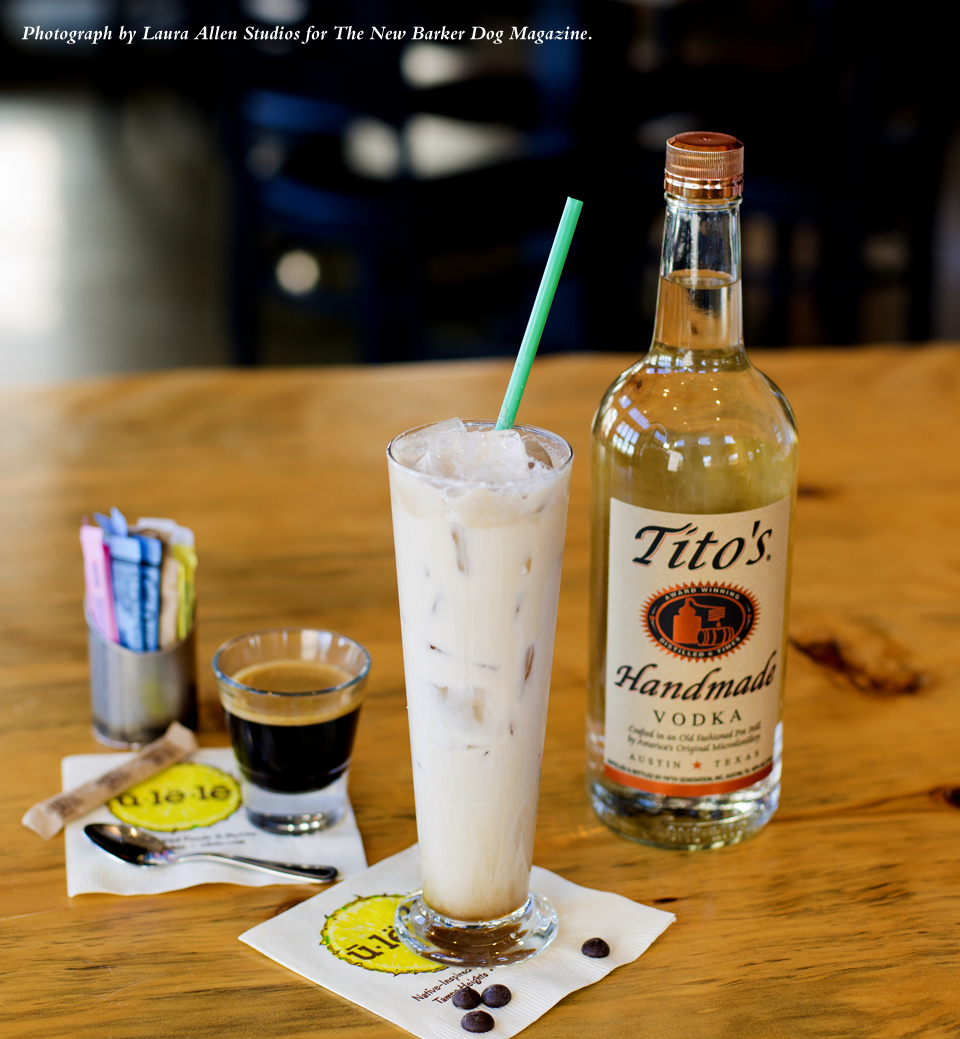
Colorado Bulldog 11/2 ounces Tito’s Vodka 11/2 ounces Kahlua 1 ounce cream or condensed milk Dark cola soda Combine vodka, Kahlua and cream in tin. Shake. Strain over fresh ice into a collins or pilsner glass. Top with fresh cola. Garnish with three chocolate chips and serve with a tall straw. Serves one. Shown with a shot of ulele espresso.
Colorado Bulldog. Photograph by Laura Allen Studios for The New Barker.
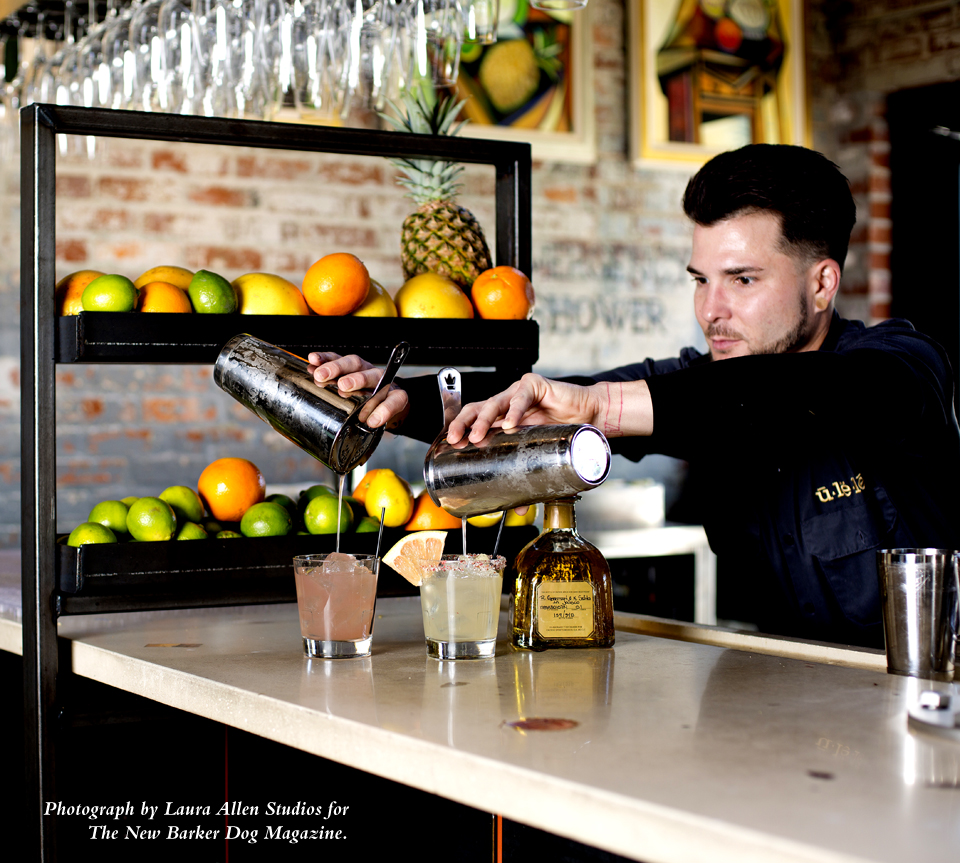
Pomeranian 11/2 ounces white rum (Don Q) 1/2 ounce pomegranate liqueur (Pama) 1/2 ounce triple sec 1/2 ounce fresh squeezed lemon juice 1/4 ounce fresh squeezed grapefruit juice Combine rum, liqueur, triple sec and juices in tin. Shake. Strain over fresh ice into an old fashioned glass. Garnish with lemon wheel and cocktail straw. Serves one.
Salty Chihuahua Wet the rim of an old fashioned glass with lime juice, then dip in crushed pink peppercorn and salt. 11/2 tequila (Patron Anejo) 1/2 ounce grapefruit liqueur (Pamplemousse) 5 to 6 ounces fresh squeezed grapefruit juice Combine tequila, liqueur and juice in tin. Shake. Strain over fresh ice into the peppercorn and salt rimmed old fashioned glass. Garnish with grapefruit wheel. Serves one.
Mixologist Chuck Cooper pours a Pomeranian (left) and a Salty Chihuahua.
Hair of the Dog 2 ounces vodka (Cane Fireant) 1 ounce fresh squeezed lemon juice 1 ounce sangrita 1 ounce fresh egg white 1 slice of jalapeño or Thai chili pepper Combine all ingredients in tin. Shake. Strain over fresh ice into an old fashioned glass. Garnish with lemon and chili. Serve with a tall straw. Serves one.
“Learning about spirits enhances my need to know. It intrigues me and made me realize I’m a history buff. After work, I go home and read books about booze, then create new drinks.” Mixologist, Chuck Cooper, pouring a Hair Of The Dog.
Bloodhound 1 ounce Gin (Nolet’s) 1/3 ounce dry vermouth 1/3 ounce sweet vermouth 1/4 strawberry puree Combine all ingredients in tin with crushed ice. Shake. Strain into coupe glass. Garnish with a slice of strawberry. Serves one.
The beautiful Bloodhound.
Dog’s Nose 11/2 ounce Absolut Vanilla Vodka 14 ounces Buckhorn Black Nutmeg or cinnamon Add vodka to a 16 ounce chilled pilsner glass. Pour beer over vodka to fill glass. Dust with the freshly grated nutmeg or cinnamon. Serves one.
Inside the Ulele Spring Brewery (left to right): Rusty Red, Pirate’s Barrel Lager, Buckhorn Black Lager for Dog’s Nose.
The colloquialism, hair of the dog originally referred to a method of treatment after being bitten by a rabid dog. In the Dictionary of Phrase and Fable (1898), Ebenezer Cobham Brewer wrote, “In Scotland, it was a popular belief that a few hairs of the dog that bit you applied to the wound would prevent evil consequences. Applied to drinks, it means, if overnight you have indulged too freely, take a glass of the same wine within 24 hours to soothe the nerves.”
The Money Shot, in one take, at the front entry of ulele. Wow. From left to right: Guinevere, Hope, Abby, Bella, Levi, Miss Roux, Peter. Photograph by award-winning photographer, Laura Allen.
INTRO: One of the recipients of the 14th annual AKC Humane Fund Award for Canine Excellence (ACE) was featured in the spring issue of The New Barker dog magazine. His just-announced award is well-deserved. Only four months after his front leg was amputated and three weeks after completing chemotherapy, Bart earned his Senior Hunter title and continued to the Master Hunter level. Bart and Darcy, his human, were invited to visit with soldiers from the Wounded Warrior program. Bart, who ran fast and hard during a guided hunt, was an inspiration to the soldiers without limbs, and overcoming their own battle scars. Our story, A Case for the Power of Love, was written by Pam Stuart, a member of the Tampa Bay Vizsla Club. It may look like a long read, but if you’re in need of a smile and some inspiration, it’s well worth your time.
Bart with Darcy, getting ready for a run to guide Wounded Warriors.
STORY: Life. It’s been said that life is what happens to you while you’re making plans. If you’re familiar with the sport of agility, life is like running an agility course: you have a start line at the beginning and a finish line at the end, with lots of obstacles in between. Sometimes there are challenges—wrong courses and dropped bars—but you and your dog run the course together and there is always praise and joy because you tried. You may not have a perfect run, you may not have earned a “Q”, but you and your best friend ran together, did as well as you could, and lived and loved in that moment.
Life. In times of strife, those challenges—those wrong courses and dropped bars—become the defining moments in which we find our strengths and our capabilities. Those moments test our mettle, our courage, our fortitude and our resolve. It is a great test for us when our beloved dog, our best friend and our heart on four legs, is diagnosed with a serious illness. Shock. Sadness. Denial. Reality. How did this happen and why? If we had the answers, oh, if we had the answers. It’s always been Darcy and Bart. For years. I can’t remember how or when we met, but it has always been Darcy and Bart. Darcy is a friend of immeasurable love, kindness, and strength. Strength that was tested when she and her Vizsla Bart, started on their journey.
It began with a limp early in 2008, during hunt and field season. It was just a sports-related injury. Bart was only three years old; a strong, young dog from a well-planned breeding who had already finished his show championship. He ran marathons with Darcy, his longest at 16 miles. He was on his way to great success in the field as nothing was slowing him down. Not even this limp. Dogs have their way of communicating with us. We know. We know our dogs and we just know. Is it a look? Is it intuition? Whatever It is—it is.
One June morning, Bart came out of his crate, looked up at Darcy and they went to the vet. The doctor found a lump on the top of the left shoulder and x-rays were ordered. They revealed that 80% of the scapula had been eaten away by cancer. Thankfully, Bart was young and in peak physical condition, which may have prevented further injury. After a biopsy confirmed osteosarcoma, Darcy, without hesitation, looked at the vet and asked how quickly Bart’s leg could be removed. Bart underwent a full scapulectomy. The surgery was a success as the doctor was able to get clean margins.
How could this happen to such a sweet, young dog? And why? Everything about Bart was not about cancer. Everything about osteosarcoma was bleak: the statistics, the poor prognoses, the dismal outcomes. Again, why? When word went out through the Vizsla grapevine of Darcy and Bart’s plight, I remember the sinking feeling of knowing osteosarcoma, and all that this diagnosis meant. I asked Darcy how she found the strength. She said: “Love. When he was first diagnosed, I kept asking myself why we were going through this and twice I saw the word LOVE, in bright, luminescent letters, inside my mind’s eye. When I saw it the second time, I gave in and took a leap of faith that this was going to be a journey of LOVE. Love of Bart, love from friends, love from strangers, love of this journey—and that has been my strength. It has been the best worst thing that has ever happened to me. Thankfully, there is an endless supply of love, so I feel we are prepared to keep on keepin’ on for as long as we need to.”
Friends came together in the name of love, as true friends do. Bart’s breeder became the Research and Development Department, attending vet appointments, taking notes, supporting her friend through this maze of science, medicine and spirituality. A TeamBarty Yahoo group sprang up so everyone could be kept up to date on the latest developments through photos and shared stories. Darcy put it best: “Friends became family, and strangers became friends.” TeamBarty gained traction and folks began to send items for the fund-raising yard sales, financial support, emotional support, prayers, toys and treats. Cards and letters from across the country started appearing in the mail box, often from strangers offering their sympathy, love and support.
When Bart came home from surgery, Darcy’s first priority was to try to get back to a sense of normalcy and Bart was all for that. They would take their morning walks, at first only to the end of the driveway. Then to the neighbor’s yard, then further down the street. Walks became runs. A milestone was reached when a run included an easy jump over a low retaining wall. Barty was back. A Vizsla is a hunting dog and hunting was deep in Bart’s genes. In October 2008, as a tri-paw, four months after an amputation and three weeks after completing his chemotherapy, Bart earned the fourth and final leg towards his Senior Hunter title for pointing breeds. For those not familiar with pointing breed hunt and field titles, to qualify for the SH title, the dog must run and hunt birds for 30 minutes, find, point and retrieve to the AKC’s exacting standards. Many dogs don’t get that far on four legs. Bart did it in grand style on three.
Bart continues to amaze and inspire those around him.
Darcy and Bart went even further and began competing for the Master Hunter title. There were times during their hunt tests when judges would have a sympathetic look for that poor girl and her three legged dog. Sympathy changed to awe as many grown men and women, often with tears in their eyes, were so moved by the courage and determination of the beautiful spirit in that beautiful dog. And Bart did earn that Master Hunter title, ten months after his amputation. Bart is the first Vizsla in history to have completed the Master Hunter title, start to finish—on three legs. Darcy and Bart have soldiered on, continuing their journey together in living life and performing in the field. They have also participated in the Vizsla Club of America All-Star review which honors Vizslas that have earned both their conformation championship along with one of the highest hunt or field titles.
Darcy with Bart, who gets some attention from one of the Wounded Warriors members.
The ribbons, the titles, the accolades—that’s all a bonus. Darcy and Bart have already won the real prize. They have lived, loved and grown through this journey that continues still. In the summer of 2010, Darcy and Bart were invited to visit with the military personnel in Fort Campbell, Kentucky, who are part of the Wounded Warrior Project. Later that fall, the Wounded Warriors came to Atlanta over Thanksgiving weekend and watched Bart compete in a field trial. Most recently, in January 2013, Bart, who will soon turn eight, ran fast and hard during a guided hunt with the Wounded Warriors, inspiring soldiers returning home who are overcoming their own battle scars.
Bart, on point. Love, in bright luminescent letters.
Bart leads by example—thriving; never giving up and living life to the fullest thanks to love—in bright, luminescent letters.
We look forward to meeting Bart and the other ACE recipients this December in Orlando during a ceremony at the AKC Eukanuba Nationals.
How deep into a soul does one have to dig to find the strength to help someone else who is standing at the edge of their life? Especially knowing that the life you are about to help has been affected, almost to the brink, by the ravages of war? Shari Duval was a volunteer for the Wounded Warrior Project out of Jacksonville, and saw firsthand the number of young men and women coming home from their tour of duty with an invisible disorder, Post Traumatic Stress Disorder or PTSD. And yet, when her son Brett, a Veteran K9 Police Officer and contractor for the Department of the Army, returned home after serving two tours in Iraq, she honestly did not know what was wrong with him. He was withdrawn, isolating himself from family and friends. As a bomb dog handler, Shari knew he had been in dangerous and deadly situations, but he was a veteran police officer, she thought to herself. “It just never dawned on me that these were signs of PTSD as a result of what he had seen in Iraq,” she said.
Thankfully, the family had the financial ability to get Brett the help he needed. During his treatment, Shari began heavily researching PTSD, and discovered the success in treating the disease through the use of service dogs. With the blessings and support from the Wounded Warriors Project, Shari created K9s for Warriors, a non-profit organization in Ponte Vedra Beach to train and provide service canines to military personnel suffering from PTSD. “They are like seeing eye dogs for the mind,” she said.
Oscar, a Marine, with his K9s for Warriors dog, Courage. Photograph by Heidi Joy Howard for The New Barker Dog Magazine.
Since September 11, 2001, this country has produced 500,000 disabled warriors, and of that number, one in five is diagnosed with PTSD. One in six of those diagnosed will attempt or commit suicide. That’s over 16,000 suicides, alarming proof that war can and does cause severe brain damage. Symptoms of the disease include hostility, aggression, depression, paranoia, acrophobia, nightmares, panic attacks, poor coping skills, memory loss and lack of trust. Studies have proven that there are actual physical changes in the hippocampus and prefrontal cortex of the brain as a result of a horrific experience someone has endured, like the effects of war.
Service canines have been medically proven to aid in the recovery of warriors suffering from PTSD. The dogs are recognized by the United States Department of Justice Civil Rights Division, and qualify under the American Disability Act of 1990. “With this information, I just knew we were on to something, and wondered how many thousands more we could help through our program,” said Shari.
All of the dogs in the K9s for Warriors program are either adopted from shelters or rescue groups, or gifted by concerned citizens. Most of the dogs are mixes, with either Labrador or Golden Retriever in them. Each dog undergoes a series of tests to ensure they are not skittish, aggressive or shy. They must get along with children and other animals, and not be adversely affected by loud noises. The evaluation process is pretty standard, and is overseen by Shari’s son Brett who is now Director of K9 Operations, and Sherrie Keshner, Coordinator of K9 Operations. All of the dogs accepted must be less than two years old to try and maximize the length of time the service animal has with the warrior. Right now, there are around 15 sources across the state that the organization works with. “The groups know what kind of dog we’re looking for, and when they see a dog who might fit our criteria, they’ll give us a call,” said Shari. Naturally, they are receiving calls every day. “There is just no reason for us to purchase a dog when there are dogs available to us who can qualify for a life of service work,” she added.
Shari believes K9s for Warriors approach differs from other programs in that each warrior’s own personal needs are taken into careful consideration. This factor is imperative for a successful match-up between the warrior and the dog, resulting in a successful recovery process. “We can never begin to imagine the horrors these men and women have seen and experienced, physically, emotionally and psychologically. And, while we are very careful not to ask why or prod during their three-week stay with us, it usually comes out,” said Shari. A couple of examples she gave were much too graphic to print here. “Oftentimes, the experiences they share with us have never even been divulged to anyone else,” she told us. “We have a volunteer crisis management psychologist who is available 24/7, and almost all of the warriors have taken us up on our offer.”
The absolute favorite part of Shari’s job at K9s for Warriors is pairing the dogs with their warriors before they arrive. “I cannot sleep the night before the warriors arrive for their first day. I cannot tell you how it works, but it works. We have been able to match the dogs correctly with almost every warrior in our program.”
Case in point: “We had a warrior driving in from Texas. He got as far as Jacksonville when he had a mental breakdown. Fear took over. He couldn’t go any further. He checked into a hotel without letting us know where he was or what was going on. We couldn’t reach him. Finally, after about six hours past his scheduled time to arrive here, he called me and told me he couldn’t move. I told him he had to. Get in the car and come here, now. He was here in about 30 minutes, shaking, questioning why he agreed to do the program. I suggested we go outside and just talk for a few minutes. As we sat outside, he wouldn’t open up. When I asked him if he would like to meet his dog, he just looked at me, unable to answer. At that point, Military, a Golden Retriever, came bounding around the corner towards him. She twirled around a few times in front of him, and jumped on his lap. He hugged the dog, then started crying. Military gave Rick, an Army Ranger, his life back. He is now back with his family, and is off his medications. He’s even writing a children’s book about dogs. He is a new man because of Military, the dog. And every story here is like that.”
During the three-week program, the warriors stay in living quarters on the K9s for Warriors campus, which also houses the dog kennels. In addition to the canine and housing, the program provides training, certification, equipment, seminars, vet care and most of the food. The food is actually donated and prepared by a group of local women, Kasseroles for K9s. “We find out what they like to eat, and these magnificent women cook delicious food for the warriors the entire time they are here,” said Shari.
The scene when a new group of warriors arrives is usually the same. They come with duffel bags full of medication, and plenty of skepticism. They question the length of the program, and how the dogs are going to help them get better. They may complain about the prospect of having to get up out of bed to take the dog outside. “How the hell is that going to help me?” is often heard. Shari and her staff tell them the same thing every time: “Just give it a week.” Within 48 hours, the dog and warrior have bonded.
The warriors are expected to be up by 7 a.m. Their job is to let the other dogs, not yet in the program, out for their morning constitutional, play, give them food and fresh water and clean out their kennels. Then the warriors sit down to their own breakfast. The day’s schedule is reviewed at that time. During the group training sessions, warriors learn the skills needed to train their own canines. After a group training session they break for lunch, then head out into the community with their dogs. “We do fun things so that the warriors won’t become bored, otherwise their minds will wander off to somewhere else. They love St. Augustine, and we are so fortunate to have such a dog friendly and scenic town nearby in which to train,” said Shari.
K9s for Warriors accepts around 30 warriors for the Academy in a calendar year. “Our goal is to help these men and women return to civilian life with dignity and independence,” said Shari. They come from as far away as California and Oregon. One new applicant is coming from Hawaii. The only thing that K9s for Warriors cannot afford to provide at this time is transportation for the warriors to get to Ponte Vedra. “The Marines have a Semper Fi Fund, and they are the only branch of the military right now paying for a Marine’s travel expenses to get here,” said Shari.
The dogs are service dogs, but Shari refers to them as medical equipment. During the program, the warriors are weaned off many of their drugs. “They get back to living instead of living in a fog. And the dogs, who are now they’re walking prescriptions, have helped bring them out of that fog,” said Shari.
Here is how K9s for Warriors works. The dogs are crate trained, and remain so until they are matched with their warriors. At this point the dogs remain with their warriors within the living quarters. They are allowed to sleep with them, be by their side, never going back to their crates. They go on walks, and travel to places together in the car. The dogs now look at the warriors as the key to their newfound happiness and freedom. The next group of dogs is the one the current class is taking care of. They have a vested interest in them, wanting to know who was paired with which dog. The Canine Alumni Program at K9s for Warriors encourages alumni and new students to communicate with each other either about the program or the dogs. “There is a lot of social media correspondence,” said Shari who also encourages each applicant to contact one of the Academy’s alumni.
The new pontiff was presented to the world as: “Cardinalem Bergoglio, qui sibi nomen impost Franciscum.” (translated: Cardinal Bergoglio, who takes for himself the name of Francis). Bergoglio’s decision to become the first pope ever to be known by the name Francis is almost unprecedented and a bold choice, according to Vatican analyst John Thavis.
Picked in a reference to Saint Francis of Assisi, the most iconic saint in Catholic tradition, the name symbolizes poverty, humility, simplicity and peace. “What has made this pope an early hit with the public is the sense that Francis is more than a name. It is a statement about the kind of pope he wants to be,” Thavis wrote on the National Catholic Reporter.
So, it is no coincidence that one of the first privileged to receive a physical blessing from Pope Francis’s hands this past weekend was a Labrador Retriever named Asia. Scores of journalists came from all over the world to cover the conclave that led to the election of the first Jesuit, the first non-European and the first Latin American pontiff. Asia is a service dog belonging to visually impaired radio journalist, Alessandro Forlani, who works for Italian RAI radio.
As Forlani waited in line with Asia to enter the hall, security guards told him that most likely he would not be allowed inside. “But after a few minutes, Vatican officials gave me the green light, and I was accompanied by a Swiss guard to the audience hall,” said Forlani. He and Asia were seated near the first row of seats.
At the end of the pope’s magnetic speech, a previously-selected group of media notables was presented to the pontiff. While the journalists lined up to be greeted by Pope Francis, Vatican officials approached Forlani and Asia.
Pope Francis blesses Asia, a Labrador Retriever. Photo credit Discovery News.
“They said that Pope Francis had asked to meet me. He had seen Asia and wanted to see both of us,” said Forlani, who asked the Pope for a blessing for his wife and daughter at home. Then, Pope Francis bent down to caress Asia and said, “and a special blessing for (your) dog too.”
It was a fitting image for a pope inspired by the patron saint of animals.
The New Barker dog magazine is Florida’s top dog lifestyle magazine.
While doing some window shopping over the last couple of weeks, we discovered some fun finds for Valentine’s Day gift ideas at local Tampa Bay Area dog boutiques. The proprietors are constantly searching the country for unique dog-themed items. So, if you’re in the mood to shop with and for your dog, stop in at any one of the local area shops, and say hello. It pays to shop with The New Barker Valentine’s Gift Guide. Simply mention The New Barker dog magazine when you make a purchase, email us your receipt (info@thenewbarker.com) and you will automatically receive one of the following, while supplies last:
1) A gift certificate from a Bay Area dog-friendly restaurant.
5) A perpetual dog-themed calendar, with beautiful black and white photos, and touching dog-themed quotes. Perfect for annual recurring dates like birthdays and anniversaries.
7) Then, you will automatically be registered (just by sending us your emailed receipt) for A Getaway Package from one of our dog-friendly Florida resort partners, like the TradeWinds Island Grand, Steinhatchee Landing Resort, Changing Tides, Hotel Indigo, Siesta Key Bungalows, The Chart House Suites, Heron Cay Lakeview Bed & Breakfast.
So, how much do we love our dogs? Let us count the ways.
1) Accentuate Your Love – We found these pillows (shown below) at Fluffy Puppies in Clearwater. Vamp up a couch or chair, and show the world you love to adopt dogs.
These pillows are the perfect Valentine’s gift for anyone who volunteers in animal rescue.
2) One of our most spectacular finds were these Bada Bling Bada Bloom collars at Fluffy Puppies (shown below). Exquisitely adorned with Swarovski crystal beads, you might think they would be ridiculously expensive. But, think again. They’re beautiful and reasonably priced. Perfect for a night on the town.
Gorgeous collars, adorned with Swarovski beads. Available at Fluffy Puppies.
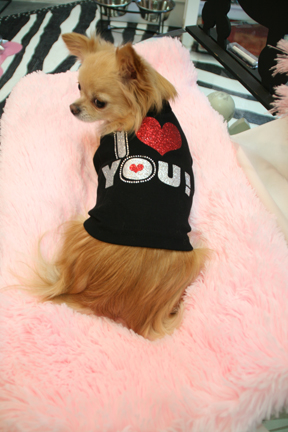
3) Be My Valentine. Now, if it’s your dog you’re shopping for, this sweet little I Heart You tee, worn by our model, Chloe, says it all. Available at One Lucky Dog in multiple sizes, while supplies last. Be sure to check out their line of tee shirts for humans, including the “I Kissed A Dog and I Liked It.”
Nothing says “Be Mine” than the I Heart You tee shirt from One Lucky Dog, St. Pete.Soft, nicely cut tee shirts from One Lucky Dog, St. Petersburg.
4 & 5) Call Me, Maybe? Oh yea these numbers are one-of-a-kind finds, and available exclusively at Pawsitively Posh Pooch. Hand-sewn with delicate appliqués and jewels, the couture lines carried at Pawsitively Posh Pooch are from fashion-first cities like Milan, Paris, and Spain. Plan on spending some time here, as you uncover treasure after treasure, like the gorgeous harness, worn by store dog, Zoe. Available in various sizes.
This couture doggie design, exclusively at Pawsitively Posh Pooch, St. Petersburg.Zoe, our Pawsitively Posh Pooch model, wearing a one-of-a-kind halter.
6) Dental Health Month. In conjunction with National Pet Dental Health Month, February is also Responsible Pet Owners Month. Now is a good time to stock up on some in-home preventive measures like the Fresh Breath Liquid Floss spray and Triflossball, available at Pet Food Warehouse. The dynamic duo treatment doubles as a great way to clean your dog’s teeth during playtime. Throughout February, Pet Food Warehouse is offering 20% off on all dental products. Stop in to see their huge display, and have your questions answered by a knowledgeable staff. Be sure to check out their I Heart Dogs T-shirts. Another sweet Valentine’s gift for dog lovers.
Floss and Fun with your dog for healthier teeth. Available at Pet Food Warehouse, St. Pete.Novelty tee-shirts, like this one, available at Pet Food Warehouse, St. Petersburg.
7) Environmentally dog-friendly. Who can resist the charming handmade and hand-painted Adirondack chairs, complete with a motif that includes your dog’s likeness? Wet Noses, the shabby-chic cottage boutique in Sarasota’s Downtown, carries some wonderful finds, created by local artists.
Handmade and hand-painted Adirondack chairs, available at Wet Noses Boutique, Sarasota.
For the love of dog, come along and have some fun with Florida’s top dog lifestyle magazine. Be sure to stay connected to all things Florida Dog via The New Barker blog, Facebook page and Weekend PupDates. We’ll be offering fun specials and more giveaways throughout the year.
Retired U.S. Marine Rober Harr, 86 (center) with U.S. Marine Gunnery Sgt. Christopher Willingham (right) and U.S. Marine Cpl. Juan Rodriguez (left) with Lucca on the Natural Balance 2013 Rose Parade Float, Canines with Courage. (Gary Friedman, Los Angeles Times).
A decade ago, Military Working Dogs like Lucca would have most likely been euthanized after her service. The dogs were considered government equipment and too dangerous to return to domestic life. Thousands of dogs working for the military have been sent overseas since 1942. Over the years, many have been left behind as excess equipment. During the Vietnam War, about 4,000 American war dogs were employed in various capacities. About 300 dogs were killed in action or were victims of either tropical diseases or infections. The rest of the dogs were reportedly put down by military veterinarians or given to the South Vietnamese Army.
In 2000, President Clinton signed a law allowing retired soldiers and civilians to adopt the Military Working Dogs after their deployments.
John Burnam, who served in Vietnam and wrote a first-person account of working with a front-line scout dog named Clipper, will also be riding on the float today. Clipper never made it back to the United States. Burnam is president of the foundation that established the Military Working Dog Teams National Monument, which is scheduled to be completed in October, 2013. Burnam’s story about Clipper inspired Rep. Walter B. Jones (R-NC), who introduced legislation for a national monument. In 2008, President Bush signed the bill into law, and President Obama authorized Burnam’s foundation to build and maintain the San Antonio, Texas monument.
The bronze statue features a Doberman Pinscher, German Shepherd, Labrador Retriever and a Belgian Malinois leading a dog handler on patrol. The $1.2 million dollar price tag was funded solely by grants and donations led by sponsors Natural Balance, Petco and Maddie’s Fund.
Cpl. Juan Rodriguez, 23, credits Lucca with saving his life. The dog sniffed out a booby trap, setting off the bomb that took her leg. Cpl. Rodriguez later escorted Lucca to her first handler, Marine Gunnery Sgt. Christopher Willingham, 33. Lucca is living the life of spoiled retirement, and enjoying every minute of it.
The New Barker dog magazine is honored to be a longtime supporter and sponsor of Military Working Dog Team Support Association (MWDTSA). Over the years, through the support of our retail advertisers and their own generous customers, supplies have been collected for the dogs and their handlers currently deployed overseas. We have collected the donations and transported them to the SPCA Florida in Lakeland. There, they are either shipped to Atlanta, or Dixie Whitman, the executive director of MWDTSA drives to Lakeland from Atlanta to pick up the supplies. Dixie then packages and ships the supplies directly to the deployed handlers and their dogs.
We wanted to share a story that was first reported by the New York Daily News on Monday, December 17. The comfort dogs are able to bring is no surprise to dog lovers. The New Barker joins the nation in sending our thoughts and prayers to those who lost loved ones as a result of this tragedy.
Comfort dogs help ease pain of mourning Newtown Community. By Jennifer H. Cunningham and Adam Edelman for the New York Daily News. Photography is by Allison Joyce for the New York Daily News.
A pack of sympathetic groups bearing supportive canines spent much of Monday with bereaved Connecticut residents affected by last week’s Sandy Hook Elementary School massacre, providing children and adults alike with the cuddly comfort that only a four-legged friend can give.
The therapy dogs were brought in by at least three groups late Sunday to help kids and adults alike cope with last week’s horrific shooting in Newtown that left 20 first graders and six school officials dead.
Among the groups was the Hudson Valley Golden Retrievers Club, whose members spent the afternoon at a makeshift memorial near the town center, where both kids and adults in need of compassion stopped to pet and cuddle the dogs.
Mourning or otherwise devastated children and parents said that petting the dogs gave them relief from their sadness.
“I just love dogs, so whenever I’m around them, they make me feel better,” said 12-year-old Ryan Williams. “When they come over and you pet them you kind of forget about what’s happening for a little bit.”
Jenna Stuart, a school bus driver from Newtown, said the dogs were an enormous help to her four-year-old daughter, Kylie, who attends preschool at the Children’s Adventure Center in front of Sandy Hook Elementary and lost friends in the tragedy.
“I like the dogs because they made me happy,” said Kylie, after petting one on the head. “The dogs love me.”
Some residents, who weren’t directly affected by the bloodshed, found peace in simply bringing their own dogs to help others.
Sandy Hook resident Ann Mari Cioffi, a member of the Hudson Valley Golden Retrievers Club, brought her dog, Libby, 5, to comfort victims, at a memorial in the center of town.
“They’re just gentle, caring, kind and sweet. Cioffi said of the dogs. “They just seem to sense it. They just sense when somebody’s sad.”
Massachusetts- based K-9’s For Kids Pediatric Therapy Dogs was also among the groups sharing their tail-wagging buddies.
Crystal Wright, 52, of Becket, Mass., a dog handler with the group for Rhiku, a 5 year old Sheltie, said the canine had been easing frowns all day.
“Everyone likes to pet a dog,” she said. “It changes the mood. It kind of takes them away from what they’re going through for a moment. I think it’s helping. I think they needed it.”
Some canines even traveled across the country to help out.
Trainers from the Chicago-based Lutheran Church Charities, which has deployed its comfort dogs to other communities hit by tragedy in the past, brought in 10 to 15 Golden Retrievers and their handlers to Connecticut to help with the consolation efforts, Tim Hetzner, the president of the organization, said.







 Go forth and shop, fellow dog lovers. You have now been properly advised, and Santa can’t hold a cookie to your super shopping powers.












 The Art Of Dog.™
You must be logged in to post a comment.