Meet Angel, the newest addition to The New Barker staff. Like Bailey, the dog in the movie A Dog’s Purpose, we’re clueless as to what Angel’s purpose is at the moment. We’re not even certain what compelled us to adopt a puppy at this stage in our lives. It’s been 18 years since we’ve raised one, and evidently our memory bank was devoid of all that is involved. Maybe it has something to do with her name, given to her before we adopted her from VIP Rescue Florida in Clearwater. Divine intervention for two broken hearts?
Our home, over the last 10 years, was complete with four dogs. As editor of The New Barker dog magazine, there are many opportunities for dogs to cross my path, increasing the odds of falling in love, over and over again. In A Dog’s Purpose, Bailey falls in love over and over again with a different human. Without love, after all, what is the purpose of life?
While attending this year’s Florida Gulf Coast Classic Clusters dog show with a dear friend, she mentioned why she enjoyed coming to the show so much. “I love watching you interact with the dogs, because every dog you see, it’s as if it’s the first time you’ve ever seen a dog.”
Over the course of eight months during this past year, we lost our two Cockapoos, Zoe and Chloe. They had been a big part of our lives for 18 years, and boom, just like that, we were a family of four – two humans and two canines.
One of the reasons it’s so difficult getting over the loss of a dog is the simple fact that they are so dependent on us. They won’t “grow up” and develop a new circle of friends, go off to college, establish a career and start families. They leave us only when their time is up, whenever or however that may be. Their departure opens a space in the heart that may never be filled. But, what if, having known that one dog, a place is opened in the heart to make room for more love, compassion, faith and hope? Room for another dog, whose purpose may not be clear at first.
With it’s cool soundtrack, A Dog’s Purpose is not just a story about dogs. It’s as much a story about humans, with our foibles, our loneliness and our ability to forgive and love again. Yes, it’s a love story that will make you laugh and cry, then laugh again, which is exactly what dogs do.
While Angel’s purpose may not be clear to us, for now, she is helping to mend a pair of broken hearts. And, at present, that’s all we can ask of a nine-week old puppy.
Angel’s Adventures will be a weekly feature of The New Barker blog, so be sure to sign up. Follow The New Barker on Facebook, Twitter,Instagram and Pinterest for a cuteness overload of Angel as we follow her growth and discover just what her purpose in our lives will be.
Rawhide is a dangerous treat, given unknowingly by pet parents to their dogs. It is not, as many folks believe, the by-product of the beef industry nor is it made of dehydrated meat. It is actually the by-product of the leather industry. Producing rawhide begins with the splitting of an animal hide, usually from cattle. The top grain is generally tanned and made into leather products, while the inner portion, in its “raw” state, goes to the dogs. Harmful chemicals, glue and paint are added to the product. A brief 4-step explanation below this illustration describes how the actual process transforms the hide to the dangerous chew stick. And, below the explanation, we’ve included some safer, healthier treat option suggestions (vegetarian option as well).
STEP 1: Normally, cattle hides are shipped to tanneries for processing. The hides are treated with a chemical bath to help “preserve” the product during transport to help prevent spoilage.
Once at the tannery, the hides are soaked and treated with either an ash-lye solution or a highly toxic recipe of sodium sulphide liming. This process will help strip the hair and fat that maybe attached to the hides themselves.
The hides are then treated with chemicals that help “puff” the hide, making it easier to split into layers. The outer layer of the hide is used for goods like car seats, clothing, shoes, purses, etc. But, it’s the inner layer that is needed to make the rawhide, and other things like gelatin, cosmetics, and glue.
STEP 2: The post-tannery stage: Hides are washed and whitened using a solution of hydrogen peroxide and/or bleach; this will also help remove the smell of the rotten or putrid leather. (Research also shows that other chemicals maybe used to help the whitening process if the bleach isn’t strong enough.)
STEP 3: Now it’s time to make these whitened sheets of this “leathery by-product” look delicious. So, here is where the artistic painting process comes in.
Basted, smoked, and decoratively tinted products might be any color (or odor) underneath the coating of (often artificial) dyes and flavors. They can even be painted with a coating of titanium oxide to make them appear white and pretty on the pet store shelves.
The Material Safety Data Sheet reveals a toxic confection containing the carcinogen FD&C Red 40, along with preservatives like sodium benzoate. Tracking the effects of chemical exposure is nearly impossible when it’s a matter of slow, low-dose poisoning.
STEP 4: How does it last forever? Because the FDA does not consider these chews to be food, it’s a free for all when it comes to the manufacturers of these leather strips, and the products they may want to add to these chews, to get them to last forever. Any sort of glue may be added here to help ensure they never come apart.
When tested: Lead, arsenic, mercury, chromium salts, formaldehyde, and other toxic chemicals have been detected in raw hides.
Finally, it’s time to package and attach all the glorious marketing labels to the product. The fine print warning is attached with some rawhide products: “Choking or blockages. If your dog swallows large pieces of rawhide, the rawhide can get stuck in the esophagus or other parts of the digestive tract. Sometimes, abdominal surgery is needed to remove them from the stomach or intestines. If it isn’t resolved, a blockage can lead to death.“
How do proactive veterinarians feel about these chews? This is what world-renowned veterinarian Doctor Karen Becker has to say on the matter:
“The name ‘rawhide’ is technically incorrect. A more accurate name would be processed-hide, because the skin isn’t raw at all. But the term “rawhide” has stuck. Rawhide chews start out hard, but as your dog works the chew it becomes softer, and eventually he can unknot the knots on each end and the chew takes on the consistency of a slimy piece of taffy or bubble gum. And by that time your dog cannot stop working it — it becomes almost addictive.At this point, there’s no longer any dental benefit to the chew because it has turned soft and gooey, and, in fact, it has become a choking and intestinal obstruction hazard.“
An investigation by Humane Society International stated in their report, “In a particularly grisly twist, the skins of brutally slaughtered dogs in Thailand are mixed with other bits of skin to produce rawhide chew toys for pet dogs. Manufacturers told investigators that these chew toys are regularly exported to and sold in U.S. stores.”
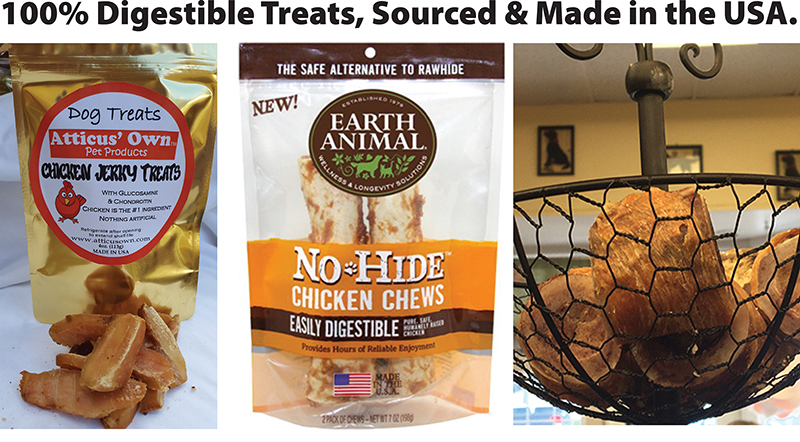
Healthy, Safer & Delicious Treat Alternatives, as Suggested by THE NEW BARKER dog magazine.
Atticus’ Own Pet Products – a variety of delicious treats, chock full of all things healthy, like glucosamine and chondroitin. A super treat to keep you dog’s hips and joints healthy. The jerky is made from USDA-certified, all-natural chicken breast from family farms right here in the USA. In fact, Atticus’ Own Pet Products is headquartered right here in Florida. Grain free. No wheat, corn, soy or additives. In addition to the chicken jerky, Atticus’ Own offers Fish Jerky treats “like heaven in a bag…” A great source of omega-3’s. For dogs and cats. Follow the adventures of Atticus’ Own Gibbs and Sunshine at Atticus’ Own Pet Products. Better yet, order up some treats at http://www.atticusown.com
Earth Animal No-Hide Chicken Chews – 100% USA-sourced chicken, made in the USA. The chicken has been carefully rolled, cooked and uniquely dried for a one-of-a-kind chew. No hormones or additives. Also available: Beef and Salmon. You’ll find these delicious dog treats at fine Florida dog stores such as Dog Mania & Cats in Dade City.
Al CaBONES – We’ve watched customers load up on these treats, as their dogs just love them. The treats are actually beef marrow bones wrapped in chicken. No additives, preservatives or fillers. All goodness, sourced and made in the USA. Bada bing, bada boom. Trust us. This is a treat your dog can’t refuse. Available at fine independent pet retail stores including Fluffy Puppies in Clearwater and Pet Food Warehouse in St. Petersburg.
Einstein Pets – What about an alternative for the vegetarian lover? Einstein Pets uses only ingredients that matter. Ingredients like oats, rich in nutrients. Veggie Time dog treats are made with real carrots, turmeric and chia which promotes heart and liver health. This Sarasota, FL company is turning heads in the pet treat industry with awards from Pet Product News and the Best Brand award from American Choice Awards. You’ll find them at fine independent pet retail stores including Wet Noses, Sarasota;Bark Life, Seminole; Downtown Dogs, Tampa’s Hyde Park; The Modern Paws, Tampa; Wag Natural Pet Market, Tampa’s Davis Island; Earthwise Pet Supply in Gainesville, Valrico,Naples and Jacksonville Beach.
Finally – always supervise your pet when giving any chew treats. It’s also a good idea to check with your veterinarian, especially if your dog is on a special diet.
Sources: Pet nutrition blogger Rodney Habib, Planet Paws, The Whole Dog Journal and The Bark.
THE NEW BARKER dog magazine, established in 2006, publishes quarterly. Each cover of THE NEW BARKER dog magazine features an original work of art by a different Florida artist. For more information, visit http://www.TheNewBarker.com
The holidays may be over, but the spirit of the season of giving and hope lives on in this dog story.
Macho. Photograph, courtesy of Feeling Fine Canine and Equine Rescue.
Miami-Dade Animal Services (MDAS) is a loud place, often crowded with more dogs than space. Macho was one of the lucky ones. On December 12, volunteers from a West Palm Beach rescue group, Feeling Fine Canine and Equine Rescue, pulled Macho. He was emaciated, very weak and looked as if he had lost his will to live.
He was immediately taken to Gardens Animal Hospital for tests. Along with a diagnosis of pancreatitis, high levels of calcium in his blood indicated Macho had cancer. Tracey Godin, founder and operator of Feeling Fine Canine and Equine Rescue, said that Macho was able to spend Christmas with her family. Caela, Godin’s daughter, hand-fed Macho and slept on the floor with him. Macho must have known he was loved. Just 18 days after he was pulled from MDAS, Macho peacefully passed away.
Caela and Macho. Photograph, courtesy of Feeling Fine Canine and Equine Rescue.
The following day, Godin’s mother was scheduled for surgery that would require her to be under anesthesia for four hours. Prior to her mom’s surgery, Godin said a prayer, asking everyone she knew in Heaven to keep her mother safe.
“After surgery, my mom told my aunt that she spoke to my father, who had passed away last February,” said Godin. “In the hospital room, I said to mom, ‘so I hear dad visited you?’ And mom answered, ‘Dad has Macho…’ She repeated it several times. The crazy thing is, mom had only met Macho one time for about 10 minutes.”
Do dogs go to Heaven? In the 18 days Macho was with Godin and her family, he managed to touch the hearts of many. Why, out of all the dogs at MDAS, was Macho pulled by this rescue group? Some people believe there are no coincidences in life. There seems to be a guardian angel watching over a family who gave their hearts to him for a short period of time. Peace, Macho.
Rock, adopted during the December MEGA Adoption Event in Jacksonville, FL
Four years ago First Coast No More Homeless Pets invited Northeast Florida animal shelters and rescue groups to fill a huge Jacksonville Fairgrounds exhibit hall with adoptable dogs and cats for three days. About 900 animals found new homes at that first Mega Adoption Event.
Since then, 13,249 animals have been adopted at local mega events, which are sponsored by Petco and organized three or four times a year at the fairgrounds. The record mega adoption tally was 1,164 in July 2014, according to the nonprofit, which runs two low-cost veterinary clinics and leads Jacksonville’s no-kill effort.
Now First Coast No More Homeless Pets has begun to help other animal welfare organizations across the country stage their own large-scale adoption events, mentoring them on logistics, marketing and other issues. The first such out-of-town advice was for the inaugural mega in early December by Brandywine Valley SPCA in Chester, Pa.
Brandywine staff and volunteers did the work, while First Coast founder and CEO Rick DuCharme provided guidance and encouragement.
“I held their hand throughout the whole thing,” he said.
When Brandywine ran out of adoptable animals two days into its three-day event, DuCharme even mobilized the Northeast Florida animal rescue community to truck almost 100 dogs and cats from Jacksonville to Pennsylvania to fill some of the empty crates.
“Duval County is nationally recognized for our no-kill status and this is one more example of our communities’ passion for the mission of helping dogs and cats find new homes — wherever they might be,” he said.
Leading the Way
When Brandywine staff first pondered having a large-scale adoption, they knew where to go for advice. CEO Adam Lamb, who formerly worked in Lakeland, knew DuCharme and Denise Deisler, executive director of the Jacksonville Humane Society, a First Coast partner agency. He knew about their success with mega events and reaching no-kill status in Jacksonville, which means at least 90 percent of shelter animals leave alive.
“They are very big [in animal rescue],” said June Iv, Brandywine’s chief development officer. “Everybody in Florida knows them.”
Including the Northeast Florida animals, 886 dogs and cats were adopted at the Brandywine event, she said. The event went so well that Brandywine is already planning its second mega sometime in 2017.
“It was very successful. We were shocked by how successful,” Iv said. “We were thinking 500. That was crazy for a first-time deal.”
Pennsylvania is not exactly in First Coast’s service area, but DuCharme said helping shelters across the country falls in line with the nonprofit’s overall mission: ending the killing of shelter animals in Jacksonville, Northeast Florida and the nation, he said.
Jacksonville achieved no-kill status in 2014. Meanwhile, First Coast also helps neighboring counties work toward the no-kill goal through free and low-cost spay/neuter and adoption initiatives and programs that help struggling families keep their pets, among other things.
Also, many shelters and rescues across North Florida participate in the mega events. The mega concept was patterned after similar but smaller-scale events at Best Friends Animal Society in Utah, which is a national no-kill leader and has funded various First Coast initiatives. Initially, DuCharme, Deisler and Scott Trebatoski, then director of Jacksonville Animal Care and Protective Services, had joint adoption events at their three locations. Then they worked “hand in hand … to structure, refine, set up and carry out mega events” at the larger Fairgrounds venue and share the idea with other areas, Deisler said.
“Megas have benefited animal welfare through both marketing efforts focused on adoption and by providing additional adoption avenues — especially for some of the smaller groups,” she said. Also, they “provide great selection in one place for potential adopters,” Deisler said.
Brandywine’s Iv agreed. Many potential adopters are more likely to go to a “fair-type atmosphere” to adopt a pet than to a shelter, which some people find depressing, she said.
Adoption numbers at Jacksonville’s megas have declined in recent years — 668 animals found homes at the December event — but that does not necessarily indicate that fewer animals are being adopted in the community, Deisler said. Several factors are at work, such as shelters having more regular marketing efforts during the year.
“The novelty may be wearing off as well,” she said. DuCharme said local media outlets do not give the events as much attention as they once did.
But megas will remain “a very significant adoption program,” Deisler said. “That Jacksonville is considered a model community for mega and other progressive and successful animal welfare practices is a feather [in the community’s cap] for sure — a very positive statement about an engaged and compassionate community,” she said.
Committed to the Cause.
Roscoe was relinquished to Alachua County Animal Services. As part of Jacksonville’s MEGA Adoption Event in December, thankfully, Roscoe found his forever family.
Now DuCharme is seeking additional funding to expand First Coast’s mega-reach to as many as 25 animal rescue organizations across the country. How First Coast and its local partner agencies responded to the animal shortage at the Brandywine event shows their commitment to the cause, he said.
“When I was first notified that they had been so successful, I knew it was an opportunity, but I also knew few teams could rally so quickly to make this happen in less than 10 hours,” DuCharme said, referring to the overnight transport of animals from Jacksonville-area shelters to Pennsylvania.
Such long-distance transport goes both ways at First Coast. Among the adoptable animals at the Dec. 16-18 mega event in Jacksonville were 28 dogs rescued four months earlier from floodwaters in Lafayette and Baton Rouge, La. The dogs were nursed back to health by volunteers at the Saint Tammany Humane Society, just north of New Orleans, and brought to Jacksonville for adoption. Each of them found new homes.
First Coast No More Homeless Pets To make an appointment or get more information, call (904) 425-0005. To donate or ask fundraising-related questions, call 904.520.7900. Clinics are at 464 Cassat Ave. and 6817 Norwood Ave., both in Jacksonville.
We have been creating The New Barker dog magazine for 10 years. It’s been an amazing journey.
To All The Dogs We’ve Loved & Lost. And Those We’ve Never Met. A Journey Of Hope, Happiness, Heartbreak & Healing.
The 10-year anniversary edition of The New Barker is in distribution and being mailed to subscribers. It is hard to believe that ten years ago, December 2006, we produced the first edition of the print magazine during a time when 155 new magazine titles were created; a time when the demise of print was being predicted.
Our very first cover. December 2006.
While the decline of print continues to be argued (ironically in newspapers and business publications), a total of 862 new magazines were launched in 2013 “with a courageous repudiation to their critics,” said Samir Husni, Ph.D., also known as Mr. Magazine. Husni featured The New Barker in one of his 2016 weekly interviews.
“There is a tangible connection between myself and magazines. I don’t choose them, they choose me, so the living and breathing passion that I have felt for magazines over the last 30 years has instilled within me an innate ability to meld with ink on paper,” said Husni. He looks for a magazine’s ability to engage an audience through photography, undeniable style and noteworthy content. As the director of the Magazine Innovation Center at the University of Mississippi, School of Journalism, he is widely considered to be the country’s expert on magazines.
Our editorial philosophy, here at The New Barker has always been to focus on feel-good lifestyle stories about people and their dogs. Unfortunately, one of the first harsh realities we faced while developing feature stories was discovering the number of shelters in Florida. The open intakes (many of which are high kill shelters), the limited intakes, the privately-run and/or county-run shelters. Look further, and there is a huge contingent of breed-specific rescue groups, SPCA and Humane Society organizations that are all independently-operated. There is no connection, other than name association, between the national organizations and the local shelters in our communities.
Someone once told me that a new shelter could open down the street from another, and within a week, it would also be full of abandoned, unwanted dogs and cats. Why? Why do more shelters keep opening and filling up? Why are so many adoptable dogs and cats euthanized? Where are the people who supposedly want to adopt them? With all of this presented before us, some people actually believe that the pet overpopulation problem is a myth, taking the No Kill movement’s information out of context. Pose any of these questions to a shelter employee and you’re likely to receive a cold shoulder. It’s a tough business, running a shelter, and understandably, some become defensive. Yet, the public shouldn’t be bullied into not asking important questions.
There are plenty of opinions on how to fix the problem, some extreme. While we’re arguing which solution is right, 10,000 healthy, adoptable dogs, puppies, cats and kittens are euthanized every day in this country. Extreme solutions or not, no matter how we get there, we all want the same things: to stop the needless killing of adoptable dogs and cats — and increase the number of adoptions.
Over the last 10 years, The New Barker has donated close to $200,000 in money, in-kind advertising, goods and services to Florida shelters, rescue groups and animal advocacy programs. This, and the magazine’s very existence, are made possible because of three very important elements: First, and foremost, our advertising partners. The New Barker is 100 percent advertiser-supported. Second, our wonderful team of independent photographers, graphic designers, and rover reporters who have been with us almost since our first year. And last, but certainly not least — you, our gentle readers. We love hearing from you — your opinions, your story ideas, your passion. Thank you to each and everyone of you, without whom this would not be possible. It has been an incredible journey.
The photo on the left, taken by professional photographer Laura Allen in 2006, was for the very first issue’s Editor Unleashed column. It ran for several years until we adopted Dougie, the Scottish Terrier, from Dunedin Dog Rescue. Laura, again, took the photo. We set up at Honeymoon Island in Dunedin. In the past year, we have lost Zoe (the blond Cockapoo) and Chloe (the black and tan Cockapoo). They each lived with us for 18 years.
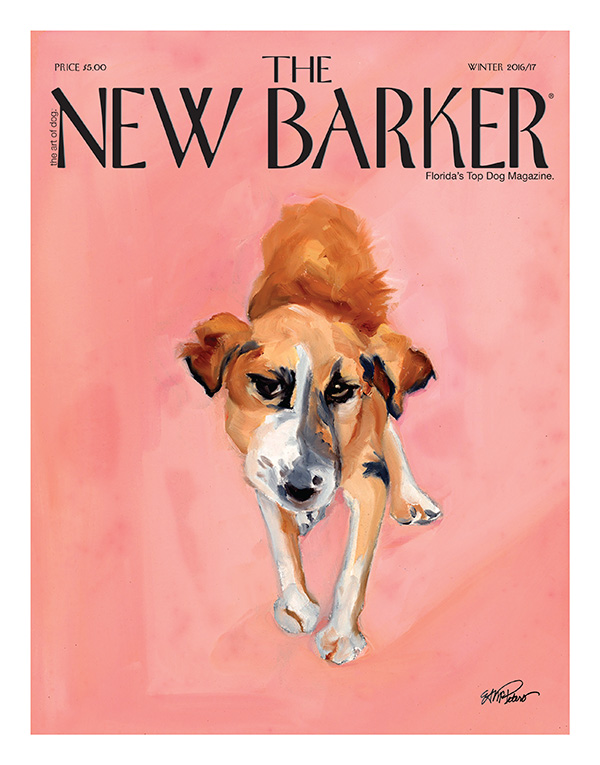
10-year Anniversary edition of The New Barker dog magazine. Cover title: The Dog in Pink, by Myakka City artist Evelyn McCorristin Peters. Every cover of The New Barker has featured an original work of art by a different artist.
Dorice Stancher of New Jersey with Wheaten Terriers Charlie (left) and Krista (right).
The AKC National Championship competition is in Orlando this weekend. The New Barker has a couple of our lucky dog rover reporters covering Conformation, Agility, Obedience, Meet the Breeds and Dock Diving. A family from New Jersey is in town competing in the dock-diving trials and it appears the trip will have been well worth it. Dorice Stancher traveled with her two Wheaten Terriers, Charlie and Krista for the Nationals.
Krista has been up against some stiff competition this week involving around 30 dogs – Labrador Retrievers, German Shepherd Dogs and an Old English Sheepdog. There seems to be a large concentration of Wheaten Terrier fans in Orlando and they all showed up to cheer on Krista. “No other dog of her breed has ever competed in diving events before,” said Dorice. “She’s something of a trailblazer.”
It’s actually a miracle that Krista is even in Florida competing at all. She pulled a tendon in her right rear leg – the leg she pushes off with in diving. She spent four days in a cast to immobilize the injured leg in November. Treatment included massages and physical therapy. On Wednesday, Krista, our Jersey girl, won a first-place ribbon during warm-up trials. Stay tuned.
Erik Babb and his service dog Matai. Photo by John Budnik.
After serving two lengthy deployments in the Army during Operation Iraqi Freedom, Erik Babb medically retired in 2010. He lost a lot of friends during the war, and now struggles with post-traumatic stress disorder and a traumatic brain injury. When he began working at the Warrior Transition Unit (WTU) at Joint Base Elmendorf-Richardson, Alaska, Babb acknowledged he was broken. However, he did not seek help right away. Instead, he self-medicated with alcohol and energy drinks.
When the WTU shut down because of budget constraints, Babb accepted a position with the U.S. Army Corps of Engineers in the Alaska District’s Contracting Division. His concerned colleagues urged Babb to seek help through the VA. “The VA in Alaska has never failed me,” Babb said. “Even working with a guy like me. I chewed up their interns.”
Babb continued to harbor thoughts of suicide even after going through a 40-day inpatient program in Tacoma, Washington. A former supervisor, Robin Norby, suggested Babb look into adopting a dog to help him deal with people, crowds and life. Stubborn, Babb refused to embrace the idea, until a defining moment. One day, on his way to an appointment, Babb was noticeably depressed. A coworker from the Corps stopped him, hugged him and reminded him that someone always cared.
Babb began researching service dogs through many resources and organizations. He was looking and hoping to find a dog that was hypoallergenic since his wife suffered from allergies. When he found out the cost of obtaining a service dog, he was discouraged, but refused to give up.
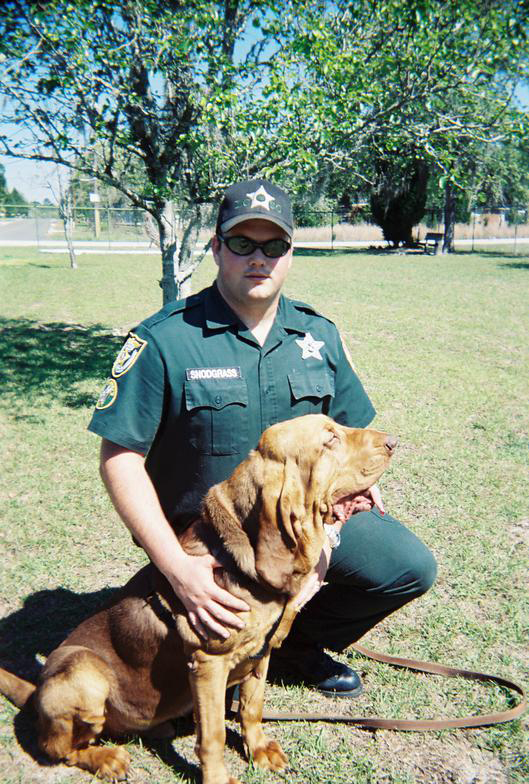
From Florida, Duke Snodgrass reached out to Babb via a telephone call after receiving his email. Snodgrass is the executive director and founder of 832 K9’s Deputy Dogs in Inverness. He and his wife Angela founded the organization 10 years ago in honor of their son Kody, a police officer and K9 handler with the Lake County Sheriff’s Office. Kody’s badge number was 832. In 2001, Kody died in a motorcycle accident.
“Kody loved Bloodhounds. Ever since he was a kid he wanted to raise them. We founded the Kody Snodgrass Memorial Foundation and began raising, training and placing Bloodhounds with sheriff departments in his honor,” said Snodgrass. “Kody always used to say that there is no excuse for a child to go missing, not when there was a Bloodhound around,” said Snodgrass. 832 K9’s Deputy Dogs has placed more than 200 dogs with law enforcement agencies across the country. They provide the dogs at little to no cost to the agencies. It costs anywhere between $10,000 to $15,000 to raise and train the dogs, which includes working with the K9 officers.
Deputy Snodgrass and K9 Jimmy.
Listening to Babb on the phone, Snodgrass knew he wanted to help him. “I could tell that he was genuine, and could relate to some of the things he was going through. On some of the work we do with the Bloodhounds, looking for missing or abducted children, I’ve had some nightmares too. Not as deep as Erik’s, but stuff that I do not want to remember,” said Snodgrass.
832 K9’s Deputy Dogs was able to donate a Portuguese Water Dog to fulfill Babb’s needs.
Babb flew to Tampa to meet Snodgrass and the dog, who instantly jumped to greet him. “I felt like it was Christmas,” said Babb. “I almost cried. What had I done to really deserve this? I know there are others who are in worse shape.”
Inspired by his wife’s ancestry, Babb named his dog Matai, which means “chief” in Samoan. Matai is being trained to recognize symptoms of anxiety and tension in Babb, reminding him to be calm by tapping his foot or rubbing up against him. The dog will also wake Babb from nightmares. The pair is going through basic and specialized training.
“One thing Duke asked me to do was to pay it forward in life,” said Babb. “To take any opportunity to stop and listen to a young man or woman in need.”
Snodgrass has admitted that he had “a real problem with God” after his son’s death. He now realizes there was a bigger purpose in the tragedy. “It’s Kody’s living legacy. I come up to the cemetery to see him every day. He’s looking down at us and smiling,” said Snodgrass.
Duke Snodgrass with James Bond 007. Photograph by Stephen Coddington.
For the picky eater, dogs now have their own grocery store in Miami.
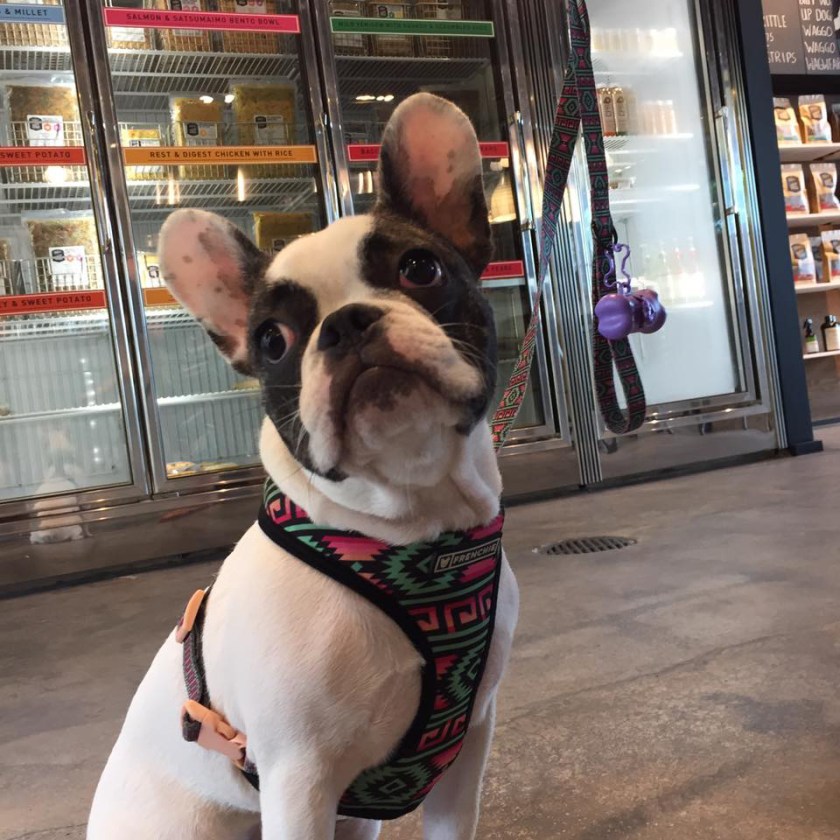
Michael O’Rourke first started cooking for Ripley as soon as his girlfriend brought the dog home. “Ripley was an extremely picky eater, which made me start to cook her food,” said O’Rourke.
Miami is ranked among the most pet friendly cities in the U.S. Armed with that knowledge and his desire to start his own business, O’Rourke moved to Miami from Los Angeles, and has just opened a retail store called Dishes For Dogs on North Miami Avenue. Not only can customers come in to order their dog’s food, which is prepared in full view, the canine kitchen has also formed partnerships with dog-friendly Shooters Waterfront,Glass & Vine and Mister Block Cafe to provide dog meals for patrons dining with their dogs. They are also negotiating a deal with Kimpton Hotels in Miami.
The company’s website describes the dog food as being prepared fresh using whole food to create the nutritionally balanced meals. O’Rourke partnered with Dr. Justin Shmalberg, a board-certified veterinary nutritionist who specializes in home prepared diets for pets, to help develop the recipes for Dogs For Dishes.
That’s Some Serious Cooking For Dogs.
While a storefront that sells only homemade dog cuisine is pretty unique, including dog dishes on restaurant and hotel menus is actually not a new concept. TradeWinds Island Resorts on St. Pete Beach provides a doggie room service menu from the PAW Court Bistro as part of their Pet Friendly Package. Sweet Sage Cafe on North Redington Beach offers up items like the French Poodle, Three Dog Night and Wake Up Little Shih Tzu on their Canine Cuisine menu. In Dunedin (aka DogEdin), it’s no surprise to dog lovers that many restaurants include a dog dining menu, including The Honu Cafe and The Living Room on Main.
As Laura drives down the road that leads up to the Aquatic Center, Lucy is already jumping around in the car.
Florida municipalities, hip on the dog revolution, open up their public pools for dog swims at the end of their swim seasons. Public pools in Fort Lauderdale, Largo, St. Petersburg and Tampa have been doing it for several years now, much to the delight of their canine citizens. On Saturday, November 5, the City of Tampa hosts Drool In The Pool Doggie Paddle at Copeland Park Pool in North Tampa (11001 North 15th Street). There is a $5 per dog charge. Humans enter free (but no humans are allowed in the pool). Next Saturday at Largo’s Highland Family Aquatic Center, the annual Soggy Doggy Splash Party will be from 11a-1p (400 Highland Avenue). There is a bonus day on Sunday from Noon-3p. Again, this is strictly a dog swim. No humans are allowed in the pools.
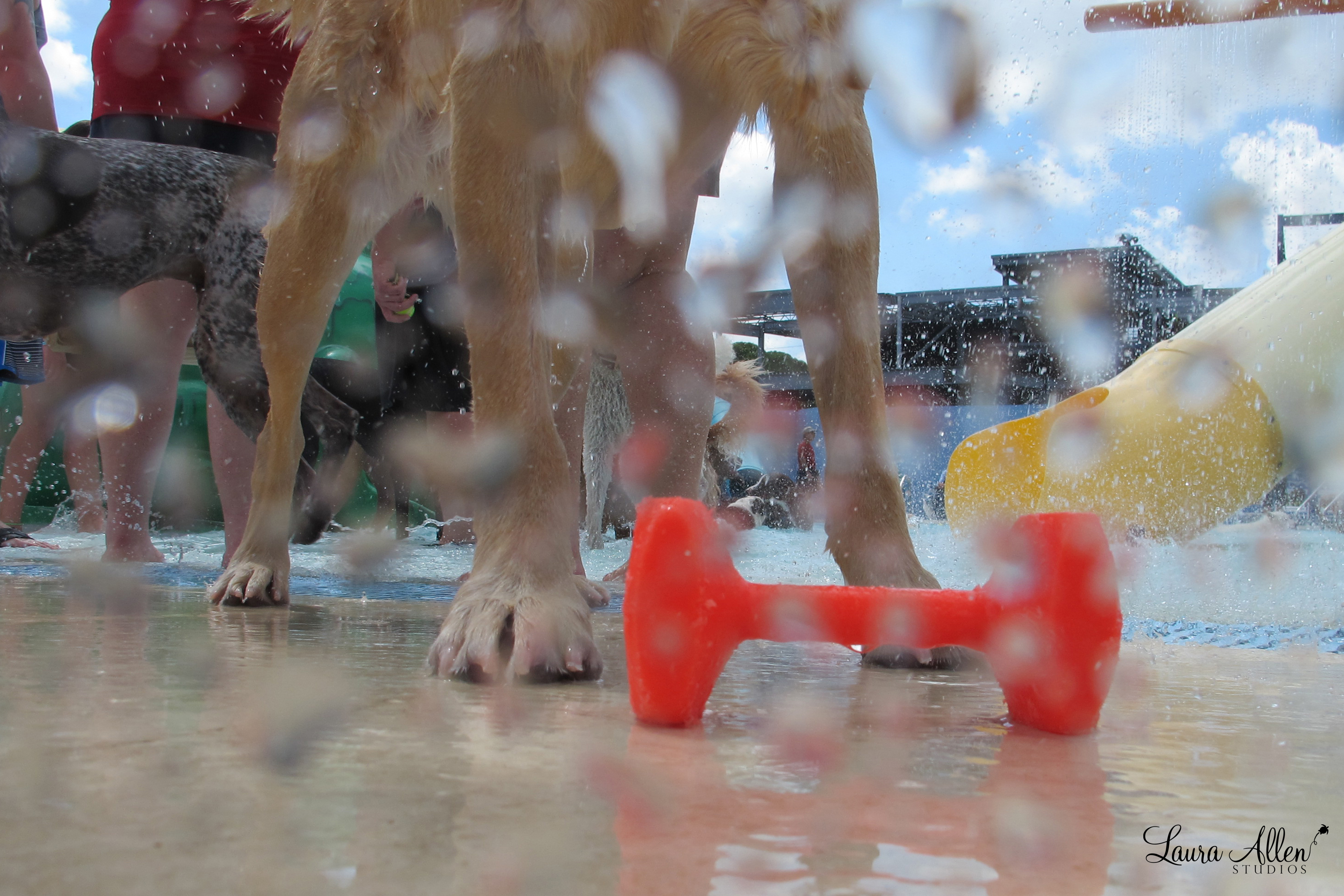
Lucy, a Labrador Retriever who lives with her human Laura Allen, loves the Soggy Doggy Splash Party. The following is an excerpt from a feature that appeared in the Fall 2012 edition of The New Barker dog magazine.
As Laura drives down the road that leads up to the Aquatic Center, before even seeing the other dogs or the pool, Lucy is already jumping around in the car. When the gates to the pool open, this dog is ready for some serious play time. She takes off with the other dogs, barely looking back at Laura. Occasionally, Lucy will look up and around for Laura, just to make sure. She gives Laura a reassuring smile before going back to playing.
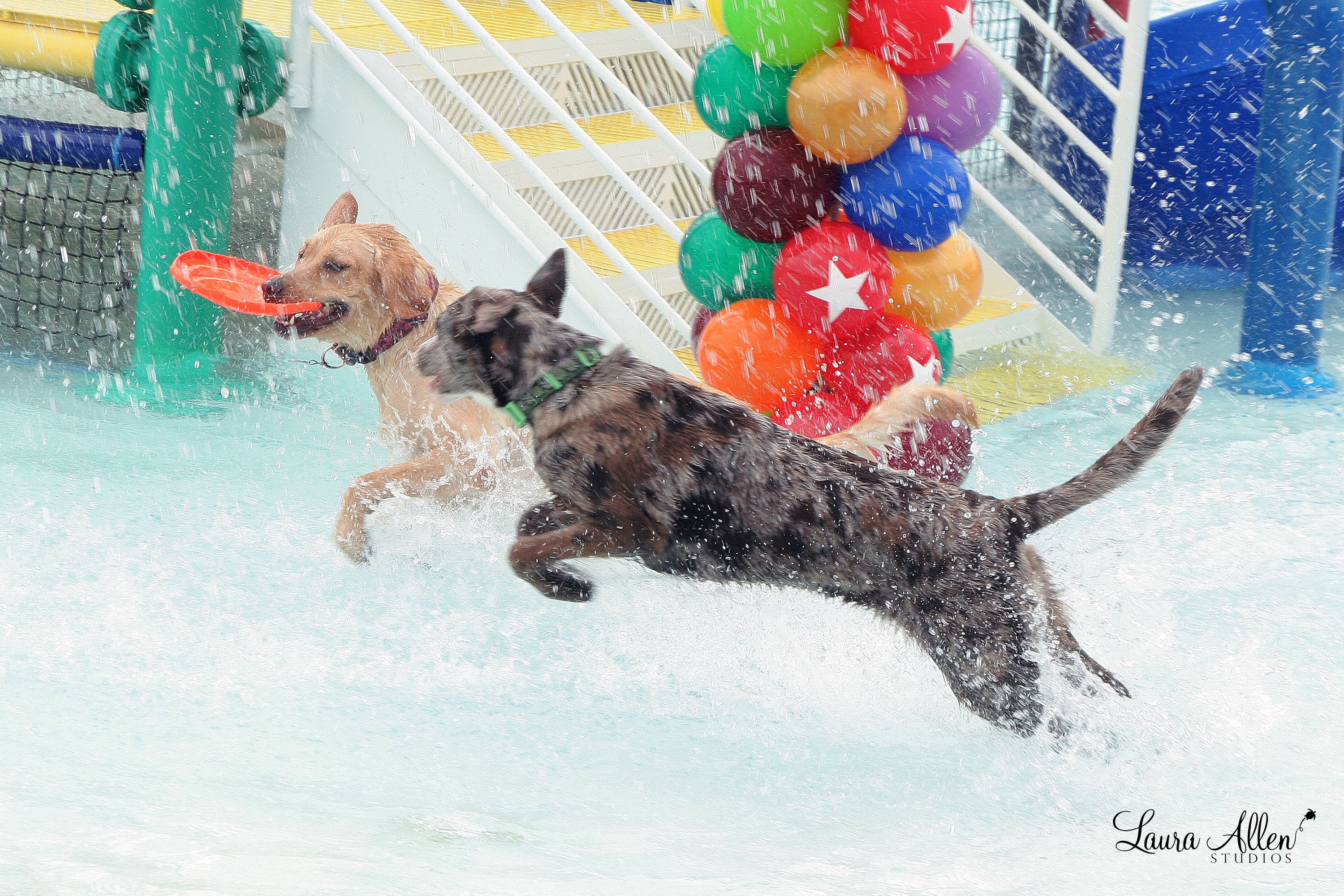
Lucy and Oliver.Oliver and his human drive from South Tampa each year to attend Largo’s Soggy Doggy Splash Party. Photograph by Laura Allen Studios for The New Barker dog magazine.
Lucy is the life of any party and has never met another dog she didn’t like. One moment she is relentlessly flirting with her best friend, Catahoula mix Oliver, adopted from the Humane Society of Tampa Bay. The next moment, she’s taking her toy to another human she doesn’t even know, coaxing him to throw it. No one can resist Lucy’s charm or her invitation to play ball. No one. She will continue to pick up and drop the toy in front of a stranger, until he finally picks it up to throw it into the pool. Mission accomplished, and off she runs.
Throw My Toy. Now.“I don’t know you. But, throw my toy and we will be BFF,” coaxed Lucy to a stranger. Photograph by Laura Allen Studios.
Toy-driven and focused, Lucy will dive down three to five feet in the water to retrieve a toy. She loves swimming with Laura in the Gulf or in a swimming pool, so she has definitely honed her aquatic skills. That came in handy during the 25-yard swim, another event held during the Soggy Doggy Day Splash Party. On this particular day, there was a massive start at the relay, as the dogs all jumped in the water at the same time. Every dog was swimming in all directions. Every dog, that is, except Lucy. With an almost inaudible whistle from Laura, Lucy quickly spotted her mark at the other end of the pool, and was soon cutting through the water like an arrow. Of course it didn’t hurt that Laura held one of Lucy’s toys in her hand. Advantage: Team Lucy, winner of the 2013 Soggy Doggy Splash Party 25-yard swim.
Should I Stay Or Should I Go?Lucy checks out how far down her toy is before diving in after it. Photograph by Laura Allen Studios for The New Barker dog magazine.
Lucy embodies the complete and utter joy of a dog, and Laura brings the best of that out in her. They go almost everywhere together when Laura is not working on location or on assignment as a professional photographer. Laura, who completely appreciates our domestication of dogs as a society, also believes dogs should be allowed to be dogs. Like children, dogs sometimes like to get dirty, and roll around in the grass, or mud. Laura believes in taking it all in stride.
“If I know we’re going to a place where Lucy will get dirty, I just make it a bath day. I try to live in the moment, just like Lucy does, and to not stress about the little things,” said Laura.
Lucy. The Belle of the Ball.Photograph by Laura Allen Studios for The New Barker Dog Magazine.
Each story in The New Barker dog magazine offers up some kind of hope. While the story may start out sad, there is always an ending that will make the reader feel good.
In its 10th year of publishing, The New Barker features the Florida lifestyle. The quarterly magazine is all about dogs and the people who love them. Each day we sort through press releases, phone messages and emails from people who have a story to tell about a dog. We review the news-feeds of the good, the bad and the ugly to determine which ones we want to pursue to develop a story. Most of the time, we are heartened by the stories. Other times, we cannot believe how cruel humans can be towards the creature known for its devotion. Man’s best friend.
There is so much negativity in the news already, and many of you dog lovers are most likely already aware of the atrocities occurring. We usually make the decision not to write about the bad or the ugly, unless there is a good side to it.
The following story, however, does not have a good side to it. And yet, we cannot look away. It makes us angry.
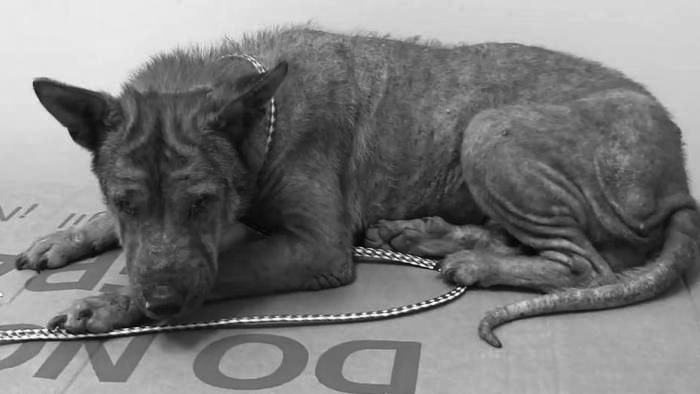
This is Lady, one of two dogs confiscated by Miami-Dade Animal Services in a cruelty case.
In a court appearance last week, Ronald Wilson, the former police chief of Opa-locka, pleaded not guilty to two felony counts of animal cruelty with intent to injure or kill. “He’s a really nice guy, very honorable,” said his defense lawyer, Sky Smith. “He has tremendous guilt over what he’s charged with.”
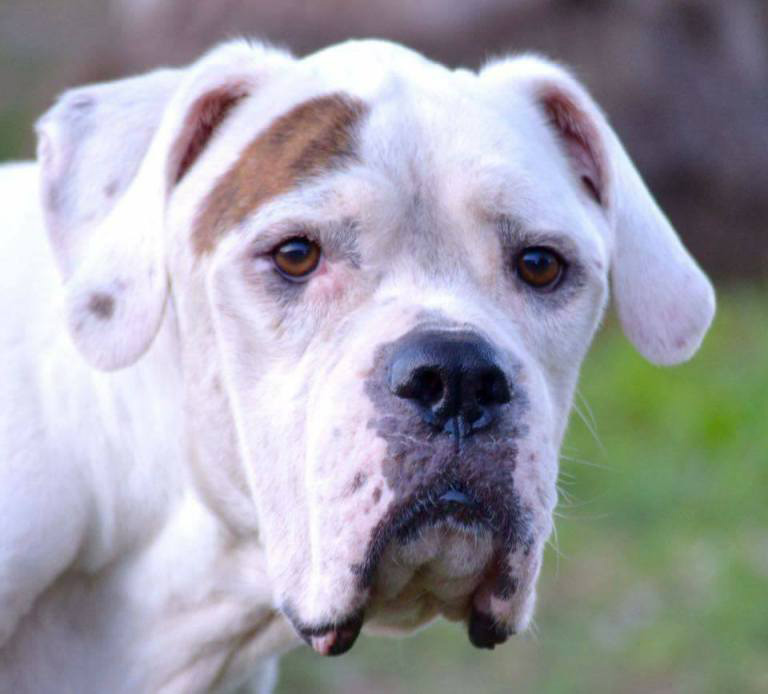
Really nice guy? In the yard of his Miami Gardens home, authorities discovered two German Shepherd mixes named Lady and Thug. They were severely emaciated. Their skin was cracked and bleeding. Most of their teeth were missing, their eyes oozing. Tremendous guilt? The dogs were removed while Wilson was out of town on a cruise.
X-rays revealed that Thug has two bullets lodged inside him.
Wilson has voluntarily turned over the dogs to Miami-Dade Animal Services.
Lady had to have several surgeries to remove 28 growths from her body. She needs eye surgery. Putting on a little weight and regaining some of her fur, she is faring better than Thug. X-rays revealed he has two bullets lodged in his body and suffered broken bones that have not properly healed. He is barely able to walk. Both dogs are currently being cared for by volunteers at Dezzy’s Second Chance Animal Rescue, a five-acre animal sanctuary in Palm Beach County.
“Mr. Wilson had no explanation why the two dogs were in horrible physical condition,” county animal services investigator Lisa Yambrich wrote in her report.

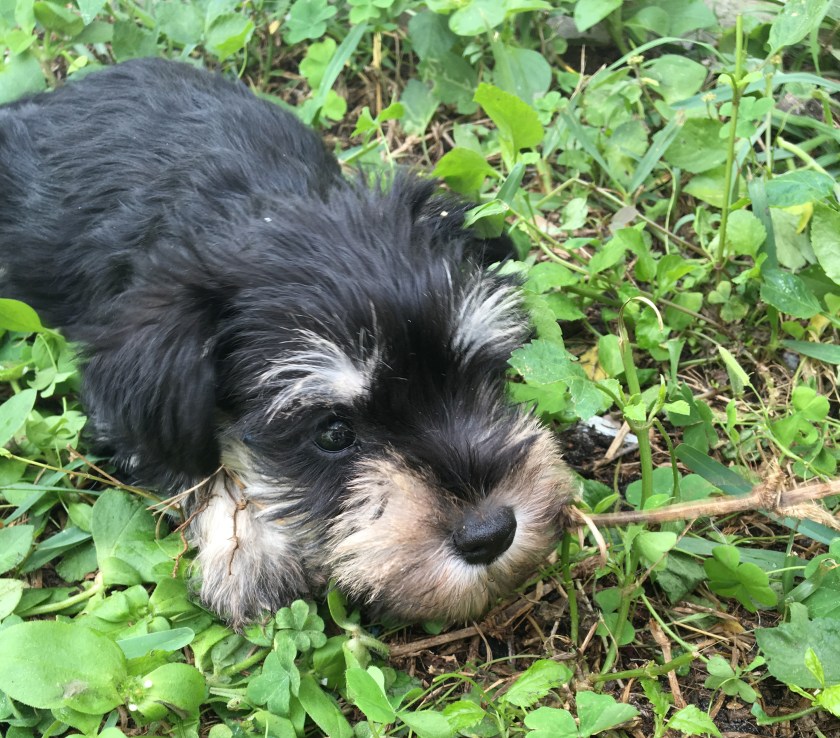 Meet Angel, the newest addition to The New Barker staff. Like Bailey, the dog in the movie A Dog’s Purpose, we’re clueless as to what Angel’s purpose is at the moment. We’re not even certain what compelled us to adopt a puppy at this stage in our lives. It’s been 18 years since we’ve raised one, and evidently our memory bank was devoid of all that is involved. Maybe it has something to do with her name, given to her before we adopted her from VIP Rescue Florida in Clearwater. Divine intervention for two broken hearts?












 Michael O’Rourke first started cooking for Ripley as soon as his girlfriend brought the dog home. “Ripley was an extremely picky eater, which made me start to cook her food,” said O’Rourke.




 The Art Of Dog.™
You must be logged in to post a comment.