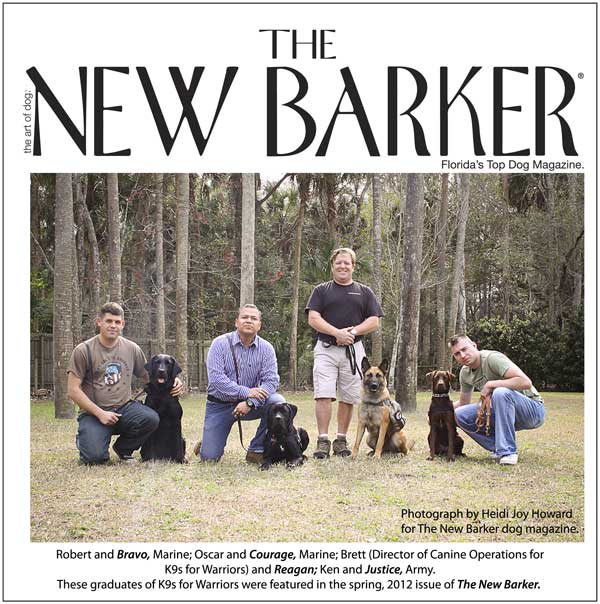
K9s for Warriors. Seeing Eye Dogs for the Mind.

By Anna Cooke for The New Barker Dog Magazine.

How deep into a soul does one have to dig to find the strength to help someone else who is standing at the edge of their life? Especially knowing that the life you are about to help has been affected, almost to the brink, by the ravages of war? Shari Duval was a volunteer for the Wounded Warrior Project out of Jacksonville, and saw firsthand the number of young men and women coming home from their tour of duty with an invisible disorder, Post Traumatic Stress Disorder or PTSD. And yet, when her son Brett, a Veteran K9 Police Officer and contractor for the Department of the Army, returned home after serving two tours in Iraq, she honestly did not know what was wrong with him. He was withdrawn, isolating himself from family and friends. As a bomb dog handler, Shari knew he had been in dangerous and deadly situations, but he was a veteran police officer, she thought to herself. “It just never dawned on me that these were signs of PTSD as a result of what he had seen in Iraq,” she said.

Thankfully, the family had the financial ability to get Brett the help he needed. During his treatment, Shari began heavily researching PTSD, and discovered the success in treating the disease through the use of service dogs. With the blessings and support from the Wounded Warriors Project, Shari created K9s for Warriors, a non-profit organization in Ponte Vedra Beach to train and provide service canines to military personnel suffering from PTSD. “They are like seeing eye dogs for the mind,” she said.
Image
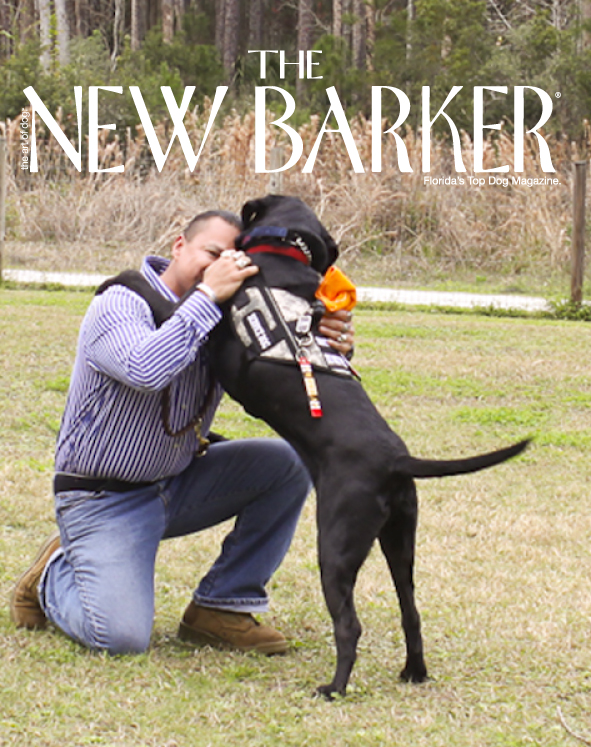
Oscar, a Marine, with his K9s for Warriors dog, Courage. Photograph by Heidi Joy Howard for The New Barker Dog Magazine.

Since September 11, 2001, this country has produced 500,000 disabled warriors, and of that number, one in five is diagnosed with PTSD. One in six of those diagnosed will attempt or commit suicide. That’s over 16,000 suicides, alarming proof that war can and does cause severe brain damage. Symptoms of the disease include hostility, aggression, depression, paranoia, acrophobia, nightmares, panic attacks, poor coping skills, memory loss and lack of trust. Studies have proven that there are actual physical changes in the hippocampus and prefrontal cortex of the brain as a result of a horrific experience someone has endured, like the effects of war.

Service canines have been medically proven to aid in the recovery of warriors suffering from PTSD. The dogs are recognized by the United States Department of Justice Civil Rights Division, and qualify under the American Disability Act of 1990. “With this information, I just knew we were on to something, and wondered how many thousands more we could help through our program,” said Shari.

All of the dogs in the K9s for Warriors program are either adopted from shelters or rescue groups, or gifted by concerned citizens. Most of the dogs are mixes, with either Labrador or Golden Retriever in them. Each dog undergoes a series of tests to ensure they are not skittish, aggressive or shy. They must get along with children and other animals, and not be adversely affected by loud noises. The evaluation process is pretty standard, and is overseen by Shari’s son Brett who is now Director of K9 Operations, and Sherrie Keshner, Coordinator of K9 Operations. All of the dogs accepted must be less than two years old to try and maximize the length of time the service animal has with the warrior. Right now, there are around 15 sources across the state that the organization works with. “The groups know what kind of dog we’re looking for, and when they see a dog who might fit our criteria, they’ll give us a call,” said Shari. Naturally, they are receiving calls every day. “There is just no reason for us to purchase a dog when there are dogs available to us who can qualify for a life of service work,” she added.

Shari believes K9s for Warriors approach differs from other programs in that each warrior’s own personal needs are taken into careful consideration. This factor is imperative for a successful match-up between the warrior and the dog, resulting in a successful recovery process. “We can never begin to imagine the horrors these men and women have seen and experienced, physically, emotionally and psychologically. And, while we are very careful not to ask why or prod during their three-week stay with us, it usually comes out,” said Shari. A couple of examples she gave were much too graphic to print here. “Oftentimes, the experiences they share with us have never even been divulged to anyone else,” she told us. “We have a volunteer crisis management psychologist who is available 24/7, and almost all of the warriors have taken us up on our offer.”

The absolute favorite part of Shari’s job at K9s for Warriors is pairing the dogs with their warriors before they arrive. “I cannot sleep the night before the warriors arrive for their first day. I cannot tell you how it works, but it works. We have been able to match the dogs correctly with almost every warrior in our program.”

Case in point: “We had a warrior driving in from Texas. He got as far as Jacksonville when he had a mental breakdown. Fear took over. He couldn’t go any further. He checked into a hotel without letting us know where he was or what was going on. We couldn’t reach him. Finally, after about six hours past his scheduled time to arrive here, he called me and told me he couldn’t move. I told him he had to. Get in the car and come here, now. He was here in about 30 minutes, shaking, questioning why he agreed to do the program. I suggested we go outside and just talk for a few minutes. As we sat outside, he wouldn’t open up. When I asked him if he would like to meet his dog, he just looked at me, unable to answer. At that point, Military, a Golden Retriever, came bounding around the corner towards him. She twirled around a few times in front of him, and jumped on his lap. He hugged the dog, then started crying. Military gave Rick, an Army Ranger, his life back. He is now back with his family, and is off his medications. He’s even writing a children’s book about dogs. He is a new man because of Military, the dog. And every story here is like that.”

During the three-week program, the warriors stay in living quarters on the K9s for Warriors campus, which also houses the dog kennels. In addition to the canine and housing, the program provides training, certification, equipment, seminars, vet care and most of the food. The food is actually donated and prepared by a group of local women, Kasseroles for K9s. “We find out what they like to eat, and these magnificent women cook delicious food for the warriors the entire time they are here,” said Shari.

The scene when a new group of warriors arrives is usually the same. They come with duffel bags full of medication, and plenty of skepticism. They question the length of the program, and how the dogs are going to help them get better. They may complain about the prospect of having to get up out of bed to take the dog outside. “How the hell is that going to help me?” is often heard. Shari and her staff tell them the same thing every time: “Just give it a week.” Within 48 hours, the dog and warrior have bonded.

The warriors are expected to be up by 7 a.m. Their job is to let the other dogs, not yet in the program, out for their morning constitutional, play, give them food and fresh water and clean out their kennels. Then the warriors sit down to their own breakfast. The day’s schedule is reviewed at that time. During the group training sessions, warriors learn the skills needed to train their own canines. After a group training session they break for lunch, then head out into the community with their dogs. “We do fun things so that the warriors won’t become bored, otherwise their minds will wander off to somewhere else. They love St. Augustine, and we are so fortunate to have such a dog friendly and scenic town nearby in which to train,” said Shari.

K9s for Warriors accepts around 30 warriors for the Academy in a calendar year. “Our goal is to help these men and women return to civilian life with dignity and independence,” said Shari. They come from as far away as California and Oregon. One new applicant is coming from Hawaii. The only thing that K9s for Warriors cannot afford to provide at this time is transportation for the warriors to get to Ponte Vedra. “The Marines have a Semper Fi Fund, and they are the only branch of the military right now paying for a Marine’s travel expenses to get here,” said Shari.

The dogs are service dogs, but Shari refers to them as medical equipment. During the program, the warriors are weaned off many of their drugs. “They get back to living instead of living in a fog. And the dogs, who are now they’re walking prescriptions, have helped bring them out of that fog,” said Shari.

Here is how K9s for Warriors works. The dogs are crate trained, and remain so until they are matched with their warriors. At this point the dogs remain with their warriors within the living quarters. They are allowed to sleep with them, be by their side, never going back to their crates. They go on walks, and travel to places together in the car. The dogs now look at the warriors as the key to their newfound happiness and freedom. The next group of dogs is the one the current class is taking care of. They have a vested interest in them, wanting to know who was paired with which dog. The Canine Alumni Program at K9s for Warriors encourages alumni and new students to communicate with each other either about the program or the dogs. “There is a lot of social media correspondence,” said Shari who also encourages each applicant to contact one of the Academy’s alumni.

For more information, please visit http://www.k9sForWarriors.org. Visit them on Facebook at http://www.Facebook.com/K9sForWarriors. You may also call them at 904.686.1956.

WISH LIST: Concrete slab for outdoor kennels. Large Dog Crates and Carriers. Gift cards to area pet stores.

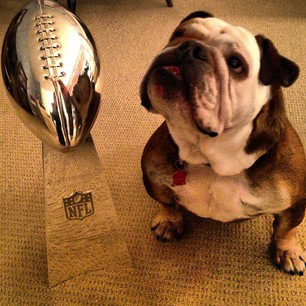
Michael Phelps’ Dogs Pose with Super Bowl Trophy?

Michael Phelps: 18-time Olympic gold medalist. Fan of the Baltimore Ravens. Friend of Baltimore Ravens player, Ray Lewis. Phelps credits Lewis with inspiring him to return to swimming to compete in the 2012 Olympics. He won six more medals, including four gold, and then retired after the Games.

Somehow, Phelps snagged the Vince Lombardi Trophy (or the Tiffany Trophy as it is sometimes known, after Tiffany & Co., the famed jeweler that makes the trophy). He then posed each of his dogs next to the trophy and snapped up some photos. The New Barker dog magazine heard from  a spokesdog for the Puppy Bowl dogs, who are understandably steamed. “We do all the heavy lifting, and those Phelps’ dogs get all the glory,” said the spokes dog.

The Ravens may have won Super Bowl XLVII. But the champs here are Herman and Stella. And we heard they’re heading to Disney World.

Meet Stella, Michael Phelps' dog in front of the Super Bowl Trophy.
Meet Stella, Michael Phelps’ dog in front of the Super Bowl Trophy.
Meet Herman Phelps, who appears unfazed by the Super Bowl Trophy.

Her Name is Lucca, the Military Working Dog.

'Canines With Courage'
Retired U.S. Marine Rober Harr, 86 (center) with U.S. Marine Gunnery Sgt. Christopher Willingham (right) and U.S. Marine Cpl. Juan Rodriguez (left) with Lucca on the Natural Balance 2013 Rose Parade Float, Canines with Courage. (Gary Friedman, Los Angeles Times).

A decade ago, Military Working Dogs like Lucca would have most likely been euthanized after her service. The dogs were considered government equipment and too dangerous to return to domestic life. Thousands of dogs working for the military have been sent overseas since 1942. Over the years, many have been left behind as excess equipment. During the Vietnam War, about 4,000 American war dogs were employed in various capacities. About 300 dogs were killed in action or were victims of either tropical diseases or infections. The rest of the dogs were reportedly put down by military veterinarians or given to the South Vietnamese Army.

In 2000, President Clinton signed a law allowing retired soldiers and civilians to adopt the Military Working Dogs after their deployments.

John Burnam, who served in Vietnam and wrote a first-person account of working with a front-line scout dog named Clipper, will also be riding on the float today. Clipper never made it back to the United States. Burnam is president of the foundation that established the Military Working Dog Teams National Monument, which is scheduled to be completed in October, 2013. Burnam’s story about Clipper inspired Rep. Walter B. Jones (R-NC), who introduced legislation for a national monument. In 2008, President Bush signed the bill into law, and President Obama authorized Burnam’s foundation to build and maintain the San Antonio, Texas monument.

The bronze statue features a Doberman Pinscher, German Shepherd, Labrador Retriever and a Belgian Malinois leading a dog handler on patrol. The $1.2 million dollar price tag was funded solely by grants and donations led by sponsors Natural Balance, Petco and Maddie’s Fund.

Cpl. Juan Rodriguez, 23, credits Lucca with saving his life. The dog sniffed out a booby trap, setting off the bomb that took her leg. Cpl. Rodriguez later escorted Lucca to her first handler, Marine Gunnery Sgt. Christopher Willingham, 33. Lucca is living the life of spoiled retirement, and enjoying every minute of it.

The New Barker dog magazine is honored to be a longtime supporter and sponsor of Military Working Dog Team Support Association (MWDTSA). Over the years, through the support of our retail advertisers and their own generous customers, supplies have been collected for the dogs and their handlers currently deployed overseas. We have collected the donations and transported them to the SPCA Florida in Lakeland. There, they are either shipped to Atlanta, or Dixie Whitman, the executive director of MWDTSA drives to Lakeland from Atlanta to pick up the supplies. Dixie then packages and ships the supplies directly to the deployed handlers and their dogs.

You can learn more about this fine organization by reading Lucca’s story. Supplies continue to be collected at Fluffy Puppies, Clearwater; Gone to the Dogs, St. Pete Beach; Groovy Cats & Dogs, Tampa; One Lucky Dog, St. Petersburg; Paw Paws Pet Boutique, Madeira Beach; Pawsitively Posh Pooch, St. Petersburg; Pet Food Warehouse, St. Petersburg; Pet Supplies Plus, Clearwater & Pinellas Park; and Wet Noses Boutique, Sarasota.

We wanted to share a story that was first reported by the New York Daily News on Monday, December 17. The comfort dogs are able to bring is no surprise to dog lovers. The New Barker joins the nation in sending our thoughts and prayers to those who lost loved ones as a result of this tragedy.

Comfort dogs help ease pain of mourning Newtown Community. By Jennifer H. Cunningham and Adam Edelman for the New York Daily News. Photography is by Allison Joyce for the New York Daily News.

A pack of sympathetic groups bearing supportive canines spent much of Monday with bereaved Connecticut residents affected by last week’s Sandy Hook Elementary School massacre, providing children and adults alike with the cuddly comfort that only a four-legged friend can give.

The therapy dogs were brought in by at least three groups late Sunday to help kids and adults alike cope with last week’s horrific shooting in Newtown that left 20 first graders and six school officials dead.

Among the groups was the Hudson Valley Golden Retrievers Club, whose members spent the afternoon at a makeshift memorial near the town center, where both kids and adults in need of compassion stopped to pet and cuddle the dogs.

Mourning or otherwise devastated children and parents said that petting the dogs gave them relief from their sadness.

“I just love dogs, so whenever I’m around them, they make me feel better,” said 12-year-old Ryan Williams. “When they come over and you pet them you kind of forget about what’s happening for a little bit.”

Jenna Stuart, a school bus driver from Newtown, said the dogs were an enormous help to her four-year-old daughter, Kylie, who attends preschool at the Children’s Adventure Center in front of Sandy Hook Elementary and lost friends in the tragedy.

“I like the dogs because they made me happy,” said Kylie, after petting one on the head. “The dogs love me.”

Some residents, who weren’t directly affected by the bloodshed, found peace in simply bringing their own dogs to help others.

Sandy Hook resident Ann Mari Cioffi, a member of the Hudson Valley Golden Retrievers Club, brought her dog, Libby, 5, to comfort victims, at a memorial in the center of town.

“They’re just gentle, caring, kind and sweet. Cioffi said of the dogs. “They just seem to sense it. They just sense when somebody’s sad.”

Massachusetts- based K-9’s For Kids Pediatric Therapy Dogs was also among the groups sharing their tail-wagging buddies.

Crystal Wright, 52, of Becket, Mass., a dog handler with the group for Rhiku, a 5 year old Sheltie, said the canine had been easing frowns all day.

“Everyone likes to pet a dog,” she said. “It changes the mood. It kind of takes them away from what they’re going through for a moment. I think it’s helping. I think they needed it.”

Some canines even traveled across the country to help out.

Trainers from the Chicago-based Lutheran Church Charities, which has deployed its comfort dogs to other communities hit by tragedy in the past, brought in 10 to 15 Golden Retrievers and their handlers to Connecticut to help with the consolation efforts, Tim Hetzner, the president of the organization, said.

For information on becoming a therapy dog team with your dog, contact the following organizations: Therapy Dogs International: http://www.TDI-Dog.org; Delta Society: http://www.DeltaSociety.org; Therapy Dogs Inc.: http://www.TherapyDogs.com

Florida’s New Tourism Slogan: The Good Dog State.

This month, the Governor’s Office of  Tourism, Trade, and Economic Development might want to consider re-branding the Sunshine State to the Good Dog State. From Jacksonville to West Palm Beach, Tampa Bay to Orlando and everywhere in between, Florida is chockfull of dog friendly events.

What’s more, if you’ve been thinking about bringing another dog into the family, October is Adopt a Shelter Dog Month. Many of the events this weekend and next will have rescue groups and their adoptables on hand.

This is Petey, available for adoption through All Dog Rescue of Florida.

Over the last couple of weeks we have met some pretty amazing people who donate whatever time they have to volunteer for various rescue groups. Of course, we’ve met some pretty incredible dogs too. Like Petey, who was abandoned as a puppy along with his mom, both found wandering the streets. All Dog Rescue of Florida is fostering Petey, and has already put $800 into him for his medical treatment. And still, his adoption fee is only $300. So, in your travels over the weekend, should you happen to attend one of the following events and come upon a rescue group, please drop a dollar or two in the donation jar. Petey (and many more like him) will thank you with puppy love and sweet kisses.

While you’re out and about on Saturday, October 20, you will definitely work up an appetite. And that’s a good thing, because our best event pick of the day is happening at the Clearwater Quaker Steak & Lube.  Don’t miss the Red Hot Rescue Chili Cook Off from 1p until 6p, hosted by the Florida Great Pyrenees Club. There will be some delicious samplings from some pretty competitive cooks, along with live entertainment, rescue groups, raffle items, giveaways, auctions and demonstrations. Not only will you satisfy your appetite, but your heart and soul will be filled up as well. All proceeds will benefit the participating rescue groups.

If you happen to be traveling through Lutz on Saturday, you might think you’re seeing spots. You would be right, since Dalmatian Rescue of Tampa Bay will be hosting their annual fundraiser, Dal-loween at Lake Park just off North Dale Mabry Highway. This is another one of those rescue groups whose volunteers have worked tirelessly over the years, and this is the one event that helps them sustain as a 501c3 all year long. Go, Spots. Go.

About 2000 people and hundreds of their dogs are expected to be at the Shell Factory’s Doggy Heaven this Saturday, October 20 for Goldenfest, hosted by Golden Retriever Rescue of Southwest Florida. If you know Golden Retrievers, you’ll love that one of the offerings throughout the day will be Pet Brushing and Furminating. The Shell Factory (located in Fort Myers) is also home to SunCoast DockDogs, so demonstrations and competitions will be held. Other organizations on hand with adoptables: SW Florida Wiener Dog Club, Healing Paws-Ability Agility, Gulf Coast Humane Society, Grey Muzzle, Labrador Retriever Rescue of Florida, and the Pitbull Crew of Florida.If you happen to stick around through Sunday, check out the Doggie Church, a half hour non-denominational service held at 12:30 pm. By the way, our choice for dog friendly hotel accommodations would be Hotel Indigo, just minutes from the Shell Factory.

Maybe you’re a fan of the low-riding wiener dog. You’re in luck. The annual Dachstoberfest takes place on Sunday, October 21 between 10a and 2p at Centennial Square in West Palm Beach. There will be a Dachshund Parade, Doxie Dash Race, and a Costume Contest Competition conducted by The New Barker rover reporter and award-winning photographer, Tina Valant. Proceeds from this event benefit Dachshund Rescue of South Florida. Tina will also be handing out complimentary copies of The New Barker while supplies last. Travel tip: You’ll receive a delicious brunch during your stay at Hibiscus House B&B in West Palm Beach. Your dogs get to wander around the lushly landscaped, fenced-in yard, while you dine poolside.

We’re betting that the biggest gathering of dogs and people in Florida will take place this Sunday, October 21, at the 12th Annual Stride for Strays 3k Walk and Fundraiser for Animal Coalition of Tampa. Curtis Hixon Park on the Riverfront is one of the coolest venues in Florida. Stride for Strays has proven time and again, to be one of the most entertaining, fun-filled afternoons for the entire family. The Doggie Fun Zone will be set up for Agility demonstrations, and there will be plenty of food available (including vegan-friendly menus). Be sure to check out Groovy Cats & Dogs and Lucky Dog Daycare for specials and treats.

Also this Sunday, The Jacksonville Landing is hosting their 4th Annual Howl-O-Ween Bash and Yappy Hour between 2p and 5p. This has become known as the Largest Dog Costume Contest in Jacksonville. Complimentary copies of The New Barker will be available. Travel tip: Hotel Indigo does have a Jacksonville location as well.

Pitbull advocate and singer/songwriter John Shipe will be coming to Florida next weekend, courtesy of Pitbull Happenings. He will be at the 4th Annual Dogtoberfest at The Shops of Wiregrass, a daylong adoptathon on Saturday, October 27 with multiple rescue groups from all over Florida on hand. The event is hosted by Animal Based Charities.

For more howling good times, be sure to check out The New Barker calendar. Spooktacular picks, including the 6th Annual Barkoween, hosted by Fluffy Puppies, and A Pawsitively Posh Halloween Party, hosted by Pawsitively Posh Pooch are always good bets for a whole lotta fun. One Lucky Dog in St. Petersburg and Wet Noses Boutique in Sarasota are each hosting their own dog-friendly Halloween Parties, as are Pet Food Warehouse, Gone to the Dogs Boutique, What A Dog Play Center and The Doggie Door.

Whatever you do, wherever you go, be safe. Florida dogs are counting on you to look out for them (and to not leave them behind). For now, we’ll leave you with a funny (yet, sadly true) PSA from The Shelter Pet Project.

Pardon Me, Madam…Is That Your Dogue?

Whilst the rest of us hound dogs gear up for the DVD release of Beverly Hills Chihuahua 3, and the advance screening of Tim Burton’s Frankenweenie, Haute Dogs in New York will enjoy a night at the opera. The world premiere of Dog Days opens at the Alexander Kasser Theater on September 29th.

The ad for Dog Days, the opera as it appeared in The New York Times, Sunday edition.

Based on the short story of the same name by Judy Budnitz, the production by Peak Performances is being billed in the New York Times as Opera Unleashed. Featuring world class vocal talent, Dog Days is a dark comedy brought to life through David T. Little’s inventive compositions of classical and contemporary music elements.

The setting of the story is an apocalyptic near-future that focuses on a suburban family as they cope with the domestic complications of the United States involvement in the next world war. As hunger begins to take over, in the midst of the war-induced chaos, the family makes the acquaintance of an unusual furry friend: a man dressed as a dog, whining and begging for food.

Here is an excerpt from chapter one of the book, Dog Days: The man in the dog suit whines outside the door. “Again?” sighs my mother. “Where’s my gun?” says my dad. “We’ll take care of it this time,” my older brothers say. They all go outside. We hear the shouts and the scuffle, and whimpers as he crawls away up the street.

My brothers come back in. “That takes care of that,” they say, rubbing their hands together. “Damn nutcase,” my dad growls. But the next day he is back. His dog suit is shabby. The zipper’s gone; the front is held together with safety pins. He looks like a mutt. His tongue is flat and pink like a slice of bologna. He pants at me. “Mom,” I call, “he’s back.” My mother sighs, then comes to the door and looks at him. He cocks his head at her. “Oh, look at him, he looks hungry,” my mother says. “He looks sad.” I say, “He smells.” My mother says, “No collar. He must be a stray.”

“Mother,” I say, “He’s a man in a dog suit.” He sits up and begs. My mother doesn’t look at me. She reaches out and strokes the man’s head. He blinks at her longingly. “Go get a plate,” she tells me. “See what you can dig out of the garbage.”

It should make for some pretty interesting opera, and leaves one wondering who will make the full length feature film? (Ellie Lee produced a short film in 2000).  Maybe the actor Jason Gann will play the man in the dog suit (a la his role in FX’s Wilfred). Anyway, we’d love to hear from anyone who will be going to the opera, Dog Days which runs through October 7.

Simply Irresistible.

This will get your week off to an inspirational start. If it wasn’t for Vickie Dryer, a veterinary technician in St. Cloud, a Chihuahua mix puppy born without functioning front legs would have been euthanized. The vet tech at Osceola County Animal Control stopped the request to put down the then-2-week-old puppy and decided to help rehab him.

While this little guy will never walk, stand or run like other pups, he doesn’t let his let his lack of front limbs stop him from enjoying life.

“His personality is wonderfully sweet, very outgoing. He’s brave, just playful. He’s a normal puppy,” Dryer told the station.

Staff at the Osceola County Animal Control was so inspired by the Chihuahua that they named him after Olympian Oscar Pistorius, the South African double-amputee track star who competed in the London Olympics.

Best of all, Oscar now has a forever home. A staff member who can take care of all of Oscar’s special needs fell in love with the pup and adopted him. Who could resist this little angel? Watch the video from  Fox 35 out of Orlando.

Source: Vetstreet and Fox 35/Orlando.

Is That Any Way to Support Our Troops?

A preliminary report by the Department of Veterans Affairs states that benefits for service dogs will be provided to the vision, hearing and mobility impaired. But benefits will not be provided for those with Post Traumatic Stress Disease (note…it is a disease, not a disorder). This ruling will become final in 30 days.

In the spring issue of The New Barker dog magazine, we featured a story by Heidi Joy Howard on K9s for Warriors out of Ponte Vedra Beach. Today, we asked Shari Duval, president of K9s for Warriors for her thoughts on the Department of Veterans Affairs report. “The new ruling is extremely disappointing and a setback for our Veterans suffering from PTSD.  Since 9/11 there are more than 500,000 disabled veterans. One in five suffers from PTSD. One in six will attempt or commit suicide. Service Dogs are medical equipment for PTSD, and should be regarded as such, the same as a wheelchair, or walker. Service canines are proven recovery aids for PTSD, often reducing the need for massive medications.  Until the VA recognizes the enormity and severity of PTSD we are moving backwards, certainly not towards recovery for our veterans.  The VA will pay for equine therapy, but not service dogs?  This ruling will not effect K9s For Warriors efforts as we are a non-profit organization and our resource is free to our warriors.  We are also in compliance with the ADI (Assistance Dogs International) .”

Also, this week in Jacksonville, veterans who were enrolled in the K9s for Warriors program were asked to leave a business in Jacksonville Beach while out on a training session. The owner of Surf and Skate Shop asked the veterans and their dogs to leave his business, claiming disruption of the business. Again, we asked Shari for her thoughts.

“The situation at the Surf and Skate Shop involving three of our warriors, and our Trainer was a very upsetting and disappointing day.  My warriors felt humiliated and demeaned when asked to leave.  A huge problem with those who suffer from PTSD is isolation.  Service canines offer the warrior the freedom to return to civilian life with dignity and independence.  Service canines give the warriors the security and confidence to step out of their comfort zone, isolation.  When the Shop owner told them to leave, the warriors felt humiliated , singled out; all the symptoms they struggle with.  Afterwards, we talked long and hard about what happened, and we went back as a group, together to accept the owner’s apology.  We are about second chances at K9s; our shelter dogs, our broken warriors, even those who have wronged us.  Giving the owner a chance to say “I’m sorry”, gave our Warriors respect.  They deserve that.”

Who in their right mind, has the guts or the heart to mess with these guys? Photograph by Heidi Joy Howard for The New Barker dog magazine.

Please visit K9s for Warriors and Canine Companions for Independence Wounded Veteran Initiative (a national organization with an Orlando center). We have witnessed firsthand the good these two exemplary organizations are doing for our veterans. Again, these organizations are privately funded. They rely on donations in order to provide their services and the dogs at no charge to the veterans. Now that’s the way to support our troops.

Keep this conversation alive by sharing this blog with others. Visit the social media sites of each of these two organizations. Many of the graduates stay in touch via these networks. Send them words of encouragement.


In Support of the Local Independent Retailer.

The Downtown Sarasota Farmer’s Market was packed with shoppers and their dogs this past Saturday morning. Locally grown colorful produce, plants and plenty of food options. As usual, the big red double decker bus that is Java Dawg Coffee was packed with folks wanting a good cup of Joe Dawg. Foot traffic on Main Street was up, as people and their dogs shopped the boutiques, and dined at the cafes, including our favorite,  Cafe Americano.

On-Of-A-Kind Beach Chair.

This Labor Day has us thinking about, and appreciating those hardworking independent business owners across Florida. The one constant that we are witnessing now more than ever is how these businesses are supporting their communities by bringing in items that are created and produced by local artisans.

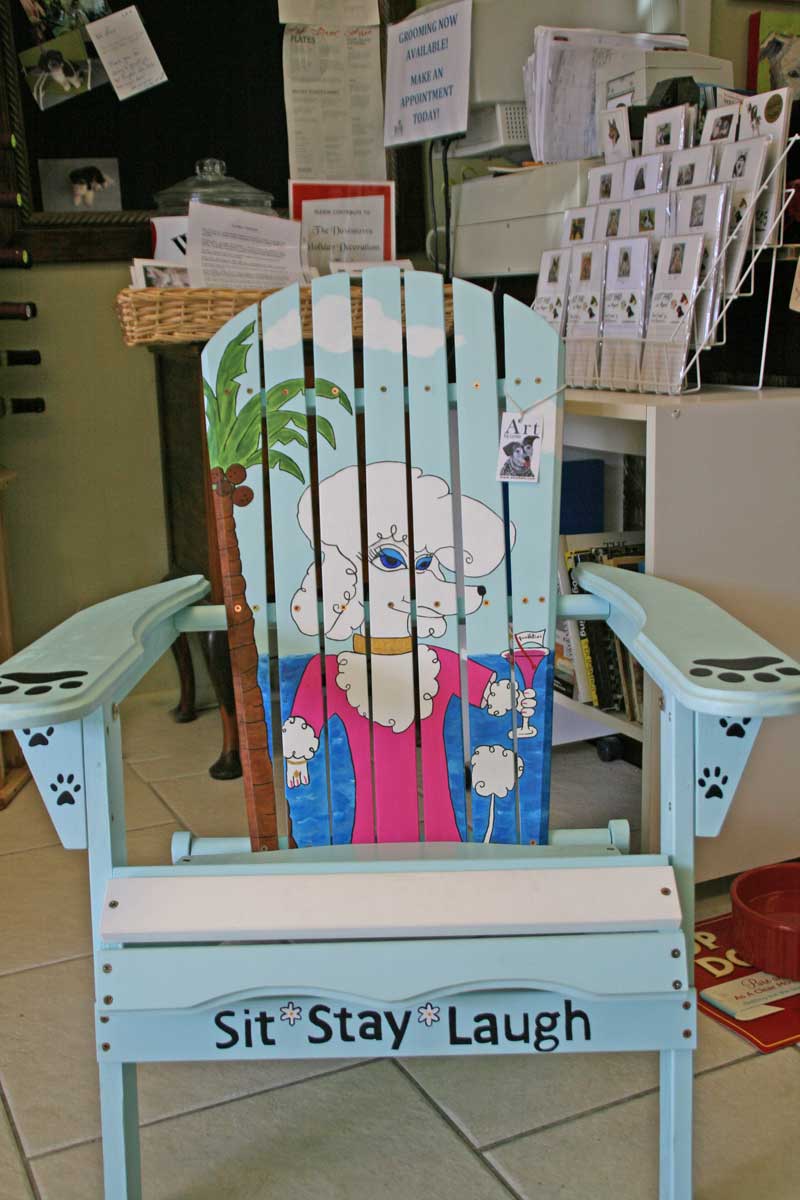
At Wet Noses Dog Boutique on Main Street, we discovered one-of-a-kind, beautifully-painted adirondack chairs. For an unbelievably reasonable price (which includes the chair), your dog’s portrait is painted with the theme of your choice.

At Bella by the Sea on Anna Maria Island’s Pine Avenue, fresh cut flowers in containers (for the picking) greet shoppers outside. Guys and dogs can take a load off, grab a refreshing cold beverage, and enjoy the scenery on the breezy front porch, while the ladies take in the delights of what’s inside. (Gentlemen, this is not a bad way to spend an afternoon). Take a stroll down to Emerson’s, and check out the world-renowned artist’s brand of quirky humor on tee-shirts, martini glasses and notecards. Emerson could have chosen any place in the world to settle down and set up shop. He chose Anna Maria Island with good reason. Quaint and vibrant Pine Avenue has been named the Greenest Little Main Street in America by the Walkable and Livable Communities Institute.

Available at Gone to the Dogs, St. Pete Beach.

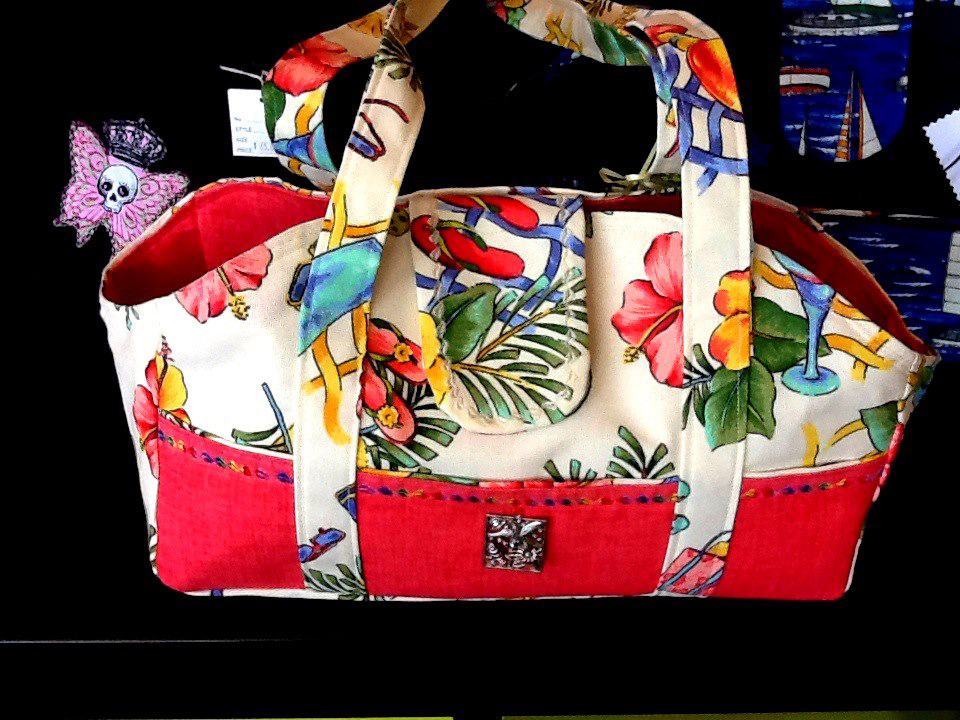
On St. Pete Beach’s historic Corey Avenue, Gone to the Dogs has an artistic array of locally created and produced items, including colorful bags by Clara. New designs are always coming in. The proprietors of Groovy Cats & Dogs in Tampa have worked hard to stock their store with items that are not only locally produced but sustainable too, like dog-themed artwork and decorative accessories for the home.

In Dog We Trust is a cool new line of locally-designed bandanas and tee-shirts. Right now, they are exclusively available at Fluffy Puppies in Clearwater, a big supporter of local artists. The Doggie Door on Park Avenue in Winter Park is another big supporter of local artists, and carries the PawPalettes line of notecards, a Florida company. Pawsitively Posh Pooch has become a destination for dog lovers looking for couture doggie clothes. One line (created by a Florida-based artist) has become internationally-known for its unique designs and use of vintage material and accessories. Think: Coco Chanel. “Dress shabbily and they’ll remember the dress. Dress impeccably and they’ll remember the dog.”  (With apologies to Ms. Chanel and Bella by the Sea).

Another constant that each of these retailers has in common is their support of local shelters and rescue groups. Like the beautiful Cat Room at Pet Food Warehouse, built out specifically to showcase adoptables from Pet Pal Animal Shelter. Or the fundraising events held regularly at Dog-Mania & Cats in Dade City and The Green K9 in Mount Dora. Time and again, these independent business owners have graciously donated their product, services and money to benefit local animal advocacy programs.

Stats to Ponder: Did you know that for every $100 spent in locally owned independent stores, $68 returns to the community? That same dollar amount spent in a national big box chain store returns only $43 to the community. Spend that same amount ($100) online, and nothing is returned to the community.

The New Barker dog magazine would like to tip our hats to the dedicated Local Independent Business Owner. From the retailer to the restaurateur; the groomer to the trainer; the hotelier to the owners of dog day care centers; the veterinarians, artists and photographers: thank you for your own dedication and support of the local economy.

Shopping local benefits each of our communities in more ways than one.

When the Unthinkable Happens, These Dogs and Handlers Spring Into Action.

Two National Disaster Search Dog Foundation Teams out of Florida have been placed on standby as a result of Hurricane Isaac. Julie Padelford-Jansen and her dog Lilly-Belle, based out of Miami, and Marshia Hall and her dogs Lilah and Trapper, out of Tampa.

National Disaster Search Dog Foundation Team, Marshia and Trapper.

Marshia and Trapper were featured in the summer, 2011 issue of The New Barker. The article appears below. More photos, taken by Anna Cooke, may be found on The New Barker facebook page.

*****

The deadly 9.0 magnitude earthquake that hit Japan in early 2011 grabbed our attention and wouldn’t let go. The devastation and loss, unfathomable to us in a land that was on the other side of the world. And then the devastation hit closer to home in Joplin, Missouri with the deadly tornado just weeks later. Through it all, The New Barker was receiving daily updates from the National Disaster Search Dog Foundation, based in Ojai, California with 76 SDF Search teams stationed across the United States. On call 24/7, search teams were deployed during both disasters. The updates were posted on The New Barker Facebook page, generating the most response to date from anything ever posted there. We recently had the good fortune to meet up with one SDF team out of Tampa.

Marshia Hall and Trapper. The dogs who are certified by the National Disaster Search Dog Foundation and their humans are incredibly dedicated to their work. But even more incredible is the fact that many of these dogs were once cast-offs – dogs no one else wanted, many found in shelters across the country. SDF’s Lead Trainer, Pluis Davern said this of the teams deployed to Joplin in May, “Watching these once cast-off dogs that with training have become life-saving tools fills me with unmitigated pride and a deep (sense) of humility for this species that can and does do so much for humankind.”

In Trapper’s case, he flunked out of training to become a guide dog through Guide Dogs of America in Sylmar, California. He is an excitable boy, which proved detrimental to completing his full training as a guide dog. He needed some kind of work more fitting to his personality, and SDF looks for dogs with the non- stop drive and personality that Trapper had. Guide dog training requires dogs not to bark, to walk around obstacles and not to climb on anything – the very skills needed to become an SDF dog. Marshia, who is an Engineer Paramedic with the Temple Terrace Fire Department, was paired with Trapper in July 2004. During their first week of training together Marshia witnessed firsthand the dog’s high energy and drive, and that uncanny Labrador Retriever personality. Every night, after returning to their motel room from training, Trapper, a 70 pound dog, would head for the bathtub and stared at Marshia. “I got the feeling he was just waiting for me to turn on the water so he could jump in to play,” said Marshia. Trapper’s puppy raisers had a swimming pool, so he grew up as a pool puppy. One of their first visits to a Florida beach demonstrated Trapper’s other drive: toys. As soon as they arrived at the beach, Trapper spotted a buoy about 75 yards out in the water. Thinking it was a toy, he intently swam for it. “I had to bring him back three times. The final time he actually got to the buoy and had brought it back a good distance towards shore. I had to wrestle it from his jaws. He was having a blast. I was exhausted,” said Marshia, laughing as she recalled the incident.

Trapper’s first deployment was Hurricane Katrina in 2005. Deployed to Mississippi as part of the Central Florida Task Fource 4, Trapper’s job was to search residential subdivisions in Pascagoula, Gautier and Biloxi. Marshia described what the areas looked like when they arrived on the scene. “It looked as if a huge explosion had gone off. A cross between a landfill and a lumber mill. Just a river of debris. You couldn’t tell where one house began and another ended. Toys, including pet toys, were scattered everywhere. And even though Trapper is toy-driven, he never lost his focus or became distracted. His job was to find people, alive but trapped in the debris.” They worked 12 hour shifts going into homes and cars that were partially collapsed. Trapper either walked on top of the debris or went directly inside, trying to pick up a scent of life. Search Dog Foundation training teaches the dogs the ability and agility to maneuver over extremely difficult terrain, including unstable, slippery surfaces. The dogs are able to penetrate debris and small spaces more quickly than any human can. The dogs are also trained not to touch any water or food they find at a search site in case of contamination. Because the dogs are so focused while they’re working, their handlers keep a close eye out for injury, overheating or thirst.

December 6, 2007 Search and Rescue teams in Florida were called out to assist the Jacksonville Fire Department with a structural collapse. Parts of a six-story parking garage had gone down while under construction. Marshia and Trapper had just returned to Orlando from a Miami search team training session. With their gear still in the car, she, Trapper and her other search dog at the time, Shade headed to Jacksonville to join five other K9 teams. “We assessed the situation and determined what each dog was best suited for: who tunneled best, who wouldn’t jump off the cantilevered floors, whose weight wouldn’t cause a secondary collapse in weakened areas. We divided up into teams, assigned areas to search, and went to work. Before searching, we verified that veterinary treatment was available, should any of the dogs be injured,” explained Marshia. There was rebar every four inches, either broken and protruding, or stretched to its limit, waiting to snap. Walls of cement were dangling over the areas that needed to be searched. Loose four-by-four boards and sheets of plywood were balancing precariously over deep voids. “It was extremely noisy, due to the cranes removing debris and generators operating tools and lights. At one point, they needed to call for “all quiet” when the K-9’s were on the pile in order for us to hear them alert. Everyone stopped and watched hoping to hear one of them bark—an alert that would mean the dogs had found someone alive,” said Marshia. At one point, Marshia said that Trapper, choosing his own route as always, stepped off a ladder onto a piece of plywood. As it slid all the way back down to the bottom of the pile, he rode it like it was the teeter totter he trains on. “He just waited until it stopped, looked up and got back on the ladder and climbed up again,” said Marshia.

Trapper is a search and rescue dog, trained to find people who are alive. For example, if 20 people are missing in the rubble of a disaster site, and three are alive, Trapper will only alert by barking in those three places. If the dogs don’t alert, then cadaver dogs are brought in to search and recover the dead. The searches at the Jacksonville site were held around the clock for two days, with the fire department doing selective breaching and debris removal. Although the dogs showed interest in some areas, they did not alert. This can be discouraging and depressing at times for the dogs. So, in the dark of night, volunteers hid, allowing the dogs to be rewarded for their good work after finding them. “This gave them the incentive to go out and search the following day,” Marshia continued.

Soon, two dogs that search for cadavers were brought up to the area and immediately alerted. Rescue workers carried out the body nearly 60 hours after the building collapsed. Despite the outcome, the teams are always at the ready for the next call.

How Was the Foundation Formed? April 19, 1995 At 9:03 a.m., just after parents dropped their children off at day-care at the Murrah Federal Building in downtown Oklahoma City, the unthinkable happened. A massive bomb inside a rental truck exploded, blowing half of the nine-story building into oblivion. A stunned nation watched as the bodies of men, women, and children were pulled from the rubble for nearly two weeks. When the smoke cleared and the exhausted rescue workers packed up and left, 168 people were dead. Eleven FEMA Task Forces were deployed to the disaster—the largest number used at a single disaster in U.S. history. Among the canine search teams was Wilma Melville, a retired teacher, and Murphy, her Black Lab. Murphy and the other search dogs were able to cover large areas of rubble, saving precious time for firefighters by indicating where victims were buried. In 1995, there were only 15 FEMA Advanced Certified disaster search dog-handler teams in the entire United States. Recognizing the critical need for more advanced teams, Wilma founded the National Disaster Search Dog Foundation as a way to train teams in a better, more cost-efficient manner.

How You Can Help People across America are becoming “Part of the Search” by helping a dog, once abused and/or abandoned, enter the ranks of the most highly trained search dogs in the nation. Individuals, families, schools and companies are sponsoring an SDF Search Dog. Sponsors get to know the dog and handler; follow their training and progress toward FEMA Certification, and disaster deployments. For more information, contact Celeste at 888.459.4376, extension 101. http://www.SearchDogFoundation.org.