Briefly, about The New Barker...
In our 15th year of publishing original stories with award-winning photography.
Reaching 30,000+ dog lovers in print each quarter.
Each cover features an original work of art by a different Florida artist.
Over the last 11 years, we have donated over $210,000 in cash, product, media space and money to animal welfare organizations across Florida.
30 days after the magazine is distributed and mailed, the digital version is uploaded.
The New Barker: Where to stay, play, dine, and just have fun in Florida with your dogs.
As Laura drives down the road that leads up to the Aquatic Center, Lucy is already jumping around in the car.
Florida municipalities, hip on the dog revolution, open up their public pools for dog swims at the end of their swim seasons. Public pools in Fort Lauderdale, Largo, St. Petersburg and Tampa have been doing it for several years now, much to the delight of their canine citizens. On Saturday, November 5, the City of Tampa hosts Drool In The Pool Doggie Paddle at Copeland Park Pool in North Tampa (11001 North 15th Street). There is a $5 per dog charge. Humans enter free (but no humans are allowed in the pool). Next Saturday at Largo’s Highland Family Aquatic Center, the annual Soggy Doggy Splash Party will be from 11a-1p (400 Highland Avenue). There is a bonus day on Sunday from Noon-3p. Again, this is strictly a dog swim. No humans are allowed in the pools.
Lucy, a Labrador Retriever who lives with her human Laura Allen, loves the Soggy Doggy Splash Party. The following is an excerpt from a feature that appeared in the Fall 2012 edition of The New Barker dog magazine.
As Laura drives down the road that leads up to the Aquatic Center, before even seeing the other dogs or the pool, Lucy is already jumping around in the car. When the gates to the pool open, this dog is ready for some serious play time. She takes off with the other dogs, barely looking back at Laura. Occasionally, Lucy will look up and around for Laura, just to make sure. She gives Laura a reassuring smile before going back to playing.
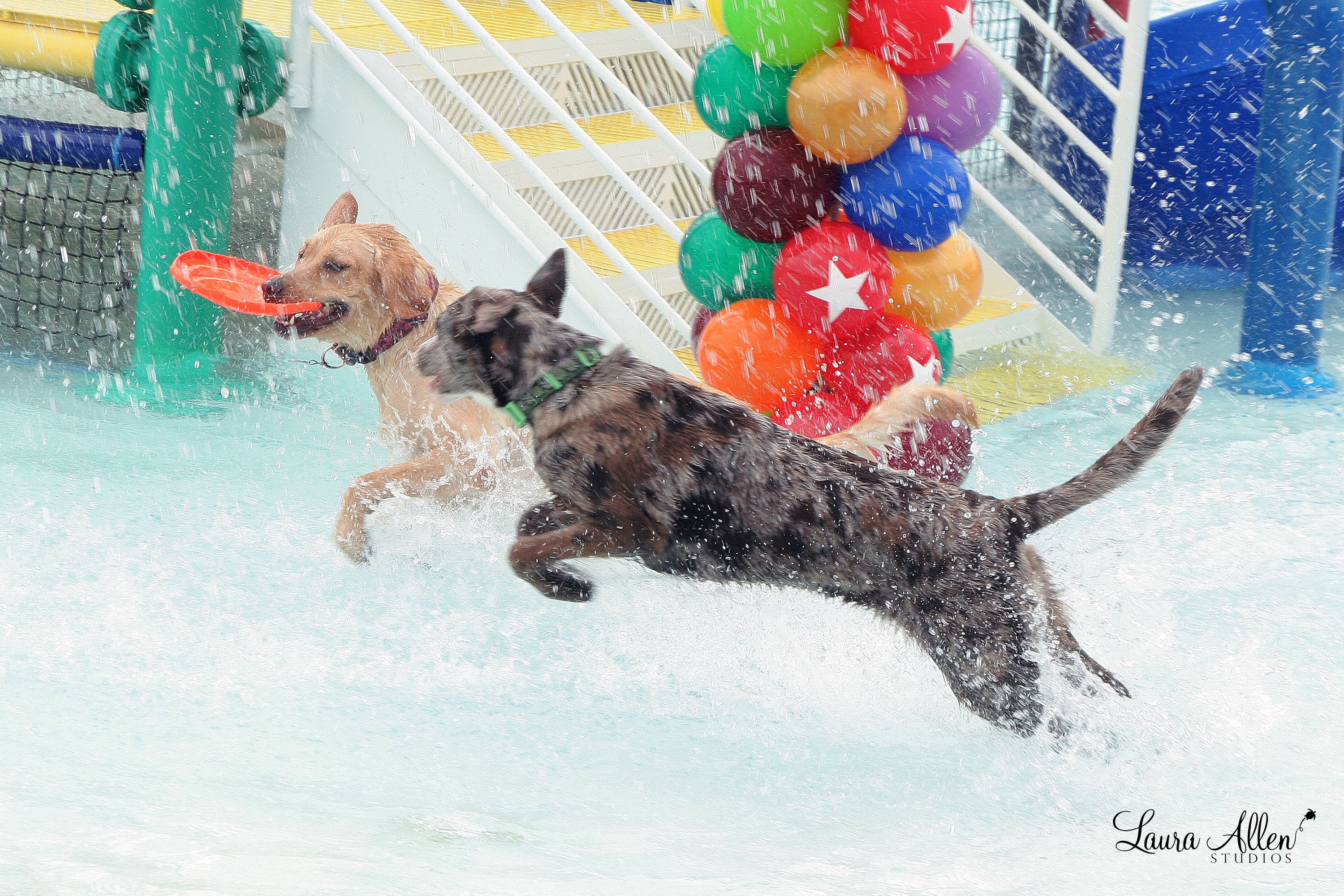
Lucy and Oliver.Oliver and his human drive from South Tampa each year to attend Largo’s Soggy Doggy Splash Party. Photograph by Laura Allen Studios for The New Barker dog magazine.
Lucy is the life of any party and has never met another dog she didn’t like. One moment she is relentlessly flirting with her best friend, Catahoula mix Oliver, adopted from the Humane Society of Tampa Bay. The next moment, she’s taking her toy to another human she doesn’t even know, coaxing him to throw it. No one can resist Lucy’s charm or her invitation to play ball. No one. She will continue to pick up and drop the toy in front of a stranger, until he finally picks it up to throw it into the pool. Mission accomplished, and off she runs.
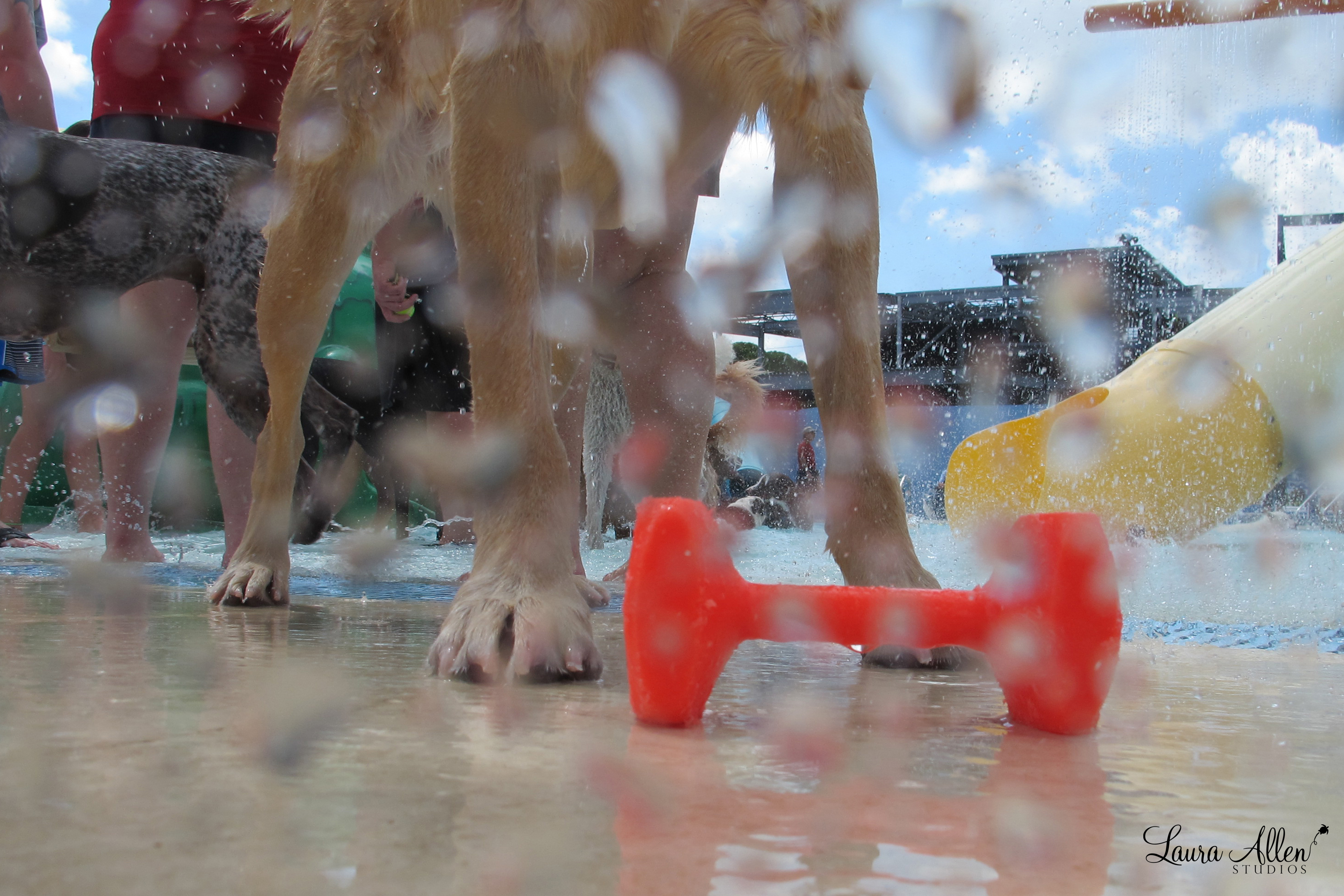
Throw My Toy. Now.“I don’t know you. But, throw my toy and we will be BFF,” coaxed Lucy to a stranger. Photograph by Laura Allen Studios.
Toy-driven and focused, Lucy will dive down three to five feet in the water to retrieve a toy. She loves swimming with Laura in the Gulf or in a swimming pool, so she has definitely honed her aquatic skills. That came in handy during the 25-yard swim, another event held during the Soggy Doggy Day Splash Party. On this particular day, there was a massive start at the relay, as the dogs all jumped in the water at the same time. Every dog was swimming in all directions. Every dog, that is, except Lucy. With an almost inaudible whistle from Laura, Lucy quickly spotted her mark at the other end of the pool, and was soon cutting through the water like an arrow. Of course it didn’t hurt that Laura held one of Lucy’s toys in her hand. Advantage: Team Lucy, winner of the 2013 Soggy Doggy Splash Party 25-yard swim.
Should I Stay Or Should I Go?Lucy checks out how far down her toy is before diving in after it. Photograph by Laura Allen Studios for The New Barker dog magazine.
Lucy embodies the complete and utter joy of a dog, and Laura brings the best of that out in her. They go almost everywhere together when Laura is not working on location or on assignment as a professional photographer. Laura, who completely appreciates our domestication of dogs as a society, also believes dogs should be allowed to be dogs. Like children, dogs sometimes like to get dirty, and roll around in the grass, or mud. Laura believes in taking it all in stride.
“If I know we’re going to a place where Lucy will get dirty, I just make it a bath day. I try to live in the moment, just like Lucy does, and to not stress about the little things,” said Laura.
Lucy. The Belle of the Ball.Photograph by Laura Allen Studios for The New Barker Dog Magazine.
Each story in The New Barker dog magazine offers up some kind of hope. While the story may start out sad, there is always an ending that will make the reader feel good.
In its 10th year of publishing, The New Barker features the Florida lifestyle. The quarterly magazine is all about dogs and the people who love them. Each day we sort through press releases, phone messages and emails from people who have a story to tell about a dog. We review the news-feeds of the good, the bad and the ugly to determine which ones we want to pursue to develop a story. Most of the time, we are heartened by the stories. Other times, we cannot believe how cruel humans can be towards the creature known for its devotion. Man’s best friend.
There is so much negativity in the news already, and many of you dog lovers are most likely already aware of the atrocities occurring. We usually make the decision not to write about the bad or the ugly, unless there is a good side to it.
The following story, however, does not have a good side to it. And yet, we cannot look away. It makes us angry.
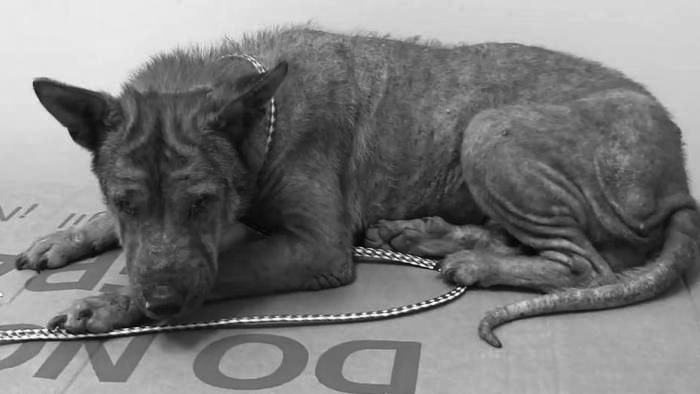
This is Lady, one of two dogs confiscated by Miami-Dade Animal Services in a cruelty case.
In a court appearance last week, Ronald Wilson, the former police chief of Opa-locka, pleaded not guilty to two felony counts of animal cruelty with intent to injure or kill. “He’s a really nice guy, very honorable,” said his defense lawyer, Sky Smith. “He has tremendous guilt over what he’s charged with.”
Really nice guy? In the yard of his Miami Gardens home, authorities discovered two German Shepherd mixes named Lady and Thug. They were severely emaciated. Their skin was cracked and bleeding. Most of their teeth were missing, their eyes oozing. Tremendous guilt? The dogs were removed while Wilson was out of town on a cruise.
X-rays revealed that Thug has two bullets lodged inside him.
Wilson has voluntarily turned over the dogs to Miami-Dade Animal Services.
Lady had to have several surgeries to remove 28 growths from her body. She needs eye surgery. Putting on a little weight and regaining some of her fur, she is faring better than Thug. X-rays revealed he has two bullets lodged in his body and suffered broken bones that have not properly healed. He is barely able to walk. Both dogs are currently being cared for by volunteers at Dezzy’s Second Chance Animal Rescue, a five-acre animal sanctuary in Palm Beach County.
“Mr. Wilson had no explanation why the two dogs were in horrible physical condition,” county animal services investigator Lisa Yambrich wrote in her report.
A story we hear again and again from rescue organizations. The cost for one dog, from rescue to adoption, can range from $400 to $1000.
Remember the recent news item reported previously on The New Barker Facebook page about Great Danes at a Walton County breeding facility? The owner abandoned the facility due to health problems. A family member called Alaqua Animal Refuge in Freeport for help. The Refuge is currently caring for 73 dogs rescued from the breeding facility. Volunteers with Northwest Florida Great Dane Rescue are caring for another 27 dogs. The dogs range in age from about eight months to eight years.
Michelle Cramer, president of Northwest Florida Great Dane Rescue said, “We’re stretched thin here and the cost is significant for us. Every donated dollar helps.”
Clancy is available for adoption through Northwest Florida Great Dane Rescue.
Over the next few days, the adoptable dogs will be added to the organization’s website. In the meantime, the group is in need of food (preferably Victor Maintenance and Victor Performance brands), new or gently used bedding and towels. And, of course, money for medical bills. About a dozen of the dogs have serious medical problems. They will all be spayed or neutered and microchipped.
Do you love Great Danes? For information on adopting or becoming a foster parent, you can message the group on Facebook or email NWFLGDR@gmail.com. Please be patient in waiting for a response. Their primary focus right now is caring for the dogs.
Breed information: A gentle giant, the Great Dane is also called the Apollos of Dogs. Apollo is the Greek god of the sun – the brightest fixture in the sky. While the Great Dane may look imposing, in reality, this dog is one of the best-natured dogs around: Sweet, affectionate; loves to play and is gentle with children. The Great Dane’s height and weight place him among the largest breeds. Only the Irish Wolfhound is taller. A few Mastiffs may outweigh the Great Dane, but not by much. Great Danes are flatulent, according to Vetstreet.com. But, you’ll always have someone to blame on your own emissions.
Society is disrespectful toward not only the animals, but shelter workers as well. Most often, animal caregivers leave shelter work, beaten down and disillusioned. The ones who stay, grow the proverbial “thick skin” in order to deal with the negativity they face, day in and day out.
Anna Cooke, Editor, The New Barker Dog magazine.
Compassion fatigue is also known as “secondary-traumatic stress disorder (STSD).” The symptoms of STSD are similar to those of PTSD. As with PTSD, compassion fatigue can lead to depression and thoughts of suicide. “Animal care professionals are some of the most pain-saturated people I have ever worked with,” said Psychotherapist J. Eric Gentry. “The very thing that makes them great at their work, their empathy and dedication and love for animals, makes them vulnerable.”
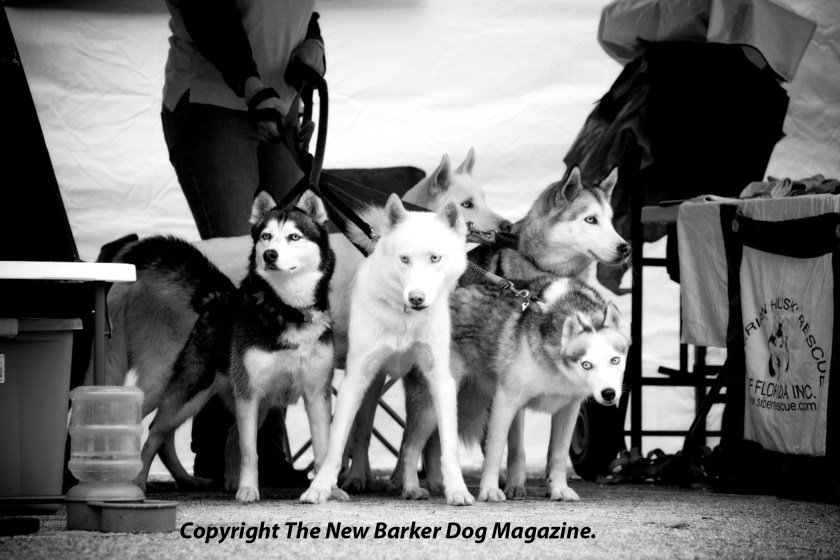
Siberian Husky Rescue of Florida. 2010 Get Rescued In Gulfport. The New Barker.
Most animal caregivers go into the work, either professionally or as a volunteer, carrying a true love for animals in their hearts. They certainly don’t choose the work because of the extraordinary benefits or high salaries. Patricia Smith, founder of the Compassion Fatigue Awareness Project believes that those who work in animal welfare face different challenges than those in other areas of care (i.e. – nurses, social workers, EMTs).
“I found in my work as training and development manager at a shelter that people enter this field very idealistic, really hoping to make a difference in the way animals are cared for and treated,” said Smith. “Unfortunately, it doesn’t take long for that bubble to burst.”
In other helping professions such as health care, teaching or firefighting, the workers are respected and even idealized. This is not the case with shelter workers. Most people believe shelter workers are part of the problem especially at shelters where the dogs and cats are euthanized.
“Society is disrespectful toward not only the animals, but shelter workers as well,” said Smith. “Most often, animal caregivers leave shelter work, beaten down and disillusioned. The ones who stay grow the proverbial “thick skin” in order to deal with the negativity they face, day in and day out.”
When the majority of workers/volunteers in an organization suffer the symptoms of compassion fatigue, the organization itself takes on the symptoms of organizational compassion fatigue. The result is high Worker’s Comp claims, absenteeism, inability of staff and management to collaborate, inability of staff to follow rules and regulations and lack of flexibility and adaptability among workers. Rescue groups experience a high turnover rate with volunteers.
Eventually, this all affects the bottom line and lack of funds creates another layer of challenges: paying decent wages and benefits, lack of quality care the animals receive, inability to retain talented workers. The list is endless.
“Turning around a shelter environment that is plagued with compassion-fatigued workers is the job of management,” said Smith.
As a caregiver, whether as a professional or as a volunteer, self-care is the only answer to healthy caregiving, especially in animal welfare. It takes hard work to become “self directed” Smith explained. “Self direction means that we have personal boundaries, we are able to say “no” without feeling guilty. We know our limitations and we honor them. We practice self-care daily. We need to heal our deep hurts and not allow ourselves to be re-traumitzied by the work we choose to do,” she added.
Compassion Fatigue is not the same as burnout, but they can co-exist. Burnout can happen to anyone in any profession. It’s a cumulative process marked by emotional exhaustion and withdrawal associated with increased workload and institutional stress. It is not trauma-related. Compassion Fatigue is specific to those who are working with a traumatized or suffering population.
“Stress is too much: too much work, too much pressure, too many deadlines. Burnout is not enough: not enough time, not enough resources, not enough energy. When you add compassion fatigue to that mixture, you have a crippled individual in body, mind and spirit.” –Patricia Smith, founder of the Compassion Fatigue Awareness Project.
“I truly believe the number one thing we can do to reduce stress and avoid burnout is to be self aware. What causes our stress? What are the triggers? How do we manage our stress? Self awareness begins with education. Not only learning about stress, burnout and compassion fatigue, but learning about ourselves,” said Smith. “Create a Personal Mission statement (what is my promise to myself?) and follow up with a Self-Care plan (start with one goal and make yourself accountable). We can begin the path to healing that will make it possible to continue to make a difference in the lives of animals.”
This Thursday, October 27, the Tampa location of The Pet Loss Center is hosting a Compassion Fatigue Seminar. It is free and open to all who are in animal care: veterinarians, vet techs, shelter employees and volunteers, rescue organization volunteers. The doors will open a 6p with refreshments served. The seminar is from 6:30p – 7:30p followed by networking. Pets are welcome.The Pet Loss Center will donate $5 for every attendee that comes to the Open House+Seminar on behalf of a local shelter or rescue organization. The rescue whose organization has the most attendees represented during the Open House will receive a $500 donation from The Pet Loss Center.
The Pet Loss Center, Tampa: 6091 Johns Road, Suite 5 33634. 813.999.4040.
by Heather Schulman for The New Barker Dog Magazine. This feature story on Tampa’s Big Cat Rescue was first published in The New Barker Dog Magazine, Winter 2015. We are posting the story in The New Barker blog in light of recent reports to the USDA of abuse at another Florida facility, Wild Things in Dade City.
Ginger, the Serval. Photograph, courtesy of Big Cat Rescue.
About a year ago, friends suggested that a visit to Dade City Wild Things might be enlightening. My fiancé and I had never heard of it, but based on their feedback, we decided to go. Let’s just say that viewing large, beautiful animals in incredibly small cages, and watching people pay to handle and be photographed with tiger cubs, was not my idea of fun. After that visit, I wanted to know more about the rules and regulations governing ownership of big cats, prompting a visit to Big Cat Rescue in Tampa, Florida. It was here that I learned of the issues facing these beautiful cats. A special thank you to Carole Baskin, CEO and Howard Baskin, Advisory Board Chairman at Big Cat Rescue. –Heather Schulman.
Big Cat Rescue, situated on 67 acres in the Citrus Park area, is one of the world’s largest accredited sanctuaries for exotic cats. It is the home to about 80 lions, tigers, lynx, leopards, bobcats, cougars, servals and other species. They are there for a variety of reasons. Some were abandoned by owners who wrongly thought they would make good pets. Some were abused by owners in order to force them to perform. Others have retired from performing acts, saved from being slaughtered to make fur coats. Still others were rescued as babies after hunters killed their mothers. The sanctuary began rescuing exotic cats on November 4, 1992 and continues to be a leading advocate in ending the abuse of captive big cats and saving wild cats from extinction. Big Cat Rescue is a non-profit 501(c)(3) sanctuary, accredited by the Global Federation of Sanctuaries and certified by Independent Charities of America as a “Best in America Charity.”
Florida Wildlife Conservation Commission regulations allow two tigers to spend their entire lives in a 10 by 20-foot cage (200 square feet). That is smaller than the typical parallel parking spot (nine by 24 feet). The U.S. Department of Agriculture (USDA) requires that exotic cats have “sufficient space to allow each animal to make normal postural and social adjustments with adequate freedom of movement.” Federal rules refer to the ability to stand and turn around, not the actual amount of space, and lists factors an inspector should consider in making a judgment. The bottom line is, the minimum standards of care as established, are inhumane. The cats at Big Cat Rescue have “adequate freedom of movement” including the ability to exercise and access to plenty of water. Although the cats have far more space per cat than most facilities, the sanctuary decided to build a two and a half acre Vacation Rotation enclosure. Each of their lions and tigers can rotate enjoying a two-week vacation in an open air space that has a pond, fountain, dens, tunnels, platforms and trees.
Currently, dozens of traveling zoos and roadside exhibitors profit from charging the public a fee to have a one-on-one encounter with a tiger cub. The fees often range from $10 to $500, allowing the public to pet, feed, train, pose, play and even swim with wild and exotic animals. To facilitate these public handlings, tiger cubs are pulled from their protective mothers shortly after birth. This is an inhumane and unhealthy practice that can be very traumatic for both the mother and her offspring. It often leads to lifelong physical and psychological problems for the tiger cub. The USDA bans contact with cubs under eight weeks old while their immune systems are still developing, coupled with a court-affirmed prohibition on contact with cubs over 12 weeks old because they are dangerous to the public.
“The only creature on earth whose natural habitat is a zoo, is the zookeeper.” Robert Brault, writer.
The current system creates an incentive for the endless cycle of tiger cub births, which can result in intensive breeding operations. The cubs are bred just to exploit the four-week window, and then discarded or disposed of after they’ve outgrown their profitable age. The discarded animals end up warehoused at poorly run roadside zoos and pseudo-sanctuaries or in the hands of unqualified people with private menageries. Many other tiger cubs fall victim to the illegal wildlife trade. The important thing to remember is that true rescuers and sanctuaries do not breed big cats. Facilities that breed or subject the animals to the stress of being carted around to exhibit, by definition, are not sanctuaries. Big Cat Rescue does not breed any of the rescued animals that come to the sanctuary. They are neutered or spayed. (Continued on following page)
What can we do to save big cats from abuse? First, never pay to touch or have your photo taken with tiger cubs. Second, do not attend circuses, fairs or attractions that feature a wild animal show. Lastly, please join forces with Big Cat Rescue to end the private possession of big cats. Privately owning exotic animals is currently permitted in a handful of states with essentially no restrictions. You must have a license to own a dog, but you are free to purchase a lion and keep it as a pet. Can you believe more exotic animals live in American homes than are cared for in American zoos?
Big Cat Rescue along with The Humane Society of the United States, World Wildlife Fund, International Fund for Animal Welfare, The Fund for Animals, Born Free USA and the Global Federation of Animal Sanctuaries, filed a legal petition — The Big Cat Public Safety Act. It asked the USDA, under the Animal Welfare Act, to prohibit public contact and close encounters with big cats, bears and primates, regardless of the age of the animals.
Let your Congressman know that you would support any piece of legislation that would keep exotic animals from living in America’s backyards, garages and living rooms. Further, you will support allowing people who currently possess these wild animals, to keep them until they die of old age, but not allow them to buy or breed moving forward.
Please make a quick call to your legislators asking them to support the Big Cat Public Safety Act, and send them an e-mail. The only way to stop the abuse of big cats in captivity is to ban private ownership. Trying to “regulate” the conditions under which the cats are kept by private owners is simply impossible. At press time, there were 21 co-sponsors of the bill in the House of Representatives. David Jolly (R-FL) and Kathy Castor (D-FL) are two Bay Area Representatives who support the bill.
Each cat at Big Cat Rescue has its own beautiful story. I noticed that the cats were all very relaxed and calm (not pacing back and forth) unlike the cats I witnessed at Dade City Wild Things. The cats that are nervous around the public are placed away from people touring the sanctuary. In 2014, Big Cat Rescue saved more than 170 kittens; partnering with the Humane Society of Tampa Bay to make certain each was fixed and adopted. If you are looking for something unique and fun to do in Tampa Bay, take a tour of Big Cat Rescue (day tours available everyday at 3 p.m. with the exception of Thursday).
Big Cat Rescue – 12802 Easy Street, Tampa 813.920.4130 – BigCatRescue.org
Earlier this year, a study from the University of Florida revealed that even experienced animal shelter workers often mislabel dogs as “pit bulls.” The researchers evaluated breed assessments made on 120 dogs by 16 shelter staff members, including four veterinarians at four different shelters, all of whom had at least three years experience. After the assessments, blood samples were taken from the dogs and researchers compiled DNA profiles for each animal. The study concluded that true pit bull-type heritage was positively identified only 33 to 75 percent of the time. Conversely, dogs with no genetic evidence of being pit bull-type dogs were mislabeled as pit bulls as much as 48 percent of the time.
Can you tell what kind of dog she is just by looking at her?
In THE NEW BARKER dog magazine’s feature on Pit Bulls (“The Never-Ending Story,” summer 2015) Page 28 – Luis Salgado, the animal services investigator who enforces Miami-Dade’s Pit Bull ban (Breed Specific Legislation or BSL) said, “There is no reliable DNA testing for that breed. DNA is useless. If you look at where that breed came from, there’s American Bulldog, there’s Terrier, all watered down and mixed together to produce the dog we now call the Pit Bull.” In enforcing the Pit Bull ban, Salgado went on to say that Miami-Dade relies on physical characteristics with a 47-point checklist. “Any dog that substantially conforms to the characteristics of a Pit Bull is considered a Pit Bull,” said Salgado. “Furthermore, it doesn’t have to be a purebred to be considered a Pit Bull. A Cocker Spaniel crossed with a Pit Bull is a Pit Bull. A German Shepherd Dog crossed with a Pit Bull is a Pit Bull.”
Also quoted in The New Barker article is Kris Irizarry, a professor of comparative genomics from the College of Veterinary Medicine at Western University of Health Sciences. “There is no boundary between what genes may or may not be in the breed. That is why it’s not a breed. It’s a general dog and there is no way to predict its behavior from its appearance.”
Adopted from Hillsborough County Animal Services.
Labeling dogs “pit bull” keeps them in shelters. The term “Pit Bull” covers any dog with a muscular build and big head. The true breeds most commonly labeled as “pit bulls” are the American Pit Bull Terrier, American Staffordshire Terrier and the Staffordshire Bull Terrier. Many dogs labeled as “pit bulls” don’t even have any DNA belonging to these aforementioned breeds.
However, according to an article in Newsweek earlier this year, shelters are unlikely to stop labeling the dogs as “pit bulls.” Ken Foster, a community dog program coordinator for Animal Care Centers of NYC told the Newsweek reporter that people expect breed labels and most of the inventories or databases that shelters use require breed labels.
An estimated 70 percent of dogs that end up in shelters in this country are classified as pit bull-type dogs. That is a devastating, oftentimes deadly label. Pit Bull detractors say these dogs are more likely to kill. Pit Bull advocates say the only thing they are more likely to do is die.
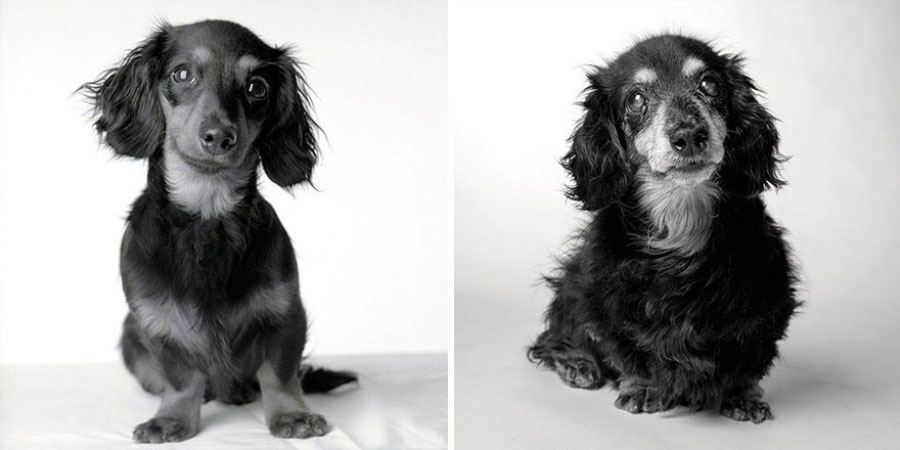
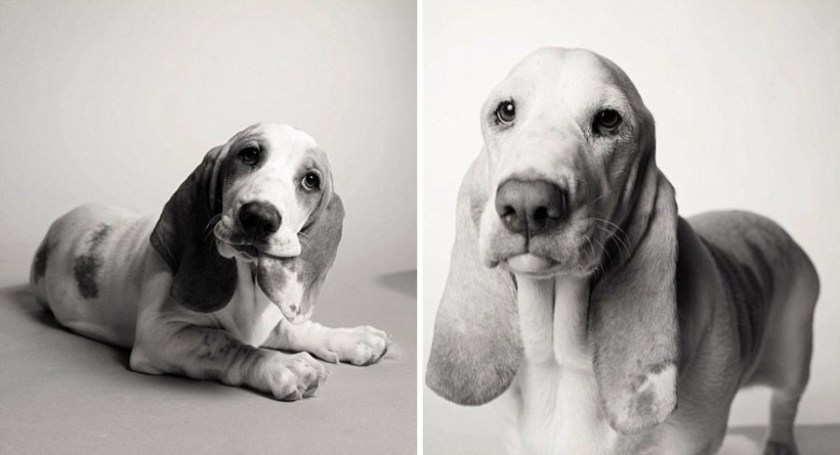
The mind of a photographer never rests. In Michael Freeman’s book, The Photographer’s Eye, he states that design is the single most important factor in creating a successful photograph. He also states that the ability to see the potential for a strong picture is equally important. The following photos are part of a 20-year project created by photographer Amanda Jones. She had the foresight and the discipline to photograph, compile and create a book that features the lifespan of a dog.
Lily at 8 months (left) and 15 years (right). Photography by Amanda Jones.
The book, “Dog Years.Faithful Friends, Then & Now,” is a beautiful look at the lives and stories of 30 dogs. Of course, many people make it a practice to chronicle their dogs’ lives over the years through the use of professional photography. So, perhaps Amanda’s book came more as a result of opportunity. She saw the lives of her clients’ dogs transform before her in the prints and digital files she had amassed over a 20-year span.
Corbet at 2 years (left) and 11 years (right). Photographs by Amanda Jones.Poppy at 1 year (left) and 7 years (right). Photographs by Amanda Jones.
Audrey at 3 years (left) and 12 years (right). Photographs by Amanda Jones.
Photography is an art that also requires the photographer to have some extra special people and animal skills.
HOW’D THEY DO THAT?
Yes, this is one photograph. The amazing work of Laura Allen, photographed outside Ulele Restaurant in Tampa, Florida. The dogs, all adopted, belong to two members of Ulele staff.Obe Wan, the most awesome Pittie ever, at the UpDog Challenge in Brooksville, Florida.
Not only do our photographers have the artistic talent and social skills needed to do their job, they have heart and compassion. They are animal advocates and givers, always donating their time, skill and talent to their communities.
Peanut loves the camera, and her human, Brian Kalish. Riverview, Florida.
We have had the opportunity to work with some of the industry’s most talented photographers here at The New Barker over the last 10 years. How much do our photographers love dogs? One of them (who shall remain unnamed) sent us a note the other day. “Do you know what I like about people? Their dogs.” True that.
Briscoe at 1 year (left) and 10 years (right). Photographs by Amanda Jones.
The golf ball bounced off the dog’s head, sailed over the fence and plopped into the canal that spilled out into Lake Okeechobee, 25 feet from the property. The dog obediently looked at her human playmate for a signal. “Okay, go get it.”
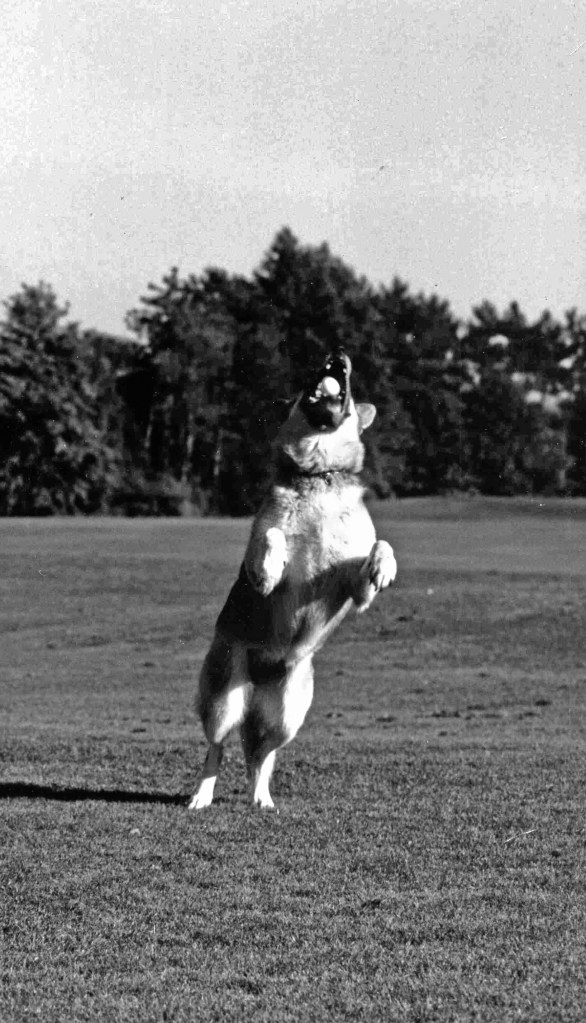
Chasing golf balls. It’s what professional golfer Ken Green has been doing since he was 12. And it’s also what Nip, his two year-old German Shepherd loved doing. Chasing and retrieving the golf balls Ken would throw during their playtime. She was good at catching them in mid-air too.
Nip was a constant companion as Green traveled the PGA and Nationwide tours during the 2002 golf season. She’d sit by the practice range. Waiting. Jumping into water hazards after the balls was no big deal to Nip. Jump. Splash. Retrieve.
On this particular day in 2003, Ken barely got the words, “Okay, go get it,” out of his mouth before his athletic beauty-of-a-dog was already scaling the fence. Splash. But the second splash, coming from Ken’s right side from behind the tree, made the hair on the back of his neck stand on end. He knew instantly what it was and jumped over the fence to see the alligator cutting through the water. It was heading straight toward Nip.
Clueless of the impending doom behind her, Nip was swimming happily with her prized golf ball. Ken stood helplessly at the shoreline. “The gator and Nip were on a collision course. I was hoping the gator would make a move, miss and give Nip time to get closer to me and out of the water,” said Ken.
Suddenly, Nip yelped as the gator grabbed her and went underwater with her. There was complete silence except for the pounding inside Ken’s head as he was thinking, “Am I really going to do this?” And before he knew it, Ken was neck deep in the dark, murky water, groping for something. Anything. The gator’s tail popped up out of the water, but his mouth was still submerged in an effort to drown Nip. Ken grabbed the gator’s tail and tried to pull him back. At first, the gator wouldn’t budge, but he soon released his grip on Nip.
Ken describes what followed next: “Up comes the rest of the gator, and now everything’s moving toward me. So I take it, and I fall back, all the way in the water, over my head. Now the gator can do anything he wants, right? If he had grabbed me, I’d have been at his mercy. I’d have been done. I mean, I’m not afraid of dying. But not like that.” As the hunter became the hunted, the stunned and disoriented gator swam away, allowing Nip and Ken to get safely to shore.
Ken quickly drove to the emergency veterinary clinic where Nip received 25 stitches in her left front leg and shoulder. Ken sustained bruised ribs from his roll with the gator, estimated to be a seven footer weighing in at about 150 pounds.
“People have asked me, ‘What in the world were you thinking?’ And, ‘Are you stupid?’ Not one person said, ‘That was the right thing to do.’ But, I couldn’t just sit there and let that happen to my dog,” said Ken.
Ken Green and his sister Shelley, his caddy in the 1980s. Photograph from the Akron Beacon Journal.
Ken Green turned professional in 1979 and joined the PGA Tour in 1980. By the late 1980s, he had $2 million in the bank, endorsement deals and a line of golf memorabilia. He had already won five times and played on the 1989 U.S. Ryder Cup team. During his time in professional golf, Green earned a reputation for being rebellious, cantankerous and colorful (often wearing green from head to toe, including fluorescent green golf shoes). He amassed more than 24 fines levied by the PGA for stunts like sneaking some buddies into The Masters in the trunk of his car, and signing autographs while playing in a tournament. His stunts pale in comparison to today’s bad-boys-of-golf antics, including drinking beer during the 1997 Masters with Arnold Palmer. Paired with Palmer that day, Ken asked a buddy to bring him a beer at the 15th hole so that he could forever say, “I had a beer with Arnie.”
It was Ken’s personal life that began to take its toll on his playing time and quality of play. The usual suspects: divorce, gambling, alcohol abuse and clinical depression. He lost his Tour Card in 2000 and coped with financial problems.
In 2008, the year he turned 50, he vowed to make a comeback, setting the over-50 Champions Tour as his goal. In 2009, he was 54th on the money list with $123,906 in 11 appearances. On June 7, 2009, Green tied for 37th in Austin. Halfway through the schedule, it was already his best season since 1996.
Aside from the golf course, Ken’s second favorite place to spend time was in his 40-foot Holiday Rambler motor home. It literally had been his home for four years through mid-2009, often found parked on a friend’s lot in West Palm Beach. He traveled the Tour in his Holiday Rambler with longtime girlfriend Jeannie Hodgin, his older brother and caddie Billy, and Nip.
“I was at my happiest in the RV, traveling. All of us, driving around, talking a lot and having fun,” said Green.
Billy Green was 57 years old when he joined Ken to be his caddie in May 2009. They traveled to Birmingham, Cleveland, Des Moines and Austin. That Sunday evening of June 7 in Austin, Green loaded up the motor home and the four of them headed east into Louisiana for the night. The plan was to get to North Carolina for a week of rest at Jeannie’s home, then head north to upstate New York.
On the morning of June 8, Team Green left Shreveport. About 40 miles from the Alabama border, something went terribly wrong. Going about 70 miles an hour, the right-side tire of the RV blew out, causing it to veer off the road, slamming into a large tree. The impact was so hard that it knocked the tree down. Jeannie, Billy and Nip died instantly, Ken was told.
“The next thing I know, I’m in the hospital,” said Ken. Upon seeing his sister Shelley and her husband Slugger White, he said, “What are you guys doing here?” He didn’t know where he was. The last thing he remembers is leaving Shreveport. Ken suffered injuries to his left eye, his jaw, torn ligaments in his left ankle and a badly damaged right leg. After conferring with his doctors, Green concluded amputation would be his best bet. His contemporaries called him at the hospital: Arnold Palmer. Jack Nicklaus. Mark Calcavecchia. Fred Funk. Mike Reid. Greg Kraft. Gary Player.
“When I heard about the leg, I just lost it,” Calcavecchia said. “But as it turned out, Ken asked the doctors what he had to do to possibly play golf again, and when they said the leg would have to go, Kenny said ‘Cut it off.’ That’s Ken.”
Ken spent the next three months recuperating at the Ormond Beach home of his sister Shelley and her husband, PGA Tour official, Slugger White. It was a good environment to be in, surrounded by three active kids and five dogs. “She would have more dogs if her husband would let her,” said Green, who added, “Seriously, I would have been lost without her.”
Having just lost his home, his brother, girlfriend and dog, golf was all this man had left and he was determined that he would play again. That was his promise to Jeannie, Billy and Nip. Minus his lower right leg, Ken set his sights on being the first professional golfer to play with a prosthetic leg. In August 2009, Ken was fitted for a prosthetic leg and began learning how to walk with it. A month later he was on the course again, playing for the first time since the accident. He shot a three over 39 for nine holes, but had to quit, exhausted after 11 holes. The constant pain he struggles with can be pretty debilitating.
“Kenny Green, regardless of what you say about him, has a huge heart,” said long-time supporter, West Palm Beach Dodge dealer Jimmy Arrigo. “He was the kind of guy who, if he had a lot, he’d make sure the people around him had what they needed. Over the years he was never portrayed that way.”
In September 2009, 100 golfers played in a charity event at Ridgewood Country Club in Danbury, Connecticut. The Friends of Green Golf Tournament raised money for the Ken Green Living Trust Fund, established by the PGA to assist with Green’s medical bills. PGA players voted to donate half of all 2010 Pro-Am purses to Ken and equally hard-hit fellow pro Chris Smith, who lost his wife Beth in a tragic auto accident that also critically injured two of his children.
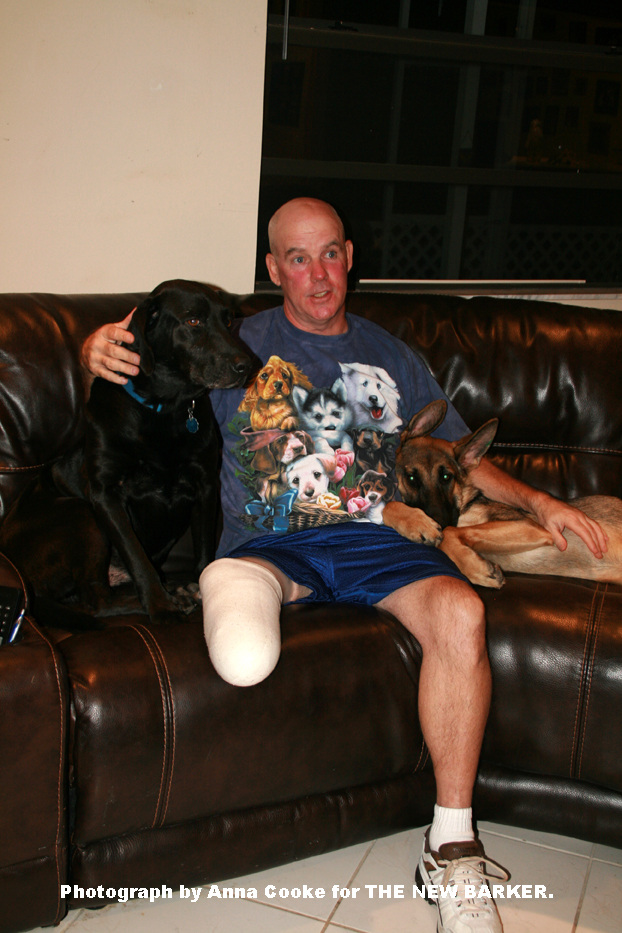
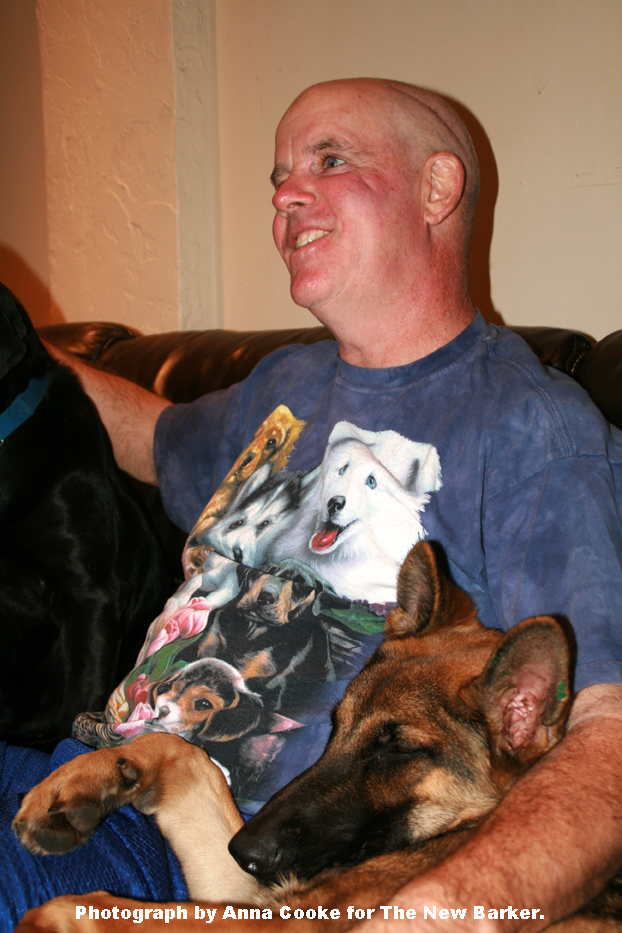
Ken Green in his West Palm Beach home with his dogs Black, the Labrador Retriever and Munch, his German Shepherd Dog, a six-month-old puppy at the time of the photograph.
Not quite a year after Ken’s accident, my publisher and I are sitting in his West Palm Beach home. He is surrounded by dogs; some by his feet, a couple on the couch. Two of the dogs belong to a visiting friend, and one of them belongs to his son, Ken Green, Jr. Sitting right next to Ken is Munch, a six-month-old German Shepherd Dog and most recent addition to the Green household.
About 20 years ago, Ken had played the Pro Am with an individual who loved German Shepherds. After hearing about what had happened to Nip, he called Ken to tell him a friend’s dog was having a litter. “He wanted to give me the pick of a most recent litter. I turned him down at first. I just didn’t think I was ready for another dog, especially a German Shepherd. Nip and I were just so tight,” said Ken. “You know, Nip could tell where I was going and whether or not she was going to come with me by the clothes I was wearing. She was an amazing dog.”
Ken eventually called the guy back and soon found himself on his way to Dallas to pick up his new puppy, whom he would name Munch. “The feeling was just so strong. Something told me to go get this dog,” said Ken. “Munch gives me another boost to live. I’ve got someone to take care of,” Ken said.
In addition to the pain, Ken struggles daily with the loss of his loved ones. And as if all that wasn’t enough, in early 2010, his younger son Hunter was found dead in his college dorm room at SMU. How much can one human being endure?
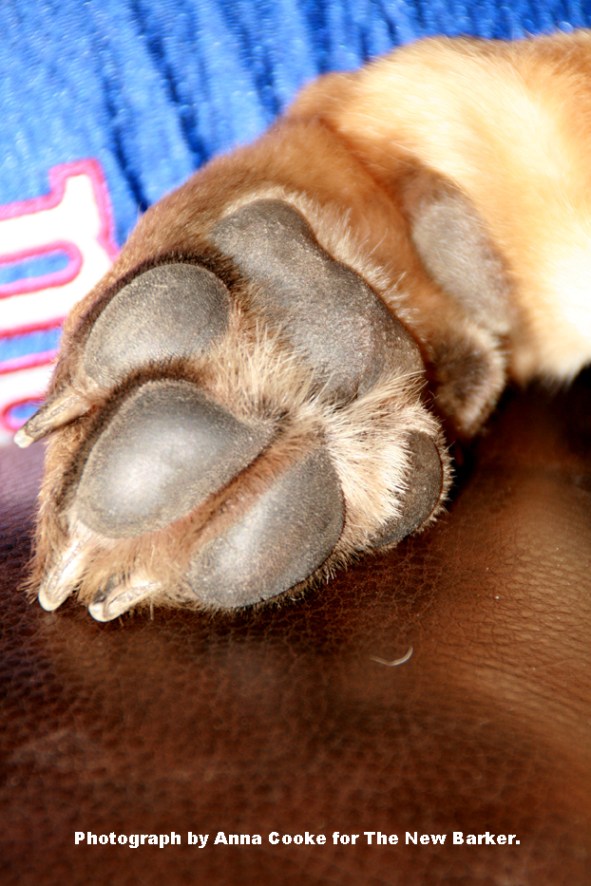
Munch’s paw.
Ken rubs Munch’s big, soft floppy ears and reflects. “You’ve got to keep moving forward. That’s the only way.” Ken continues to be an inspiration to those on and off the golf course. And despite the physical and mental pain, his sense of humor is intact. “Ken Green and inspiration were not exactly synonymous,” he said in March after playing 36 holes at the Coors Light Open at Fort Myers Country Club. “It’s a wonderful feeling when people that you don’t know come up and just say that you’re really giving them hope and joy. As men, we don’t like to admit that it hits us, but it does. It’s a great feeling when that many people care.”
Ken’s first public comment after the accident: “I have a pretty good faith in God and my belief is that if you believe in God, you shouldn’t be too upset over the fact that you’ve lost three of your best friends on the planet. They’re having a hell of a lot more fun right now than I am, I can tell you that. I know that He’s kept me breathing because I have to do something. One, I have to go figure that out, and two, I have to go do it. I’m assuming that it’s through golf that I have to go out and try to accomplish some things that haven’t been done and make people aware of certain things. So, in that sense, it’s given me a desire and a motivation to do it and I have to do it. And as far as I’m concerned, if I don’t do it, I’m a complete failure.”
Ken is scheduled to play the LEGENDS in Savannah, April 23-25 (2010) with Mike Reid. “I’m so psyched about playing with Mike. I will have enough time to bring my game up a notch or two. I am currently at level two with only three to go before I can honestly say it’s time to go play out there. I don’t want to play out there if I can’t compete. I will not to be a “show and tell.” Munch, having settled comfortably into Ken’s side on the couch now, has a calming effect on Ken. The bond is already clearly a strong one in this relatively new partnership. “Dogs won’t let you get in a rut. Munch just won’t allow me to. Dogs need to be exercised and they need to play. There is no time to feel sorry for yourself with a dog around. Munch is a constant joy to me,” said Ken.
This story by Anna Cooke first appeared in the Spring 2010 edition of The New Barker dog magazine. To learn more about what Ken Green is up to now (including rescuing homeless dogs) visit his Facebook page and let him know The New Barker sent you.
Pawsibilities is a Pinellas County courthouse program that uses therapy dogs to comfort children who must face their abusers on the witness stand. The children, sometimes as young as six years old, are victims of rape, witnesses to murders, or have suffered abuse by a friend or relative. For a child who has been through severe trauma, connecting with adults can sometimes be difficult.
Coleen Chaney, a victim advocate and co-founder of Pawsibilities said, “Handing the leash over, empowers the child.” There is a lot of waiting in and around the courthouse. “A child is more open to waiting when they have a dog. They transition from victim mode to caregiver mode. And, they become more open to talking.”
Tyrnan, a Great Pyrenees, was a therapy dog with the Pawsibilities program. “Anyone who has looked into the calm, all-knowing eyes of a Pyr knows immediately the values these dogs have as therapy animals,” said Lori Fricker, former president of the Florida Great Pyrenees Club and Tyrnan’s human handler. Intelligent, Pyrs have a sixth sense about them, and an instinct to gently protect, especially children.
Currently, the dogs are not allowed to go into the courtroom. But, in the wings of the courthouse, Tyrnan would snuggle next to a child, willingly accepting hugs or the stroking of his fur. Sometimes, the child would fall asleep, wrapped in the comfort of Tyrnan’s giant gentleness of protection.
After one particularly trying court day, Lori and Tyrnan were leaving the courthouse with Belinda Darcy, a victim advocate and also a co-founder of Pawsibilities. “We were in the elevator when the doors opened, and two men in suits entered. Tyrnan stood up, and moved in close to them. Talking to one another, the men were oblivious to the dog. I began to gently correct Tyrnan when Belinda motioned for me not to,” said Lori. Before the men exited the elevator, Tyrnan had “slimed” them – puffing up and blowing his coat, leaving fur all over mens’ suits. After the elevator doors closed, Belinda looked at Lori and told her that the men were the defense attorneys. “Tyrnan had never even met them. He had heard them, though, questioning the victim – a child – on the witness stand through the court room doors. Once that child had left the room we were in and entered the courtroom, Tyrnan never took his eyes off the thick doors. How he knew, could hear or sense what was going on is still just amazing to me,” said Lori.
In May 2014, Tyrnan was diagnosed with osteosarcoma. He died on Memorial Day. “Tyrnan was the best therapy dog I have ever had,” said Lori.
Nobody is ever really inspired by statistics alone. People are inspired by something that will create meaning in their lives. Karyn Ringhaver of Apollo Beach knew she had much to be grateful for. She loved her family and friends, and always put their needs and comfort before her own. She was a champion of the underdog and could rally her friends to join her causes, the strongest of which was the wellbeing of animals, especially dogs.
For years, Karyn volunteered at Hillsborough County Pet Resource Center. Her commitment and vision to help homeless dogs escape the threat of euthanasia inspired her friends to join her as at the shelter.
Karyn Ringhaver, Jagger (shortly before he died) and Maggie. Photo courtesy of the Ringhaver family.
Then, in 2007, Karyn’s beloved Yellow Labrador passed away from bladder cancer. How would she ever get over the loss? Determined to honor this dog’s life not by grieving, but by helping more dogs, Karyn had a vision that would become Jagger’s Dream.
Years ago, the late Steve Jobs, legendary entrepreneur and Apple CEO, was also Disney’s largest shareholder. A Disney executive charged with revitalizing the Disney stores, turned to Jobs for advice. Jobs response was simple: “Dream bigger.”
According to Forbes contributor Carmine Gallo, a compelling vision that inspires everyone’s best efforts meets four criteria: Big dreams are bold. Big dreams are specific. Big dreams are memorable. Big dreams are consistent. Jagger’s Dream now encompasses all of these, but the vision’s humble beginnings started out with a more concise focus.
Through her work at the Pet Resource Center, Karyn noticed that the dogs confiscated as a result of human criminal activities, were held at the shelter for months, sometimes even years, during litigation, without socialization. They were the forgotten ones, the un-adoptables, with nowhere to run. Karyn convinced her friends to join her in fundraising efforts that would lead to the creation of a park for those dogs. Jagger Park, a fenced-in grassy area on the campus of Hillsborough County Pet Resource Center, was officially opened in March, 2008.
The fundraising efforts of Jagger’s Dream Team, as they were affectionately known, were so successful that there was money left over. That money was used to help shelter dogs with medical issues, which the shelter could not afford to provide, like heartworm treatment. These efforts meant that more dogs would be successfully adopted, resulting in less dogs being euthanized. Jagger’s Dream Team was unstoppable. Members would come to the shelter to walk the dogs, clean kennels or “fluff them up” as Sue Green, one of Karyn’s friends and a volunteer, described.
“When we left the kennels at the end of our volunteer shifts, you could hear a pin drop. The dogs were that tired after our walks and time spent with them,” said Alyce McCathran, another friend and Jagger’s Dream Team member.
Four years after Jagger’s Dream Fund was created, Karyn was diagnosed with cancer. She continued tirelessly volunteering and fundraising for Jagger’s Dream. Her friends were amazed at her resilience, but not surprised. She had six rescue dogs of her own at home and cooked for them twice a day. Her sense of humor never waned. And she continued asking about the health and wellbeing of others.
Chris Carter, who has worked for Lance Ringhaver (Karyn’s husband) since 1985 said, “I witnessed Karyn’s love of animals and her desire to help them early on. Her level of commitment was infectious to everyone who loved her. You could not say no to Karyn.”
Karyn lost her battle with leukemia on August 19, 2014. While she was alive, Jagger’s Dream was a ragtag group of friends making a difference in the lives of dogs. “We were seat of the pants,” smiled Cathy Unruh, one of Karyn’s friends.
Today, Jagger’s Dream, Inc. is a 501(C)(3) non-profit that continues to help not only dogs, but also cats in Karyn’s honor and memory. Her friends continue to volunteer at the shelter and donate to the fund each month.
County-run shelters don’t always have the funds to help all of the sick, injured, and heartworm positive dogs in their care. In the last year alone, by covering the medical costs, Jagger’s Dream has helped more than 200 dogs find forever homes from Hillsborough County Pet Resource Center. Jagger’s Dream has also partnered with the Humane Society of Tampa Bay to help lower the cost of heartworm treatment. These efforts not only help increase adoptions, they help lower owner surrenders, ultimately saving more dogs from euthanasia.
“God gave us animals to have dominion over them in order to care for them. We are the stewards of the earth. Jagger’s Dream has been very fulfilling for me,” said Chris. “I’m grateful that we’re able to continue supporting Jagger’s Dream. And, thank goodness for the rescue groups that have stepped up to help.”
“By keeping Jagger’s Dream alive, we’re keeping Karyn’s dream going,” said Cathy “Keeping Karyn’s legacy alive keeps her with us,” she added.
The original Jagger’s Dream team: Sue Green, Chris Carter, Alyce McCathran and Cathy Unruh, shown here with Boomer. Photograph by Jacqui Silla for The New Barker.
SIDEBAR: Jagger’s Dream board of directors includes Alyce McCathran, Sue Green, Chris Carter, Lance Ringhaver and Cathy Unruh. They decide on a case-by-case basis which cases to fund. After adopting a dog, the new pet owner reimburses Jagger’s Dream fund what they can, if they are able. Such was the case of Josh and Boomer.
Since moving to Florida from Texas three years ago, Josh had been without a dog. He knew, when the time was right, that he would end up adopting a dog. Josh attended a dog adoption event and met Boomer at the Florida Big Dog Rescue (FBDR) tent. “I saw Boomer and fell in love with him right away,” said Josh.
Boomer had already been adopted and returned to the shelter once, coming back with medical issues. Jagger’s Dream covered Boomer’s medical expenses and Florida Big Dog Rescue pulled him from the shelter. After Josh adopted the dog, he ended up paying back all of the medical expenses to Jagger’s Dream. Josh affectionately calls Boomer a Pocket Rotti. “We run a lot together,” said Josh. “We go to the Mango Dog Park and I make sure he receives plenty of exercise and attention every day.”
A Dream Is A Wish Your Heart Makes, by Anna Cooke, first appeared in the winter 2015/16 edition of The New Barker. For more information on Jagger’s Dream, visit http://www.JaggersDream.org














 Tyrnan, a Great Pyrenees, was a therapy dog with the Pawsibilities program. “Anyone who has looked into the calm, all-knowing eyes of a Pyr knows immediately the values these dogs have as therapy animals,” said Lori Fricker, former president of the Florida Great Pyrenees Club and Tyrnan’s human handler. Intelligent, Pyrs have a sixth sense about them, and an instinct to gently protect, especially children.

 The Art Of Dog.™
You must be logged in to post a comment.