There have been many heroic stories of search dogs working what became known as Ground Zero after the tragedy of 9/11. But we also remember two separate stories about the guide dogs who brought their humans to safety as the day’s events were unfolding.
Guide Dog Roselle at the American Hero Dog Awards ceremony in 2002. Photo by Spencer Platt.
Roselle, a yellow Labrador Retriever, and Michael Hingson first met on November 22, 1999 at Guide Dogs for the Blind. She was his fifth guide dog. “It was obvious from our very first walk together that we were a perfect match,” said Michael.
The teamwork they developed was put to the ultimate test on September 11, 2001. As a computer sales manager, Michael was working at his desk on the 78th floor of the World Trade Center’s north tower when American Airlines Flight 11 crashed into the other side of the building, 18 floors above. Roselle guided Michael down 1,463 steps out of the building. Just as they emerged from the building, the south tower collapsed. “While everyone ran in panic, Roselle remained totally focused on her job,” said Hingson. While debris fell around them, even hitting them, Roselle remained calm. She found a subway station and led them both underground to safety.
As usual, Dorado, a yellow Labrador Retriever was lying under the desk of his charge, Omar Eduardo Rivera when the first plane hit the North Tower of the World Trade Center. Rivera’s office was on the 71st floor and he heard, felt and smelled what was happening. He also felt the unbearable heat. As he and Dorado moved toward the exit, Rivera thought about the number of stairs ahead of them and felt he would never make it. “Not having any sight I knew I wouldn’t be able to run down the stairs and through all the obstacles like other people. I was resigned to dying and decided to free Dorado to give him a chance of escape. It wasn’t fair that we should both die in that hell,” said Rivera. He unclipped Dorado’s lead, ruffled the dog’s head, gave him a nudge and ordered him to go.
Rivera felt himself alone for several minutes, but then felt a familiar fuzzy nudge beside him. “He returned to my side a few minutes later and guided me down 70 flights, out into the street,” said Rivera. They did get separated by the panicked crowd for a few minutes in the stairwell. But within moments, the dog found his way back to Rivera and again nudged his leg. As the two were making their way down the stairs, a co-worker caught up with them. Rivera held her arm with his right hand and with Dorado guiding him on his left, the dog helped them get down the stairs and onto the street. It took them more than an hour to get down the stairs and reach a safe distance before the tower collapsed.
A Southwest Airlines employee said he was sick and tired of people with their “fake service dogs” getting a free ride on the airlines, and decided to take matters into his own hands. But, he may have taken out his frustrations on the wrong person, dog and organization.
Richard Starks, a trainer with Florida’s K9s for Warriors, was all set to travel from San Jose, California to Tampa, Florida with Stew, a service dog in training on Saturday, August 31. Starks was transporting the 112-pound Bull Mastiff, scheduled to be assigned as a service dog to retired Staff Sgt., Alonzo Lunsford, a survivor of the 2009 Fort Hood mass shooting.
Starks and Stew had been cleared for boarding by Southwest Airlines Customer Service. They made it through security. But just moments before setting foot on the plane, Starks was detained by a Southwest Airlines supervisor who began loudly interrogating him, even stating, “You look fine to me…” Even after Starks presented the proper paperwork including Stew’s service dog ID, the employee would not allow the pair to board the plane. He insisted that Starks publicly disclose the details of his own disability before being allowed on the plane.
The Americans with Disabilities Act (ADA) clearly states that a service dog is permitted access to public places, including restaurants, hotels, theaters and taxicabs. A provision in the law designed to protect the privacy of people with disabilities and to prevent discrimination clearly states that the individual does not have to prove his or her disability. In fact, only two questions are permitted to be asked: 1) Is your dog a service dog? 2) What tasks has the dog been trained to perform? Businesses cannot require special identification for the dog or ask about the person’s disability. It does not matter whether the dog is wearing a service-dog vest or whether the owner’s disability is visible. These provisions have been approved by the Department of Justice.
But, the service-dog issue is posing some special problems for airlines, due partly to people traveling with dogs wearing jackets indicating that they are service dogs when they are not. The jackets are simply purchased over the internet, no questions asked. Employees, confused over the definition between a service dog and a therapy dog, are often not well-versed enough in the law and/or trained to act accordingly. To make matters more confusing, other laws supersede the ADA when it comes to air travel and housing. Unlike the ADA, the Air Carrier Access Act allows airlines to require passengers with emotional support and psychiatric service dogs to prove they are disabled and that their dog is trained to assist them. This is done via the requirement of a letter on the letterhead of a licensed psychiatrist, psychologist or clinical social worker stating that the passenger has a medically recognized mental or emotional disability and is under the professional’s care. The letter must be dated within one year of the flight.
Apparently, there have been enough passengers trying to board with emotional support and psychiatric service dogs (who fly in the cabin for free) that the U.S. Department of Transportation is letting airlines use their own discretion with regards to allowing such dogs on planes. So, was the Southwest Airlines supervisor operating within the guidelines or was he making up his own rules? At this time, Southwest Airlines is taking the position that he acted properly and within the guidelines. We would like to see those guidelines, especially the part where it states an employee is allowed to verbally abuse a passenger they believe is traveling with a “fake service dog.”
And, here is the rub, Southwest Airlines: it’s estimated that 13 to 20 percent of the more than 2.6 million Americans who served in Iraq or Afghanistan since 2001, have or could develop Post Traumatic Stress Disease (formerly known as Post Traumatic Stress Disorder). Every 80 minutes, a veteran commits suicide, which means the total number of deaths by suicide is more than 6500 veterans every year. That is more than the total number of soldiers killed in Afghanistan and Iraq to date.
Dogs, whose sole function is to provide comfort or emotional support, do not qualify as service animals under the ADA. However, according to the ADA, dogs that calm a person with PTSD during an anxiety attack are considered a “reasonable modification to ADA policies.” We would hope those policies include a person’s right to privacy and protection from discrimination.
Once the Southwest Airlines employee was satisfied with Starks’ answer, he allowed the pair to board the plane. Other passengers came up to Starks and apologized for the disgraceful conduct displayed by the Southwest Airlines employee. By the time Starks and Stew reached their layover in Phoenix, Southwest Airlines staff were on hand to greet them and ensure the rest of their trip was incident-free. But Starks admits that he was adversely-affected by the incident. He was, understandably, angry and upset and is currently contemplating his next step.
Finally on the plane, Stew provided relief to a fellow passenger. Photo provided by Richard Starks.
But, why aren’t the airlines lobbying Congress to correct these problems and clarify the laws, provisions and rules? It’s a question Shari Duval, Executive Director for K9s for Warriors is asking, and one that she will surely find an answer to as she plans to go before Congress herself. “Southwest Airlines could be the leader in righting these wrongs,” Shari told The New Barker dog magazine. “They could be an advocate for educating the public and industries that service the public on the ADA provisions, as supported by the United States Department of Justice,” she added. “Veterans who go through three weeks of training with their service dogs here at K9s for Warriors, deserve better treatment than this. And, believe me, I will fight for them,” said Shari.
About K9s for Warriors: A non-profit organization that provides and trains service dogs for veterans with PTSD. Ninety-five percent of the dogs come from rescue shelters. The office and training facility are located in Ponte Vedra Beach, Florida. The veteran is given a service canine, complete training, certification and housing during their training. There is no charge to the veteran for the service that K9s for Warriors provides. The Department of Veterans Affairs will not cover the cost of dogs assigned for mental disabilities like PTSD, according to new federal regulations. They will pay for service dogs assigned to veterans with impaired vision, hearing or mobility. Therefore K9s for Warriors relies on community support, donations and fundraising efforts. To learn more about this organization, please visit http://www.k9sforwarriors.org.
Stew, safe and sound in Ponte Vedra, Florida with K9s for Warriors executive director, Shari Duval.
INTRO: One of the recipients of the 14th annual AKC Humane Fund Award for Canine Excellence (ACE) was featured in the spring issue of The New Barker dog magazine. His just-announced award is well-deserved. Only four months after his front leg was amputated and three weeks after completing chemotherapy, Bart earned his Senior Hunter title and continued to the Master Hunter level. Bart and Darcy, his human, were invited to visit with soldiers from the Wounded Warrior program. Bart, who ran fast and hard during a guided hunt, was an inspiration to the soldiers without limbs, and overcoming their own battle scars. Our story, A Case for the Power of Love, was written by Pam Stuart, a member of the Tampa Bay Vizsla Club. It may look like a long read, but if you’re in need of a smile and some inspiration, it’s well worth your time.
Bart with Darcy, getting ready for a run to guide Wounded Warriors.
STORY: Life. It’s been said that life is what happens to you while you’re making plans. If you’re familiar with the sport of agility, life is like running an agility course: you have a start line at the beginning and a finish line at the end, with lots of obstacles in between. Sometimes there are challenges—wrong courses and dropped bars—but you and your dog run the course together and there is always praise and joy because you tried. You may not have a perfect run, you may not have earned a “Q”, but you and your best friend ran together, did as well as you could, and lived and loved in that moment.
Life. In times of strife, those challenges—those wrong courses and dropped bars—become the defining moments in which we find our strengths and our capabilities. Those moments test our mettle, our courage, our fortitude and our resolve. It is a great test for us when our beloved dog, our best friend and our heart on four legs, is diagnosed with a serious illness. Shock. Sadness. Denial. Reality. How did this happen and why? If we had the answers, oh, if we had the answers. It’s always been Darcy and Bart. For years. I can’t remember how or when we met, but it has always been Darcy and Bart. Darcy is a friend of immeasurable love, kindness, and strength. Strength that was tested when she and her Vizsla Bart, started on their journey.
It began with a limp early in 2008, during hunt and field season. It was just a sports-related injury. Bart was only three years old; a strong, young dog from a well-planned breeding who had already finished his show championship. He ran marathons with Darcy, his longest at 16 miles. He was on his way to great success in the field as nothing was slowing him down. Not even this limp. Dogs have their way of communicating with us. We know. We know our dogs and we just know. Is it a look? Is it intuition? Whatever It is—it is.
One June morning, Bart came out of his crate, looked up at Darcy and they went to the vet. The doctor found a lump on the top of the left shoulder and x-rays were ordered. They revealed that 80% of the scapula had been eaten away by cancer. Thankfully, Bart was young and in peak physical condition, which may have prevented further injury. After a biopsy confirmed osteosarcoma, Darcy, without hesitation, looked at the vet and asked how quickly Bart’s leg could be removed. Bart underwent a full scapulectomy. The surgery was a success as the doctor was able to get clean margins.
How could this happen to such a sweet, young dog? And why? Everything about Bart was not about cancer. Everything about osteosarcoma was bleak: the statistics, the poor prognoses, the dismal outcomes. Again, why? When word went out through the Vizsla grapevine of Darcy and Bart’s plight, I remember the sinking feeling of knowing osteosarcoma, and all that this diagnosis meant. I asked Darcy how she found the strength. She said: “Love. When he was first diagnosed, I kept asking myself why we were going through this and twice I saw the word LOVE, in bright, luminescent letters, inside my mind’s eye. When I saw it the second time, I gave in and took a leap of faith that this was going to be a journey of LOVE. Love of Bart, love from friends, love from strangers, love of this journey—and that has been my strength. It has been the best worst thing that has ever happened to me. Thankfully, there is an endless supply of love, so I feel we are prepared to keep on keepin’ on for as long as we need to.”
Friends came together in the name of love, as true friends do. Bart’s breeder became the Research and Development Department, attending vet appointments, taking notes, supporting her friend through this maze of science, medicine and spirituality. A TeamBarty Yahoo group sprang up so everyone could be kept up to date on the latest developments through photos and shared stories. Darcy put it best: “Friends became family, and strangers became friends.” TeamBarty gained traction and folks began to send items for the fund-raising yard sales, financial support, emotional support, prayers, toys and treats. Cards and letters from across the country started appearing in the mail box, often from strangers offering their sympathy, love and support.
When Bart came home from surgery, Darcy’s first priority was to try to get back to a sense of normalcy and Bart was all for that. They would take their morning walks, at first only to the end of the driveway. Then to the neighbor’s yard, then further down the street. Walks became runs. A milestone was reached when a run included an easy jump over a low retaining wall. Barty was back. A Vizsla is a hunting dog and hunting was deep in Bart’s genes. In October 2008, as a tri-paw, four months after an amputation and three weeks after completing his chemotherapy, Bart earned the fourth and final leg towards his Senior Hunter title for pointing breeds. For those not familiar with pointing breed hunt and field titles, to qualify for the SH title, the dog must run and hunt birds for 30 minutes, find, point and retrieve to the AKC’s exacting standards. Many dogs don’t get that far on four legs. Bart did it in grand style on three.
Bart continues to amaze and inspire those around him.
Darcy and Bart went even further and began competing for the Master Hunter title. There were times during their hunt tests when judges would have a sympathetic look for that poor girl and her three legged dog. Sympathy changed to awe as many grown men and women, often with tears in their eyes, were so moved by the courage and determination of the beautiful spirit in that beautiful dog. And Bart did earn that Master Hunter title, ten months after his amputation. Bart is the first Vizsla in history to have completed the Master Hunter title, start to finish—on three legs. Darcy and Bart have soldiered on, continuing their journey together in living life and performing in the field. They have also participated in the Vizsla Club of America All-Star review which honors Vizslas that have earned both their conformation championship along with one of the highest hunt or field titles.
Darcy with Bart, who gets some attention from one of the Wounded Warriors members.
The ribbons, the titles, the accolades—that’s all a bonus. Darcy and Bart have already won the real prize. They have lived, loved and grown through this journey that continues still. In the summer of 2010, Darcy and Bart were invited to visit with the military personnel in Fort Campbell, Kentucky, who are part of the Wounded Warrior Project. Later that fall, the Wounded Warriors came to Atlanta over Thanksgiving weekend and watched Bart compete in a field trial. Most recently, in January 2013, Bart, who will soon turn eight, ran fast and hard during a guided hunt with the Wounded Warriors, inspiring soldiers returning home who are overcoming their own battle scars.
Bart, on point. Love, in bright luminescent letters.
Bart leads by example—thriving; never giving up and living life to the fullest thanks to love—in bright, luminescent letters.
We look forward to meeting Bart and the other ACE recipients this December in Orlando during a ceremony at the AKC Eukanuba Nationals.
Starting Monday, June 24 on PBS KIDS, the all-new Martha Speaks will be filled with puppies. The popular show returns for a fifth season of new episodes, new adventures and a puppy theme all week.
Martha, of course is America’s favorite talking dog. Martha Speaks is a production of WGBH Boston and Oasis Animation Inc. The show works to help increase children’s oral vocabulary, teaching children (between the ages of four and seven) words like famous, admire, understudy and more.
“We think puppies are the perfect vehicle to teach kids new vocabulary. Words like destroy, mess, ruin, exhausted, and anticipation,” said senior executive producer Carol Greenwald.
The New Barker has listed the Florida schedule for the PBS show below. And in celebration of the fifth season, kids can visit www.PBSKIDS.org/martha to interact with Martha Speaks. Kids will be able to decorate photos of their puppies using props and descriptive words in the popular Dog Tags game. Kids will also be able to print out Puppy Printables. Parents will find recommended books about dogs for their children to read. There are also tips for kids on puppy safety and puppy adoption.
PBS KIDS is the number one educational media brand for kids, offering all children the opportunity to explore new ideas and new worlds. Watch Martha Speaks in Florida at the following stations throughout the week:
Tampa (WEDU)
New episodes Mon 6/24 – Thu 6/27 at 7:30am and 4:00pm
Miami (WPBT)
New episodes Mon 6/24 – Thu 6/27 at 3:30pm
Miami (WLRN)
New episodes Mon 6/24 – Thu 6/27 at 3:00pm
Orlando (WUCF)
New episodes Mon 6/24 – Thu 6/27 at 7:30am
West Palm Beach (WXEL)
New episodes Mon 6/24 – Thu 6/27 at 7:30am
Jacksonville (WJCT)
New episodes Mon 6/24 – Thu 6/27 at 7:30am and 5:00pm
Pensacola (WSRE)
New episodes Mon 6/24 – Thu 6/27 at 6:30am and 4:30pm
Fort Myers (WGCU)
New episodes Mon 6/24 – Thu 6/27 at 7:30am and 3:30pm
Tallahassee (WFSU)
New episodes Mon 6/24 – Thu 6/27 at 7:30am and 6:00pm
Panama City (WFSG)
New episodes Mon 6/24 – Thu 6/27 at 6:30am and 5:00pm
Have you ever noticed how dogs are instant ice-breakers in social settings? Ask somebody about their line of work, their family or how they’re doing and the response might include a grunt, shoulder shrug, and two words at best: it’s okay; they’re fine; I’m good. But ask somebody about their dogs, and the floodgates open right up.
When the first issue of The New Barker dog magazine rolled off the presses seven years ago, we didn’t have a problem filling its pages with fun content about Florida dogs. Our concern as to whether or not we would be able to continue to provide readers with original, relevant content in subsequent issues was quickly put to rest. Stories abound, and we find ourselves planning which future issue will feature a developing story. There are just so many wonderful stories to tell.
Still, we’d like to get back to our grassroots and hear more about the dogs of Florida. Your dogs. The everyday heroes, the lap dogs, the heart dogs, the dogs who make us laugh.
One: We’ve partnered with Summerhill Television, an international production company based in Canada. They’ve been given the green light to develop a television series, Dog’s Best Friend, that will document incredible friendships between dogs and other animals. They have asked The New Barker to reach out to Florida dog lovers for a possible audition. Does your dog have a friendship with a dolphin, a donkey or a horse? Do you think your dog’s relationship with the family cat or bird is particularly special (yes, of course you do). Please drop us a line or two about the friendship via email (anna@thenewbarker.com). In the subject line put “incredible dog friendship.” Please be sure to include your contact information (phone number, name, Florida city in which you reside).
Two: Is your dog swimsuit-ready? Send us a photograph of your dog in his or her best swim suit attire or beach gear. Beer belly or six-pack abs, we want them all. Email your photos with the dog’s name and your contact information to anna@thenewbarker.com. In the subject line put “swimsuit ready.” Your angel could be in a centerfold.
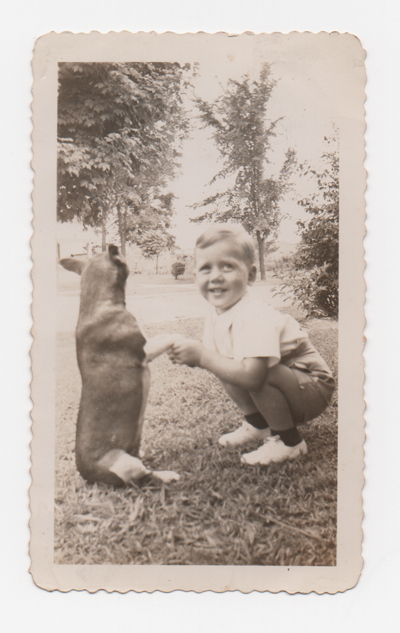
Three: While going through personal belongings, we came across some old family photos. One was of Sonny Cooke, our publisher’s older brother, and the family’s first dog, Tippy (circa 1943). We started wondering how many old photos of family dogs have long ago been tucked away in albums or drawers or envelopes. We’d like to develop a story and feature some of those photos. So, take a look around and send us a note via email (anna@thenewbarker.com). If you’re able to scan the photo, send that along too. If not, just send us a description and your contact information so that we can call you. We’ll take care of the rest.
Sonny Cooke and Tippy.
As always, we look forward to hearing more about you and your Florida Dogs.
How deep into a soul does one have to dig to find the strength to help someone else who is standing at the edge of their life? Especially knowing that the life you are about to help has been affected, almost to the brink, by the ravages of war? Shari Duval was a volunteer for the Wounded Warrior Project out of Jacksonville, and saw firsthand the number of young men and women coming home from their tour of duty with an invisible disorder, Post Traumatic Stress Disorder or PTSD. And yet, when her son Brett, a Veteran K9 Police Officer and contractor for the Department of the Army, returned home after serving two tours in Iraq, she honestly did not know what was wrong with him. He was withdrawn, isolating himself from family and friends. As a bomb dog handler, Shari knew he had been in dangerous and deadly situations, but he was a veteran police officer, she thought to herself. “It just never dawned on me that these were signs of PTSD as a result of what he had seen in Iraq,” she said.
Thankfully, the family had the financial ability to get Brett the help he needed. During his treatment, Shari began heavily researching PTSD, and discovered the success in treating the disease through the use of service dogs. With the blessings and support from the Wounded Warriors Project, Shari created K9s for Warriors, a non-profit organization in Ponte Vedra Beach to train and provide service canines to military personnel suffering from PTSD. “They are like seeing eye dogs for the mind,” she said.
Oscar, a Marine, with his K9s for Warriors dog, Courage. Photograph by Heidi Joy Howard for The New Barker Dog Magazine.
Since September 11, 2001, this country has produced 500,000 disabled warriors, and of that number, one in five is diagnosed with PTSD. One in six of those diagnosed will attempt or commit suicide. That’s over 16,000 suicides, alarming proof that war can and does cause severe brain damage. Symptoms of the disease include hostility, aggression, depression, paranoia, acrophobia, nightmares, panic attacks, poor coping skills, memory loss and lack of trust. Studies have proven that there are actual physical changes in the hippocampus and prefrontal cortex of the brain as a result of a horrific experience someone has endured, like the effects of war.
Service canines have been medically proven to aid in the recovery of warriors suffering from PTSD. The dogs are recognized by the United States Department of Justice Civil Rights Division, and qualify under the American Disability Act of 1990. “With this information, I just knew we were on to something, and wondered how many thousands more we could help through our program,” said Shari.
All of the dogs in the K9s for Warriors program are either adopted from shelters or rescue groups, or gifted by concerned citizens. Most of the dogs are mixes, with either Labrador or Golden Retriever in them. Each dog undergoes a series of tests to ensure they are not skittish, aggressive or shy. They must get along with children and other animals, and not be adversely affected by loud noises. The evaluation process is pretty standard, and is overseen by Shari’s son Brett who is now Director of K9 Operations, and Sherrie Keshner, Coordinator of K9 Operations. All of the dogs accepted must be less than two years old to try and maximize the length of time the service animal has with the warrior. Right now, there are around 15 sources across the state that the organization works with. “The groups know what kind of dog we’re looking for, and when they see a dog who might fit our criteria, they’ll give us a call,” said Shari. Naturally, they are receiving calls every day. “There is just no reason for us to purchase a dog when there are dogs available to us who can qualify for a life of service work,” she added.
Shari believes K9s for Warriors approach differs from other programs in that each warrior’s own personal needs are taken into careful consideration. This factor is imperative for a successful match-up between the warrior and the dog, resulting in a successful recovery process. “We can never begin to imagine the horrors these men and women have seen and experienced, physically, emotionally and psychologically. And, while we are very careful not to ask why or prod during their three-week stay with us, it usually comes out,” said Shari. A couple of examples she gave were much too graphic to print here. “Oftentimes, the experiences they share with us have never even been divulged to anyone else,” she told us. “We have a volunteer crisis management psychologist who is available 24/7, and almost all of the warriors have taken us up on our offer.”
The absolute favorite part of Shari’s job at K9s for Warriors is pairing the dogs with their warriors before they arrive. “I cannot sleep the night before the warriors arrive for their first day. I cannot tell you how it works, but it works. We have been able to match the dogs correctly with almost every warrior in our program.”
Case in point: “We had a warrior driving in from Texas. He got as far as Jacksonville when he had a mental breakdown. Fear took over. He couldn’t go any further. He checked into a hotel without letting us know where he was or what was going on. We couldn’t reach him. Finally, after about six hours past his scheduled time to arrive here, he called me and told me he couldn’t move. I told him he had to. Get in the car and come here, now. He was here in about 30 minutes, shaking, questioning why he agreed to do the program. I suggested we go outside and just talk for a few minutes. As we sat outside, he wouldn’t open up. When I asked him if he would like to meet his dog, he just looked at me, unable to answer. At that point, Military, a Golden Retriever, came bounding around the corner towards him. She twirled around a few times in front of him, and jumped on his lap. He hugged the dog, then started crying. Military gave Rick, an Army Ranger, his life back. He is now back with his family, and is off his medications. He’s even writing a children’s book about dogs. He is a new man because of Military, the dog. And every story here is like that.”
During the three-week program, the warriors stay in living quarters on the K9s for Warriors campus, which also houses the dog kennels. In addition to the canine and housing, the program provides training, certification, equipment, seminars, vet care and most of the food. The food is actually donated and prepared by a group of local women, Kasseroles for K9s. “We find out what they like to eat, and these magnificent women cook delicious food for the warriors the entire time they are here,” said Shari.
The scene when a new group of warriors arrives is usually the same. They come with duffel bags full of medication, and plenty of skepticism. They question the length of the program, and how the dogs are going to help them get better. They may complain about the prospect of having to get up out of bed to take the dog outside. “How the hell is that going to help me?” is often heard. Shari and her staff tell them the same thing every time: “Just give it a week.” Within 48 hours, the dog and warrior have bonded.
The warriors are expected to be up by 7 a.m. Their job is to let the other dogs, not yet in the program, out for their morning constitutional, play, give them food and fresh water and clean out their kennels. Then the warriors sit down to their own breakfast. The day’s schedule is reviewed at that time. During the group training sessions, warriors learn the skills needed to train their own canines. After a group training session they break for lunch, then head out into the community with their dogs. “We do fun things so that the warriors won’t become bored, otherwise their minds will wander off to somewhere else. They love St. Augustine, and we are so fortunate to have such a dog friendly and scenic town nearby in which to train,” said Shari.
K9s for Warriors accepts around 30 warriors for the Academy in a calendar year. “Our goal is to help these men and women return to civilian life with dignity and independence,” said Shari. They come from as far away as California and Oregon. One new applicant is coming from Hawaii. The only thing that K9s for Warriors cannot afford to provide at this time is transportation for the warriors to get to Ponte Vedra. “The Marines have a Semper Fi Fund, and they are the only branch of the military right now paying for a Marine’s travel expenses to get here,” said Shari.
The dogs are service dogs, but Shari refers to them as medical equipment. During the program, the warriors are weaned off many of their drugs. “They get back to living instead of living in a fog. And the dogs, who are now they’re walking prescriptions, have helped bring them out of that fog,” said Shari.
Here is how K9s for Warriors works. The dogs are crate trained, and remain so until they are matched with their warriors. At this point the dogs remain with their warriors within the living quarters. They are allowed to sleep with them, be by their side, never going back to their crates. They go on walks, and travel to places together in the car. The dogs now look at the warriors as the key to their newfound happiness and freedom. The next group of dogs is the one the current class is taking care of. They have a vested interest in them, wanting to know who was paired with which dog. The Canine Alumni Program at K9s for Warriors encourages alumni and new students to communicate with each other either about the program or the dogs. “There is a lot of social media correspondence,” said Shari who also encourages each applicant to contact one of the Academy’s alumni.
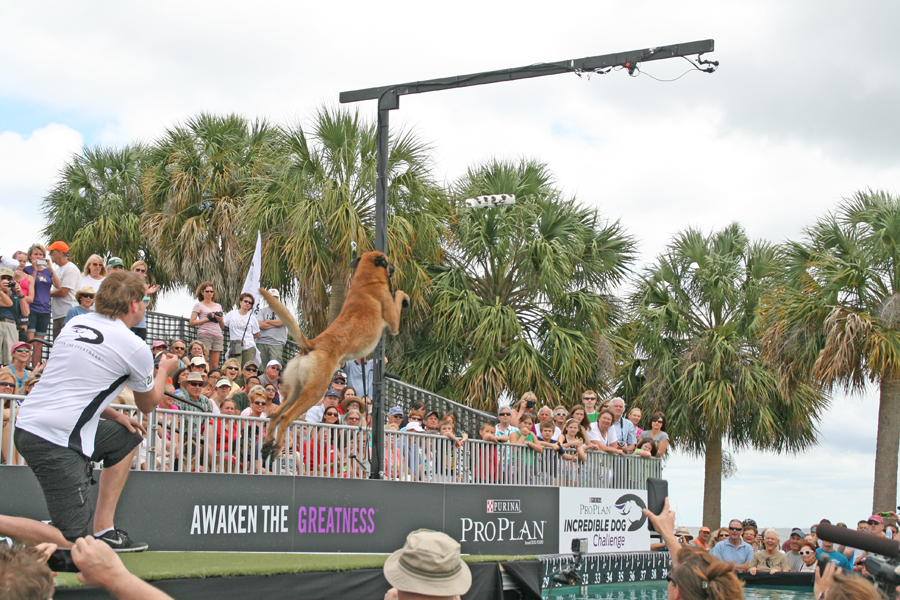
Downtown St. Petersburg had its wow factor turned on to high voltage for a spectacular dog day afternoon on Saturday, May 4. The 2013 Purina Pro Plan Incredible Dog Challenge brought in dogs and their humans from all over the country to compete in dog diving, agility, Jack Russell Terrier races, 30-weave up-and-back and freestyle flying disc. Incredible is the right word for this dog-filled event.
As a venue, Spa Beach Park is perfect. Its proximity to the St. Petersburg Pier and a boat-filled waterfront gave out-of-towners a visual treat. And while the cloud-filled sky threatened to burst at any minute, it rained only briefly, towards the end of the day. The downpour arrived during a beautiful freestyle flying disc performance. The team continued its performance, undaunted, as most of the crowd ran for cover.
The overall event set-up was pretty near perfect, with bleacher seating on two sides and VIP seating on another. There were several big screen TVs displayed throughout, including the main one just above the dog diving staging area. Spectators were able to see every competition from any vantage point within the event’s parameters, thanks to an incredible video production crew from F&F Productions. The show’s production, including sound, music and announcing were all spot-on, adding complete entertainment value to the competition. Speaking of value, the event was free to the public and their dogs.
Complimentary copies of The New Barker Dog Magazine were handed out in the main merchandise tent as well as in the VIP tent. The New Barker Dog Magazine team, including Heather Schulman and Leanne Sandbach, photographed and interviewed competitors and spectators for our summer issue. The event itself will be broadcast in Tampa Bay on May 11 on the CBS affiliate, WTSP at 1:00pm. To find out where the event broadcasts in your Florida city, visit BarkNetWork.
In the meantime, here is just a teaser of what we saw during the 2013 Purina Pro Plan Incredible Dog Challenge. No question about it, these dogs rocked & ruled.
Baxter, a two-year-old Belgian Malinois broke records during the dog diving competition. Photograph by Anna Cooke for The New Barker Dog Magazine.Baxter shakes it off after one of his jumps. Photograph by Anna Cooke for The New Barker Dog Magazine.Energy and high-flying athleticism were in full swing during this team’s freestyle flying disc performance. Photograph by Anna Cooke for The New Barker Dog MagazineFreestyle Flying Disc Competition during the 2013 Purina Pro Plan Incredible Dog Challenge in St. Petersburg, FL. Photograph by Anna Cooke for The New Barker Dog Magazine.
In the Company of Dogs is an occasional column that appears in The New Barker dog magazine that tells the story of a family-owned Florida company improving the lives of dogs. In the spring issue of The New Barker dog magazine, Mastro Subaru was featured.
The story of Mastro Subaru is the Great American Dream. Peter Mastro, Sr. emigrated from a small town in Italy more than 40 years ago. He opened a Volkswagen repair shop that soon became well-established with a good reputation for customer service. Peter was the kind of person who could see opportunities where others did not. While mainstream America chuckled at the thought of small cars, Peter bought a franchise for a then-unknown Japanese car called Subaru. When the oil crisis of the 1970’s hit, the future of Mastro Subaru was set. Growing up, brothers Pete and Stephen learned the value of customer service early on from their father.
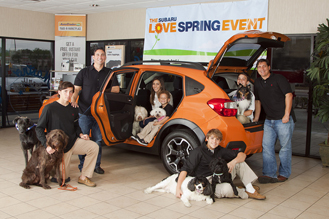
Brothers, Stephen and Pete Mastro with their kids and dogs. Photography by Laura Allen Studios.
“When we were younger, we would clean cars, sweep the lot and even cleaned parts,” recalls Pete. “Whenever we had a day off from school, our father would bring us to work with him.”
“By fifth grade, we were the detailing department of the dealership,” adds Stephen. As they grew older, the brothers worked throughout the dealership in various departments. Stephen spent most of his time in sales, while Pete worked in service and parts. When their father became ill in 1990, the two sons took over the task of running the family business. Today, Mastro Subaru is the highest volume Subaru dealer in Florida. In October 2007, a second dealership was opened in Sanford after the brothers found that many of their customers were traveling from Central Florida for both sales and service. At both locations, Pete oversees service and parts, Stephen is responsible for sales, and Stephanie (Stephen’s wife), handles finances and marketing. The family continues to grow the business, now the number one Subaru auto group in the South.
Steadfast animal lovers and community advocates, the Mastro family is very involved with the Humane Society of Tampa Bay and the SPCA of Central Florida. Several years ago, with the economy in a tailspin, adoptions at the shelters were dramatically decreasing, while owner-surrenders were increasing. It was the perfect storm of a downward spiral: as more people lost their jobs and/or homes, many were unable to care for their pets, and/or find rental homes that would allow them.
“Six years ago, just before the holidays, we decided to do something a little different with our holiday television commercials,” said Stephanie Mastro. “We advertised that we would cover a family’s pet adoption fees when they purchased a car from our dealerships.” The program was such a success that it has become a holiday tradition. It also inspired Mastro Subaru in Tampa to dedicate one Saturday a month for an adoption event. Volunteers from the Humane Society of Tampa Bay bring adoptable cats and dogs, which always draws a big happy crowd.
“The really cool thing is that the animals we use in the holiday commercials are never our own. We always use cats and dogs from the Humane Society of Tampa Bay. Within two days of the commercials airing, the animals are always adopted,” said Stephanie. “And after the commercials air, adoptions at the shelter always double,” she added. Stephanie estimates that about 1,000 dogs and cats have been adopted over the last six years since they’ve implemented the monthly adoption events.
“This has been an endeavor that the whole Mastro family has embraced, including our extended family of customers and employees,” said Stephanie. “When the economy tanked, we saw what was happening in our communities. We saw people turning in their pets, or finding that they couldn’t afford to buy food for them. We knew we wanted to do something to help out and make a difference,” added Stephanie, who also sits on the advisory board for the Humane Society of Tampa Bay.
In addition to the monthly adoption events, the dealership holds annual food drives, encouraging customers and the community at large to bring in pet food, which is then transported and donated to the Humane Society of Tampa Bay and the SPCA Of Central Florida from its Sanford location.
“What we have is a true family operation,” said Stephen. “We’re proud of that, and take it very seriously. We have so many long-term employees and customers who have seen us grow up. They are our family, and continue to be our reason to come to work every day.”
About Mastro Subaru:
Mastro Subaru was the first Subaru Signature Facility in Florida, and the first to be re-certified as a Stellar Performance Dealer, the highest recognition for excellence from Subaru. It’s no coincidence that Subaru has been big supporters of animal advocacy and the ASPCA. 75% of all Subaru owners have dogs. To watch the Dogs Tested, Dogs Approved television campaign, visit http://www.MastroSubaru.com and click onto “Get the Full Canine Experience.” The interactive fun includes getting a Florida Driver’s License for your dog (because, of course, every dog needs one), and putting your dog’s photo in a Subaru.
The Mastro Family,including their pets: Pete, Darlene, Nicholas, Jovanna and Max Mastro have a cat named Macy that they adopted from St. Francis Society Animal Rescue, Tampa, and a dog, Sam. Lisa Mastro and her son JP have a Labradoodle named Desiree. Stephanie, Stephen, Stephano and Sophia Mastro live with Rocco, Sasha, Romeo and Dolce, all dogs, and a cat, Donatello from St. Francis. “Rocco is our most recent adoption from the Humane Society of Tampa Bay,” said Stephanie. And mom, Jaye Mastro has two dogs, Picasso and Monet. Mastro Subaru 6402 West Hillsborough Avenue Tampa 813.884.7513 411 South Orlando Drive, Sanford 321.206.1792 http://www.MastroSubaru.com and http://www.MastroAutoGroup.com
Subaru…Dog Tested. Dog Approved. Photograph by Laura Allen Studios.
28.019740-82.771768
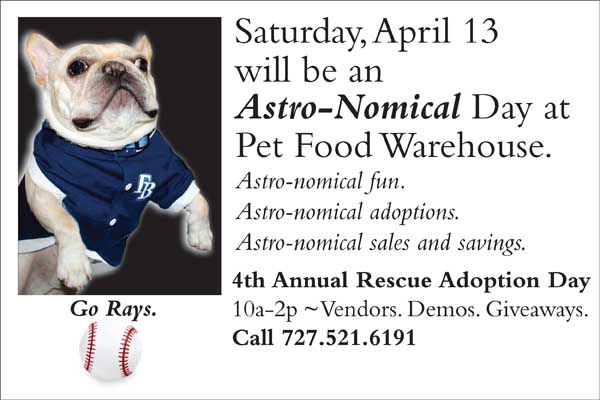
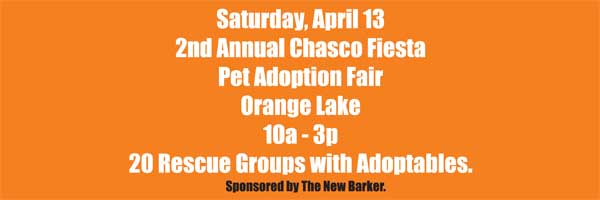
Who’s gonna let a little inclement weather keep us from having fun with dogs this weekend? Chasco Fiesta Pet Adoption Fair tomorrow/Saturday, Orange Lake in New Port Richey. The 4th Annual Rescue Adoption day is also on Saturday at Pet Food Warehouse, starting at 11a and going on until 3p. Our first Bark in the Ballpark of the season takes place in Dunedin with the Dunedin Blue Jays. What’s doggin’ in your part of Florida this weekend?








 The Art Of Dog.™
You must be logged in to post a comment.